What Is a Target Maturity SDL Index Fund? A Plain Guide
A debt fund with an end date sounds a lot like an FD. It isn't. The end date helps only if your own goal date lines up with it, and only if you can sit through the NAV moving every day until then.
The news peg: Nippon India Mutual Fund opened a New Fund Offer (NFO) from 18 to 26 November 2026 for the Nippon India CRISIL-IBX SDL-June 2037 Index Fund, an open-ended target maturity index fund that will put 95% to 100% of its money into state government bonds. It arrives weeks after the RBI raised the repo rate by 25 basis points to 5.50% on 7 October 2026, its first hike since February 2023.
This post uses that fund only as a structural example. It explains what a target maturity fund is, what SDLs are, how "hold till maturity" changes the risk picture, what it does not fix, and the questions worth asking. It is not a recommendation to invest in this or any scheme. Scheme details below are taken from launch-stage reports of the scheme documents and should be confirmed in the final SID and KIM.
First, What Is an SDL?
State Development Loans (SDLs) are bonds issued by state governments to borrow money. The RBI conducts their auctions, just as it does for central government securities (G-secs).
- Credit view: SDLs are treated as near-sovereign, with very low default risk in practice. Very low is not zero, and states' finances differ.
- The SDL spread: SDLs usually yield more than a G-sec of similar maturity. At the state bond auction of 13 October 2026, the weighted average cut-off was 8.12%, the highest since 2019, and the 10-year SDL traded about 66 basis points above the 10-year G-sec, according to ICRA's weekly state borrowing note. The spread changes every week and from state to state.
- Why the spread exists: SDLs trade less actively than G-secs, so investors ask for a little extra. State-level fiscal differences also play a part.
- What doesn't change: an SDL's price still moves with interest rates, exactly like a G-sec's.
What Makes a Fund "Target Maturity"?
A normal debt fund has no end date. The manager keeps duration in a broad range and the portfolio rolls forward indefinitely.
A target maturity fund (TMF) is different:
- It tracks a fixed-date index. Here, the CRISIL-IBX SDL Index – June 2037 holds SDLs maturing between 1 July 2036 and 30 June 2037. As of 13 October 2026, it was reported to hold 16 SDLs from 11 states in roughly equal weights.
- It is built to wind up. On maturity, units are redeemed at that day's NAV and proceeds go to unitholders on record.
- It is passive. The fund follows index rules. There are no active credit or duration calls.
- It is open-ended. Unlike a Fixed Maturity Plan (FMP), investors can generally buy and redeem on any business day at the prevailing NAV. Exit load for this scheme is reported as nil.
- Interest is reinvested. Coupons and part repayments are reinvested in line with index weights rather than paid out.
The SEBI Potential Risk Class for this scheme is reported as A-III: relatively high interest rate risk and relatively low credit risk. That label is the most honest one-line summary of a long-dated SDL fund.
Target maturity products come in three forms:
- Index fund: bought from the fund house, no demat account needed.
- ETF: traded on the exchange, needs a demat account.
- Fund of funds (FoF) investing in an ETF: no demat needed, but a second layer of cost.
Roll-Down, Explained With Time
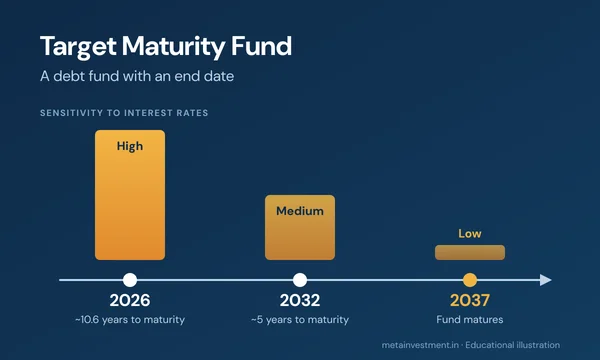
Every year, the remaining maturity shrinks.
- November 2026: about 10.6 years to June 2037.
- 2032: about 5 years.
- 2036–37: close to zero.
As maturity shrinks, so does the portfolio's sensitivity to interest rates. A 2037 fund is a long-duration product today and a short-duration product in its final years.
This is where the phrase "lock in the yield" comes from. If you invest at the start and hold to maturity, your return tends to land near the portfolio's yield to maturity at entry, minus expenses and tracking differences. Treat it as an approximation, not a promise. Interest received over the years is reinvested at whatever rates prevail then, and index rebalancing also affects the outcome.
If Interest Rates Rise, What Happens to Your Money?
The short answer: the NAV falls in the short term, but if you hold until 2037, most of that fall is made up by maturity. Whether a rate hike hurts you depends almost entirely on when you exit.
Why the NAV falls
Think of a bond you already own that pays 7.5% a year. If new bonds start paying 8%, nobody will pay full price for your 7.5% bond any more. Its price drops until its return matches the new 8% bonds. A fund holding such bonds shows that drop in its NAV the same day.
The longer the bond has left to run, the bigger the drop, because you are stuck with the lower rate for more years. In November 2026, this fund has about 10.6 years left, so it sits at the sensitive end.
How big can the fall be?
A simple rule of thumb: NAV change ≈ modified duration × change in yield. For an illustrative portfolio with a modified duration of about 7 (not this fund's figure, which will appear in its first factsheet):
| If bond yields rise by | Approximate NAV fall | On ₹1 lakh invested |
|---|---|---|
| 0.25% | About 1.75% | About ₹1,750 |
| 0.50% | About 3.5% | About ₹3,500 |
| 1.00% | About 7% | About ₹7,000 |
If yields fall, the NAV rises by a similar amount. Bond yields can move without the repo rate changing, and they don't always move as much as the repo rate does.
Why the fall mostly disappears by maturity
Bonds repay their full face value at maturity, whatever their price was along the way. So a price fall today slowly reverses as 2037 gets closer. That is called "pull to par". There is a second effect: interest the fund receives is reinvested at the new, higher yields, which helps returns over the remaining years.
So two investors in the same fund can have very different experiences:
- Investor A holds till June 2037. Interim dips are temporary on paper. The outcome tends to land near the yield at entry, after costs.
- Investor B needs the money in 2028. If yields are higher then, B redeems at a lower NAV and books the loss. The hold-to-maturity benefit never reaches B.
What an investor can actually do with this
Nobody can reliably time the peak in rates, and this post does not attempt to. What you control is the fit between the product and your own situation. Investors may consider these checks:
- Fix the date first. Write down when you need this money. If it is well before mid-2037, a 2037 fund's main feature does not apply to you. Maturities and categories closer to your goal date may be worth comparing.
- Do the worst-case arithmetic. Multiply your amount by the duration and a yield rise you can imagine, such as 1%. Ask whether you could watch a ₹7,000 dip on ₹1 lakh without selling.
- Keep near-term money separate. Emergency funds and money needed in the next two or three years carry a different purpose. Mixing them with a 2037 product is what turns a paper dip into a real loss.
- Know that entry timing changes your yield, not your risk. If rates rise further, new investors in the same fund buy at a higher yield. Some investors spread their investments over time instead of investing in one go, so their entry yield is an average. This spreads entry points; it does not remove interest rate risk.
- Check the fund's own numbers once published. Look for the portfolio yield to maturity and modified duration in the first factsheet, and use them in place of the illustration above.
On the outlook itself: RBI raised the repo rate to 5.50% on 7 October 2026, and the 10-year G-sec yield has moved between about 7.25% and 7.45% since then. Further hikes cannot be ruled out if inflation stays elevated, and future policy action will depend on incoming data. Long-duration categories are generally more sensitive to changes in interest rates and may see greater NAV volatility when yields rise.
Costs and Tracking
- Expense ratio: it reduces returns directly, every year. The scheme documents allow a base expense ratio of up to 0.90% a year plus statutory levies; the actual TER for regular and direct plans will be published by the fund house. Regular plans carry higher TERs than direct plans because they include distribution costs.
- Tracking difference: the gap between fund and index returns, driven by expenses, cash holdings and the timing of reinvesting interest.
- FoF structures: check the total cost of both layers, not just the headline fee.
On a product where the return is roughly the entry yield minus costs, cost is not a side detail.
Taxation: Short, and Dated
As of November 2026:
- A fund that invests more than 65% in debt and money market instruments is a specified mutual fund. This definition has applied since 1 April 2025 and now sits in Section 76 of the Income-tax Act, 2025.
- For units bought on or after 1 April 2023, gains are treated as short-term and taxed at your slab rate, regardless of holding period. Every unit of a fund launched in 2026 falls in this bucket.
- No indexation. Older articles that describe indexation benefits for target maturity funds are outdated.
- Timing versus FDs: both are taxed at slab rate. FD interest is generally taxable every year as it accrues. In a fund's growth option, tax arises only on redemption or maturity.
Individual tax situations differ. NRI taxation, TDS and treaty aspects are outside the scope of this post.
Target Maturity SDL Index Fund vs Bank FD
This is a structural comparison, not a "which is better" table. They are different tools for different needs.
| Feature | Bank FD | Target maturity SDL index fund |
|---|---|---|
| Who owes you the money | The bank | State governments, through the fund's bond holdings |
| Safety net | DICGC cover up to ₹5 lakh per depositor per bank (principal and interest combined) | No deposit insurance; credit risk is that of the states in the index |
| Return if held to maturity | Fixed contracted rate | Approximately the entry yield minus costs; not contracted |
| Value before maturity | Stays fixed | NAV moves daily with bond yields |
| Early exit | Allowed with a premature withdrawal penalty | Redeem at prevailing NAV; exit load nil for this scheme as reported |
| Tax rate | Slab rate | Slab rate (specified mutual fund) |
| When tax is paid | Yearly, on accrual | On redemption or maturity (growth option) |
| Minimum investment | Varies by bank | ₹1,000 lump sum for this NFO |
Seven Questions to Ask Before Considering Any Target Maturity Fund
- Horizon match: Does the fund's maturity date roughly match when I will need the money?
- Entry yield and cost: What is the portfolio yield to maturity today, and what is the expense ratio of the plan I am buying?
- Index holdings: Does the index hold only SDLs, SDLs plus G-secs, or PSU bonds, and how many states or issuers?
- Structure: Is it an index fund, an ETF or a fund of funds, and what is the total cost?
- Maturity process: What exactly happens at maturity, and where are proceeds paid?
- Interim comfort: Am I comfortable seeing the NAV fall for a year or two if rates keep rising?
- Fit: How does it sit alongside my other fixed-income holdings, such as FDs, PPF, EPF and debt funds?
The suitability of any investment category depends on an investor's financial goals, risk appetite, investment horizon and overall financial circumstances. For an NFO, the final scheme information document is the reference for every scheme-specific detail.
Key Takeaways
- A target maturity fund is a passive debt fund with an end date; this example matures around June 2037.
- SDLs are state government bonds with very low credit risk in practice, but full exposure to interest rate risk.
- Roll-down reduces rate sensitivity every year as maturity approaches.
- Holding to maturity tends to produce a return near the entry yield minus costs; it is an approximation.
- If rates rise, the NAV falls roughly by duration × yield change; holding to maturity tends to reverse that fall, while exiting early can lock it in.
- Gains are taxed at slab rate regardless of holding period; there is no indexation.
- Unlike an FD, there is no DICGC cover and no contracted rate.
An End Date Is Only Useful If It Is Your End Date
The appeal of a target maturity fund is real: a known wind-up date, a portfolio that becomes less rate-sensitive every year, and a return that tends to settle near the entry yield. That feature does its job only when the investor's own goal date lines up with the fund's.
Before the rate cycle, the NFO calendar or the yield on offer, the first question is when the money will be needed. If you are working out how fixed-income products such as FDs, target maturity funds and other debt categories behave against your own timelines, that is a conversation worth having.
Related reading: Can a 10-year SIP lose money? on why start date and horizon matter, GIFT City international funds vs domestic FoF on how fund-of-funds cost layers add up, SEBI's debt fund rules on duration bands across debt categories, and the SEBI Credit Risk-o-Meter on how bond credit risk is labelled.
Interested in Investing? Connect with Meta Investment
Meta Investment is a financial product distribution and services firm. If you'd like to explore whether a financial product is the right fit for your portfolio, our team will walk you through the details, help you assess suitability, and guide you through the onboarding process.
Meta Investment – Your Investment and Insurance Companion
Frequently Asked Questions
What is a target maturity fund?
A target maturity fund is a passive debt mutual fund that tracks a bond index in which all the bonds mature around one fixed date. The fund is built to wind up around that date and pay investors the NAV on that day. Before maturity, it is usually open-ended, so units can be bought and redeemed at the daily NAV.
What is an SDL or state development loan?
A State Development Loan (SDL) is a bond issued by an Indian state government to borrow money. SDLs are sold through auctions conducted by the RBI, much like central government securities (G-secs). They are treated as near-sovereign with very low default risk in practice, but their prices still move with interest rates.
Why do SDLs yield more than G-secs?
SDLs usually yield a little more than central government securities of similar maturity. The gap, called the SDL spread, reflects lower trading liquidity than G-secs and differences in individual states' finances. The spread changes from auction to auction and from state to state.
Is a target maturity fund the same as a fixed deposit?
No. An FD pays a fixed, contracted rate and its value does not move daily. A target maturity fund's NAV moves every day with bond yields, and its return if held to maturity tends to land near the portfolio yield at entry, minus costs, but that is an approximation, not a contracted rate. Bank FDs also carry DICGC insurance up to ₹5 lakh per depositor per bank; mutual funds do not.
What happens to a target maturity fund if interest rates rise?
When market yields rise, existing bond prices fall, so the fund's NAV falls. A rough guide is NAV change equals modified duration multiplied by the change in yield: with a duration of about 7, a 0.5% rise in yields means a fall of about 3.5%. Because bonds repay face value at maturity, the fall tends to reverse for an investor who holds until the maturity date; an investor who exits early may redeem at a lower NAV.
How can I prepare for NAV falls in a target maturity fund if interest rates rise?
Investors may first check whether the fund's maturity date matches when they need the money, then estimate a worst case by multiplying the amount by the fund's modified duration and an assumed yield rise. Keeping emergency and near-term money separate reduces the chance of being forced to sell during a dip. Some investors also spread investments over time to average their entry yield, though this does not remove interest rate risk.
Can I exit a target maturity fund before it matures?
Most target maturity index funds are open-ended, so units can be redeemed on any business day at the prevailing NAV. The scheme documents state any exit load; for the Nippon India CRISIL-IBX SDL-June 2037 Index Fund, the exit load is reported as nil. The risk is that the NAV at the time of exit may be lower than the entry NAV if yields have risen.
What does lock in yield mean in a target maturity fund?
It means that if you invest at the start and hold to maturity, your return tends to come out close to the portfolio's yield to maturity at entry, after expenses and tracking differences. It is an approximation, because interest received along the way is reinvested at whatever rates prevail then, and index rebalancing also affects the outcome.
What is roll-down in a debt fund?
Roll-down means the fund's remaining maturity shrinks every year as the target date approaches. As maturity shortens, the portfolio's sensitivity to interest rate changes, measured by duration, also falls. A fund maturing in June 2037 is highly rate-sensitive in 2026 and much less so in 2035 or 2036.
How are target maturity funds taxed in India now?
A fund that invests more than 65% in debt and money market instruments is a specified mutual fund. For units bought on or after 1 April 2023, gains are treated as short-term and taxed at the investor's income tax slab rate, regardless of how long the units are held. There is no indexation benefit. Individual tax situations vary.
Do target maturity funds get indexation benefit?
No. Older articles describe indexation benefits for target maturity funds held over three years, but that treatment no longer applies to units bought on or after 1 April 2023. Gains on such debt fund units are taxed at slab rate irrespective of holding period.
Is a target maturity fund taxed like an FD?
Both are taxed at the investor's slab rate, but the timing differs. FD interest is generally taxable every year as it accrues, even on a cumulative FD. In the growth option of a mutual fund, tax arises only when units are redeemed or the fund matures.
What is the difference between a target maturity index fund, ETF and fund of funds?
A target maturity index fund is bought and redeemed directly with the fund house and does not need a demat account. A target maturity ETF trades on the stock exchange and needs a demat account. A fund of funds invests in an ETF and adds a second layer of cost on top of the ETF's own expenses.
What does the CRISIL-IBX SDL Index June 2037 hold?
According to the scheme information reported at launch, the index holds SDLs maturing between 1 July 2036 and 30 June 2037. As of 13 October 2026, it was reported to hold 16 SDLs from 11 states in roughly equal weights. The current list of constituents is published by CRISIL and in the fund's factsheets.
What happens when a target maturity fund matures?
On maturity, units are redeemed at that day's NAV and the proceeds are paid to unitholders registered on that date, typically to their bank account on record. Investors may check the scheme information document for the exact process and timelines.
What should I check before considering a target maturity fund?
Key checks include whether the fund's maturity date matches when the money is needed, the portfolio yield to maturity at entry, the expense ratio of the plan, what the index holds, whether it is an index fund, ETF or fund of funds, what happens at maturity, and comfort with interim NAV falls if rates rise.


Mutual fund updates, SIP tips, and what's moving the market. No daily noise — only when there's something worth reading.
Read more about
- Better returns with Bonds
- Taxation on Liquid Funds - Updated for Finance Bill 2023 (Budget 2023)
- Exploring Alternative Investment Options in India
- A Comprehensive Guide to Save Tax with Insurance in India
- Lucrative Investment Opportunities Options for NRIs in India
- 10.4% EDELWEISS FINANCIAL SERVICES Secured NCD Open for subscription
- 10.75% NIDO Home Finance NCD
- 11.19% Navi Finserve NCD Public Issue
- Unlocking Your Life Goals - Overcoming Financial Barriers with Smart Investments
- Using Capital Gains Bonds in India to Maximizing Wealth Growth
- The Tax Harvesting Garden - Cultivating Wealth with Care
- Invest in this Nifty 50 Index Fund to Save Tax
- Calling All Investors: Two New NCDs Hit the Market!
- US Federal Reserve continues to hold rates
- Earn More Than Traditional Fixed Income with Market-Linked Debentures
- Brewing a Better Future: How Chai Can Teach You About Smart Investments
- Peer-to-Peer Lending: A New Era for Indian Investors?
- 10.75% NIDO Home Finance NCD
- Considering a positive outlook for TCS or Titan? These new MLDs might be for you!
- 11% EDELWEISS FINANCIAL SERVICES Secured NCD Open for subscription
- Boost Your Retirement Savings with Enhanced NPS Benefits in Budget 2024
- Taxation- Capital Gains- Revised Rates vs Previous Rate
- RBI Floating Rate Savings Bonds: A Flexible Investment Option for Uncertain Times
- 10.10% MUTHOOT FINCORP NCD Open for Subscription
- Retirement Planning for Young Indians
- ₹800 crore Adani NCD Opens for Subscription: Is it the Right Investment for You?
- 10.75% Sammaan Capital Ltd NCD Open for Subscription
- 11.00% NIDO Home Finance NCD
- 11% Edelweiss Financial Services NCD Opens for Subscription
- Building Your Layer Cake
- MOIC: A Comprehensive Guide
- A New Year, A New Chapter for Your Wealth
- Equity Linked Savings Schemes
- Two Great Fixed-Income Investment Opportunities to Lock in High Returns
- RBI Cuts Repo Rate for the First Time in 5 Years
- Unlock High Returns with Sammaan Capital Limited’s Secured NCDs – Tranche III Public Issue Now Open!
- Edelweiss NCDs 2025 – Secure 9.5% to 11% Returns | Best Fixed-Income Investment
- Edelweiss Gold Structured Products: A Smart Way to Invest in Gold with Principal Protection
- Ray Dalio: Trump’s Tariffs Accelerate US Decline (Video Analysis)
- Financial Equality: How Dr. Ambedkar’s Vision Aligns with Wealth Creation
- NRI Mutual Fund Taxation: How DTAA Can Save You Tax (Anushka Shah Case)
- Muthoot Tranche V NCD Public Issue: A High-Yield Fixed Income Opportunity
- HDFC Life Click 2 Achieve – Guaranteed Savings Plan with Life Cover
- The Power of a No-Contest Clause: How Ratan Tata's Will Prevented a Legal Battle
- India Surpasses Japan to Become 4th Largest Economy in 2025 | Growth & Challenges
- Adani Enterprises NCDs 2025 – Safe Investment with 9.3% Returns?
- From Freedom Fighters to Financial Freedom: Gen Z Investing & Independence Day Lessons
- All Weather Gold: A Principal-Protected Way to Bet on Gold (Until Aug 31)
- ESAF SFB NCD Issue: 11.30% Coupon | Basel II Compliant Bonds
- Diwali Investment 2025: Brighten Your Financial Future with Indel Money Secured NCD | High Yield Fixed Income for Pune Investors
- Light Up Your Finances This Diwali: A Guide to Wealth, Wisdom, and Long-Term Prosperity
- Adani Enterprises NCD 2026: 8.9% Yield, Secure Options for Retail Investors | Apply Now
- PFC NCD Issue Jan 2026: AAA Rated Bonds Offering up to 7.30%
- SEBI Equity Fund Rules 2026: Multi Cap, Flexi Cap Changes
- SEBI Debt Fund Rules 2026: Debt Funds Masterclass - Duration, Credit Risk, Yields Guide
- ICICI Pru Thematic Advantage Fund: What the Recategorization Means for You
- Marcellus Global Equities Fund NFO: Invest in Global Markets via GIFT City
- Short-Term Goals: Where to Park Your Money in India
- AMFI Stock Reclassification: What It Means for Your Fund
- FTSE India Index Explained: What It Is & Why It Matters Now
- US Fed Holds Rates: What It Means for Gold, Silver & the Rupee
- Pune on India's Wealth Map: What the 2026 List Reveals
- Closing Auction Session: Why Arbitrage Fund NAVs Jumped
- Emergency Fund: The Money That Buys the Right to Say No
- The 8 Freedoms Checklist for Financial Independence
- SEBI's Proposed MF-Only PMS: What Investors Should Know
- Your Increment Came Through. Did Your SIP?
- SEBI Mandatory Nomination Rules for Demat and MF Folios
- Record SIP Inflows in a Falling Month: Reading August's AMFI Data
- UPI Charges Above ₹2,000: What Changes on October 15
- Fed Rate Hike 2026: What It Means for Indian MF Investors
- Alchemy India Long Term Fund: GIFT City Guide for NRIs
- Navratri to Diwali 2026: Your Festive-Season Money Calendar
- RBI Hikes Repo Rate to 5.50%: What It Means for EMIs and FDs
- SEBI Credit Risk-o-Meter: What the Bond Colours Mean
- Got a Bonus? Jio IPO or SIP: A Simple Decision Framework
- Gold FoF Pause: What It Means for Your Gold SIP
- Can a 10-Year SIP Lose Money? What the Index Data Shows
- Can NRIs Apply for Indian IPOs? NRE vs NRO Explained
- GIFT City Funds vs International Fund of Funds: Differences
- Have a Problem With Your Mutual Fund? Here's How a Complaint Works, Step by Step
- Investing in Your Child's Name: Mutual Funds vs NPS Vatsalya
- एडलवाइस NCD 2025 – 9.5% ते 11% सुरक्षित परतावा | सर्वोत्तम निश्चित उत्पन्न गुंतवणूक
- एडलवाईस गोल्ड स्ट्रक्चर्ड प्रॉडक्ट्स: मुद्दल सुरक्षित ठेवून सोन्यात गुंतवणूक करण्याचा हुशार मार्ग
- रे डॅलिओचा इशारा: ट्रम्पच्या आयातशुल्कांमुळे अमेरिकेचा ऱ्हास वेगवान (व्हिडिओ विश्लेषण)*
- आर्थिक समानता: डॉ. आंबेडकरांच्या दृष्टिकोनातून संपत्ती निर्मिती
- NRI म्युच्युअल फंड कर: DTAA मदतीने कसे कर बचत करू शकता (अनुष्का शहा केस)
- मुथूट ट्रान्शे V एनसीडी पब्लिक इश्यू: उच्च-परतावा देणारी स्थिर उत्पन्नाची संधी
- HDFC Life Click 2 Achieve – निश्चित बचत योजना आणि जीवन विमा संरक्षण
- Demat आणि MF Folio साठी SEBI चे अनिवार्य Nomination नियम
- ₹2,000 वरील UPI शुल्क: 15 ऑक्टोबरपासून काय बदलते
- नवरात्री ते दिवाळी 2026: सणासुदीच्या काळातील आर्थिक दिनदर्शिका
- RBI ने रेपो दर 5.50% केला: तुमच्या EMI आणि FD वर काय परिणाम?
- SEBI Credit Risk-o-Meter: बाँडच्या रंगांचा अर्थ काय?
- बोनस मिळाला? Jio IPO की SIP: निर्णय घेण्याची सोपी पद्धत
- Gold FoF ला तात्पुरता ब्रेक: तुमच्या गोल्ड SIP वर काय परिणाम?
- 10 वर्षांच्या SIP मध्ये तोटा होऊ शकतो का? इंडेक्स डेटा काय सांगतो
- NRI भारतीय IPO साठी अर्ज करू शकतात का? NRE आणि NRO मधील फरक
- टार्गेट मॅच्युरिटी SDL इंडेक्स फंड म्हणजे काय? सोप्या भाषेत
Related Posts



This communication is intended solely for general educational and informational purposes. The information provided is general in nature and does not take into account the specific financial goals, risk profile, investment horizon, financial circumstances or other requirements of any particular investor. It should not be construed as personalised investment advice or as a recommendation to buy, sell or hold any specific financial product.
Fixed-income instruments such as Fixed Deposits, Bonds and NCDs carry credit/default, interest-rate, liquidity, reinvestment and issuer-specific risks; bank FDs and corporate instruments have different risk characteristics.
Distributor Disclosure: Where this content is provided by a distributor/intermediary, any applicable commission, remuneration, affiliation or other material conflict of interest shall be disclosed separately. The availability of a product through the distributor does not by itself imply that the product is suitable for every investor.
No Guarantee: No statement on this page should be interpreted as a promise, assurance or guarantee of returns or investment outcomes.
Meta Investment – Your Investment and Insurance Companion