SEBI Credit Risk-o-Meter: What the Bond Colours Mean
In school, an "A" grade sounded excellent. In the bond market, an "A" rating is the third level from the top. SEBI's new Credit Risk-o-Meter turns these ratings into simple colours that are easier to read.
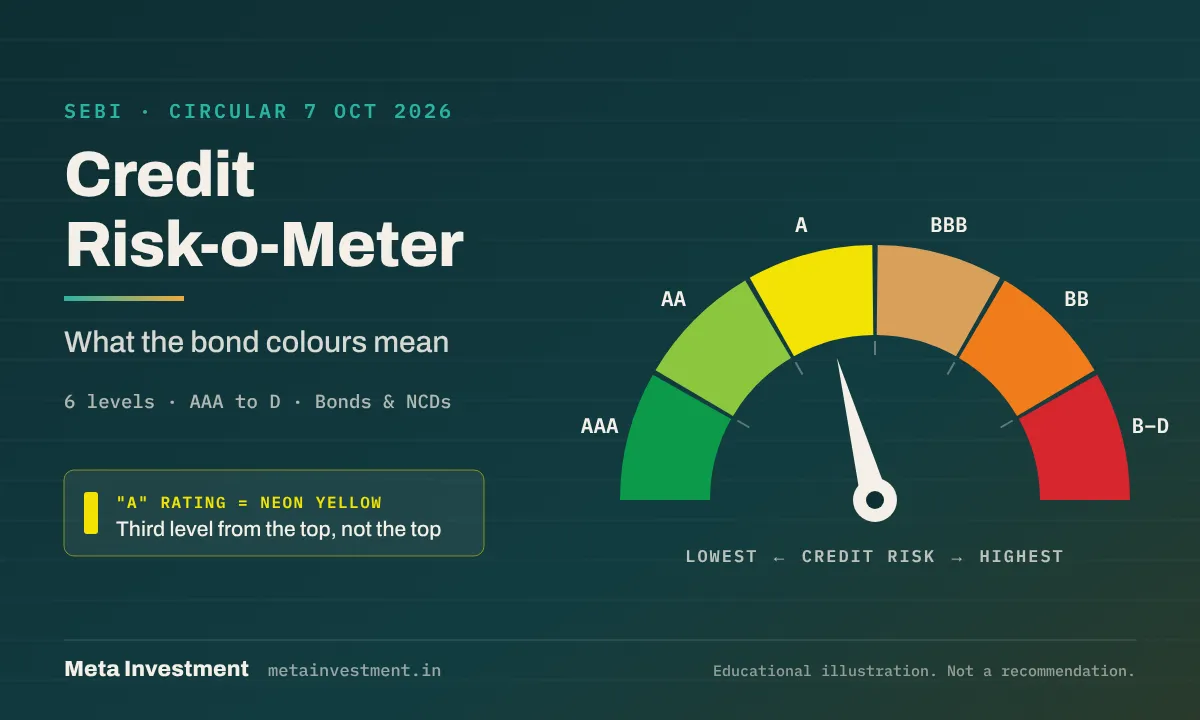
Many people now buy bonds and NCDs through apps and online bond platforms. Rating symbols like AA-, BBB+ or A2 are not easy for most investors to understand. The Credit Risk-o-Meter is SEBI's way of making credit risk visible in one look.
This guide explains what the meter is, what each colour means, where you will see it, and what it does not tell you.
What Is the SEBI Credit Risk-o-Meter?
The Credit Risk-o-Meter is a colour-coded gauge for debt securities like bonds and NCDs.
- Circular: SEBI circular HO/17/11/22(1)2026-DDHS-POD1, dated 7 October 2026.
- What it does: Takes the existing credit rating and shows it as one of six risk levels, each with its own colour.
- What it does not do: It does not create a new rating. The rating still comes from a SEBI-registered credit rating agency.
- Familiar idea: It works much like the riskometer already shown on every mutual fund factsheet, but for the credit risk of a single bond.
In simple words, it answers one question: how likely is it that the issuer fails to pay on time?
The Six Colours Explained
| Colour | Long-term rating | SEBI's label | In plain words |
|---|---|---|---|
| Irish Green | AAA | Lowest credit risk | Highest rating; issuer judged most likely to pay on time |
| Chartreuse | AA+, AA, AA- | Very low credit risk | Strong issuer, one step below the top |
| Neon Yellow | A+, A, A- | Low credit risk | Adequate safety margin, more affected by bad times |
| Caramel | BBB+, BBB, BBB- | Moderate credit risk | Lowest level of investment grade |
| Dark Orange | BB+, BB, BB- | Moderate risk of default | Below investment grade; default is a real possibility |
| Red | B+ to D | High to very high risk of default | Speculative, or already in default |
Short-term instruments like commercial paper use short-term symbols, from A1+ down to A4 and D. These are mapped onto the same meter levels.
Which Investments Are Covered?
The meter applies to listed and proposed-to-be-listed debt securities, whether issued publicly or through private placement:
- Non-convertible debentures (NCDs) and bonds
- Commercial papers
- Securitised debt instruments
- Security receipts
- Market-linked debentures
It does not apply to mutual fund schemes, which already have their own riskometer, or to bank fixed deposits.
Where You Will See It
The meter must be shown wherever a debt security is offered or advertised:
- Offer documents and abridged prospectuses
- Private placement memorandums
- Advertisements by issuers and online bond platform providers (OBPPs)
- OBPP websites and mobile apps, before the point of investing
When it starts: The rules come into force 45 days from 7 October 2026. That works out to around 21 November 2026 (calculated; the circular does not print the date).
The Details Below the Colour
The colour gets attention, but the text around it carries important information. SEBI requires:
- Rating agency and actual rating in text. The exact rating is shown, not just the colour.
- The lowest rating decides the colour. If two agencies rate a bond differently, the meter must reflect the lower rating.
- "Unsecured" in bold red. If the bond is not backed by assets, this must be clearly displayed.
- "Issuer Not Cooperating" flagged. If the issuer has stopped sharing information with the rating agency, the meter shows it.
- Extra warning for AT1 and unsecured perpetual bonds. These can lose the entire capital in certain situations, which a colour alone cannot show.
- Controls on platforms. OBPPs must take ratings only from SEBI-registered agencies, and any change in rating must be reflected on the meter.
Points 2 and 3 may change how some higher-yield products appear on bond apps.
What the Colour Does Not Tell You
The meter measures one thing: credit risk. SEBI's own disclaimer says it is not investment advice and that debt securities remain subject to market and liquidity risks.
A green colour does not cover:
- Interest-rate risk. When interest rates rise, bond prices usually fall. A long-tenure AAA bond can see a bigger price change than a short-tenure one.
- Liquidity risk. Many corporate bonds trade rarely. Selling before maturity may take time or happen at a lower price.
- Rating changes. A rating is an opinion as of today. In 2018, IL&FS carried high ratings shortly before it defaulted. Ratings, and colours, can change after investing.
- Concentration. Several bonds from the same group or sector can carry the same risk, even if each colour looks fine.
- Fit with the goal. A bond that matures in seven years may not match money needed in six months, whatever its colour.
The meter makes one risk easy to see. The other risks still need to be checked separately.
Five Points Investors May Check
For anyone looking at NCDs or bonds on an online platform, the meter can be a useful first filter. A few points worth checking alongside it:
- The written rating. The colour is a summary; the text below gives the exact grade and agency.
- Yield versus colour. A yield well above market levels usually comes with Caramel, Dark Orange or Red for a reason. Higher yield generally means higher risk.
- Secured or unsecured. This affects what investors may recover if the issuer cannot pay.
- Tenure versus need. Credit quality and time horizon are two separate questions.
- Tax impact. Bond and NCD interest is generally taxed at the investor's slab rate, which matters for those in higher tax brackets. Tax treatment depends on individual circumstances; a qualified tax professional is the right reference.
The suitability of any investment category depends on an investor's financial goals, risk appetite, investment horizon and overall financial circumstances.
Key Takeaways
- SEBI's Credit Risk-o-Meter shows credit risk in six colours, from Irish Green (AAA) to Red (B+ to D).
- It covers NCDs, bonds, commercial papers, securitised debt, security receipts and market-linked debentures.
- It comes into force 45 days after the 7 October 2026 circular, around 21 November 2026.
- If ratings differ, the lowest rating decides the colour. Unsecured bonds must say so in bold red.
- The meter shows credit risk only. Interest-rate risk, liquidity risk and suitability remain separate questions.
A Clearer Label for Bond Investors
The Credit Risk-o-Meter closes the gap between "A sounds good" and "A is third from the top". For retail investors buying bonds through apps, that clarity is a useful step.
Still, a colour cannot say whether a bond fits a particular portfolio. That depends on when the money is needed, what else is held, and how much price movement one can accept. For those working out how bonds and NCDs sit alongside FDs, debt funds and NPS, a risk profile is a practical starting point, and it is a conversation worth having.
This post is for educational purposes only and is not a recommendation to buy, sell or hold any bond, NCD or other security. Debt securities are subject to credit, interest-rate, market and liquidity risks. Please read the offer document carefully before investing.
If investments are made through a distributor, the distributor may receive commissions from issuers or Asset Management Companies. Such commissions should not influence suitability-based recommendations. Mutual Fund investments are subject to market risks. Please read all scheme-related documents carefully before investing.
Interested in Investing? Connect with Meta Investment
Meta Investment is a financial product distribution and services firm. If you'd like to explore whether a financial product is the right fit for your portfolio, our team will walk you through the details, help you assess suitability, and guide you through the onboarding process.
Meta Investment – Your Investment and Insurance Companion
Frequently Asked Questions
What is the SEBI Credit Risk-o-Meter?
The Credit Risk-o-Meter is a colour-coded meter that shows the credit risk of a bond or other debt security. SEBI introduced it through circular HO/17/11/22(1)2026-DDHS-POD1 dated 7 October 2026. It takes the existing credit rating from a SEBI-registered credit rating agency and places it on one of six risk levels, so investors can read credit risk at a glance.
What are the six colours of the Credit Risk-o-Meter?
The six levels are Irish Green (AAA, lowest credit risk), Chartreuse (AA+ to AA-, very low credit risk), Neon Yellow (A+ to A-, low credit risk), Caramel (BBB+ to BBB-, moderate credit risk), Dark Orange (BB+ to BB-, moderate risk of default) and Red (B+ to D, high to very high risk of default).
When does the Credit Risk-o-Meter come into effect?
The circular comes into force 45 days after it was issued on 7 October 2026. Counting 45 days gives about 21 November 2026. The circular itself does not print a calendar date, so the exact go-live on each platform may be confirmed with that platform.
Which investments will carry the Credit Risk-o-Meter?
It covers listed and proposed-to-be-listed non-convertible securities such as NCDs and bonds, commercial papers, securitised debt instruments, security receipts and market-linked debentures, whether issued publicly or through private placement.
Where will investors see the Credit Risk-o-Meter?
It must appear in offer documents, abridged prospectuses, private placement memorandums, advertisements by issuers and online bond platform providers, and on the websites and mobile apps of online bond platform providers.
Does a green Credit Risk-o-Meter mean a bond carries no risk?
No. Irish Green only means the bond has a AAA rating and the lowest credit risk on SEBI's scale. It does not cover interest-rate risk, liquidity risk or suitability, and a rating can be changed after the investment is made. SEBI's own disclaimer states that debt securities remain subject to market and liquidity risks.
What happens if a bond has two different ratings?
If more than one credit rating agency rates the same debt security, the Credit Risk-o-Meter must reflect the lowest of those ratings. This prevents the more favourable rating from being shown on its own.
Will the actual credit rating still be shown?
Yes. The name of the credit rating agency and the actual rating must be disclosed along with the meter. The colour is a summary; the written rating gives the exact grade.
What does 'Unsecured' in bold red mean on a bond listing?
It means the bond is not backed by any specific asset of the issuer. If the issuer cannot pay, secured lenders usually have a stronger claim on assets, so recovery for unsecured bond holders may be lower or slower. SEBI requires this word to appear in bold red for unsecured debt securities.
What does 'Issuer Not Cooperating' mean?
It means the issuer has not been sharing the information a credit rating agency needs to review the rating. In such cases the rating may be based on limited or older information. The Credit Risk-o-Meter must flag this status.
Why is there an extra warning for AT1 and perpetual bonds?
Unsecured perpetual bonds, including Additional Tier 1 (AT1) bonds issued by banks, have structural features under which investors can lose the entire capital in certain situations, even if the issuer's rating looks reasonable. SEBI requires an additional warning because the credit colour alone does not convey this risk.
Does the Credit Risk-o-Meter apply to mutual funds or fixed deposits?
No. Mutual fund schemes already carry their own riskometer under separate SEBI rules, and bank fixed deposits are outside this framework. The Credit Risk-o-Meter applies to debt securities such as bonds, NCDs and commercial paper.
Is the Credit Risk-o-Meter a recommendation to invest?
No. SEBI's prescribed disclaimer states that the meter is based on an evaluation of credit risk and is not investment advice or a recommendation to invest.
What is the difference between credit risk and interest-rate risk?
Credit risk is the chance that the issuer fails to pay interest or principal on time. Interest-rate risk is the chance that a bond's market price falls when interest rates rise, even if the issuer is strong. A long-tenure AAA bond has low credit risk but can still have high interest-rate risk.
How is interest from bonds and NCDs taxed?
Interest from bonds and NCDs is generally added to income and taxed at the investor's applicable slab rate. Tax treatment depends on individual circumstances and prevailing tax law, and may be confirmed with a qualified tax professional.
Do short-term instruments like commercial paper use the same colours?
Short-term instruments use short-term rating symbols, from A1+ at the lowest-risk end down to A4 and D. These ratings are mapped onto the same Credit Risk-o-Meter levels so that investors see a consistent visual scale.


Mutual fund updates, SIP tips, and what's moving the market. No daily noise — only when there's something worth reading.
Read more about
- Better returns with Bonds
- Exploring Alternative Investment Options in India
- Lucrative Investment Opportunities Options for NRIs in India
- 10.4% EDELWEISS FINANCIAL SERVICES Secured NCD Open for subscription
- 10.75% NIDO Home Finance NCD
- 11.19% Navi Finserve NCD Public Issue
- Unlocking Your Life Goals - Overcoming Financial Barriers with Smart Investments
- Using Capital Gains Bonds in India to Maximizing Wealth Growth
- The Tax Harvesting Garden - Cultivating Wealth with Care
- Invest in this Nifty 50 Index Fund to Save Tax
- Calling All Investors: Two New NCDs Hit the Market!
- US Federal Reserve continues to hold rates
- Earn More Than Traditional Fixed Income with Market-Linked Debentures
- Anchoring Your Portfolio: Why Fixed Income Products Deserve a Place in Your Investment Journey
- Brewing a Better Future: How Chai Can Teach You About Smart Investments
- Peer-to-Peer Lending: A New Era for Indian Investors?
- 10.75% NIDO Home Finance NCD
- Considering a positive outlook for TCS or Titan? These new MLDs might be for you!
- 11% EDELWEISS FINANCIAL SERVICES Secured NCD Open for subscription
- RBI Floating Rate Savings Bonds: A Flexible Investment Option for Uncertain Times
- 10.10% MUTHOOT FINCORP NCD Open for Subscription
- Retirement Planning for Young Indians
- ₹800 crore Adani NCD Opens for Subscription: Is it the Right Investment for You?
- 10.75% Sammaan Capital Ltd NCD Open for Subscription
- 11.00% NIDO Home Finance NCD
- 11% Edelweiss Financial Services NCD Opens for Subscription
- Building Your Layer Cake
- MOIC: A Comprehensive Guide
- A New Year, A New Chapter for Your Wealth
- Two Great Fixed-Income Investment Opportunities to Lock in High Returns
- RBI Cuts Repo Rate for the First Time in 5 Years
- Unlock High Returns with Sammaan Capital Limited’s Secured NCDs – Tranche III Public Issue Now Open!
- Nido Home Finance Limited NCD: A Secure Investment Opportunity
- Edelweiss NCDs 2025 – Secure 9.5% to 11% Returns | Best Fixed-Income Investment
- Edelweiss Gold Structured Products: A Smart Way to Invest in Gold with Principal Protection
- Ray Dalio: Trump’s Tariffs Accelerate US Decline (Video Analysis)
- Financial Equality: How Dr. Ambedkar’s Vision Aligns with Wealth Creation
- Muthoot Tranche V NCD Public Issue: A High-Yield Fixed Income Opportunity
- MPC Cuts Repo Rate by 50 bps & CRR by 100 bps: RBI Shifts to Neutral Stance
- Nido Home Finance NCD 2025: Secure 10.75% Returns | CRISIL A+ Rated Investment
- Adani Enterprises NCDs 2025 – Safe Investment with 9.3% Returns?
- All Weather Gold: A Principal-Protected Way to Bet on Gold (Until Aug 31)
- ESAF SFB NCD Issue: 11.30% Coupon | Basel II Compliant Bonds
- Diwali Investment 2025: Brighten Your Financial Future with Indel Money Secured NCD | High Yield Fixed Income for Pune Investors
- Light Up Your Finances This Diwali: A Guide to Wealth, Wisdom, and Long-Term Prosperity
- Adani Enterprises NCD 2026: 8.9% Yield, Secure Options for Retail Investors | Apply Now
- PFC NCD Issue Jan 2026: AAA Rated Bonds Offering up to 7.30%
- SEBI Debt Fund Rules 2026: Debt Funds Masterclass - Duration, Credit Risk, Yields Guide
- Short-Term Goals: Where to Park Your Money in India
- US Fed Holds Rates: What It Means for Gold, Silver & the Rupee
- Emergency Fund: The Money That Buys the Right to Say No
- The 8 Freedoms Checklist for Financial Independence
- Your Increment Came Through. Did Your SIP?
- PFRDA's New NPS Scheme Categories: What Actually Changed
- Financial Green Flags That Matter More Than Salary
- Record SIP Inflows in a Falling Month: Reading August's AMFI Data
- Fed Rate Hike 2026: What It Means for Indian MF Investors
- NPS Swasthya Guidelines 2026: What PFRDA Just Changed
- RBI Hikes Repo Rate to 5.50%: What It Means for Your EMI and FD
- निदो होम फायनान्स लिमिटेड एनसीडी: एक सुरक्षित गुंतवणूकीची संधी
- एडलवाइस NCD 2025 – 9.5% ते 11% सुरक्षित परतावा | सर्वोत्तम निश्चित उत्पन्न गुंतवणूक
- एडलवाईस गोल्ड स्ट्रक्चर्ड प्रॉडक्ट्स: मुद्दल सुरक्षित ठेवून सोन्यात गुंतवणूक करण्याचा हुशार मार्ग
- रे डॅलिओचा इशारा: ट्रम्पच्या आयातशुल्कांमुळे अमेरिकेचा ऱ्हास वेगवान (व्हिडिओ विश्लेषण)*
- आर्थिक समानता: डॉ. आंबेडकरांच्या दृष्टिकोनातून संपत्ती निर्मिती
- मुथूट ट्रान्शे V एनसीडी पब्लिक इश्यू: उच्च-परतावा देणारी स्थिर उत्पन्नाची संधी
- MPC ने रेपो रेटमध्ये 50 bps आणि CRR मध्ये 100 bps कपात केली; RBI चा स्टान्स 'न्यूट्रल' वर
- RBI ने रेपो दर 5.50% केला: तुमच्या EMI आणि FD वर काय परिणाम?
- SEBI Credit Risk-o-Meter: बाँडच्या रंगांचा अर्थ काय?
Related Posts
 ArticleSEBI Debt Fund Rules 2026: Debt Funds Masterclass - Duration, Credit Risk, Yields Guide
- GuideBond Ratings in India: A Complete Guide to Credit Ratings & Their Impact
 ArticleSEBI Mutual Fund Changes 2026: The Big Picture Explained
 ArticleNew SEBI-Validated UPI IDs: Secure Payments for Investors Explained
This communication is intended solely for general educational and informational purposes. The information provided is general in nature and does not take into account the specific financial goals, risk profile, investment horizon, financial circumstances or other requirements of any particular investor. It should not be construed as personalised investment advice or as a recommendation to buy, sell or hold any specific financial product.
Fixed-income instruments such as Fixed Deposits, Bonds and NCDs carry credit/default, interest-rate, liquidity, reinvestment and issuer-specific risks; bank FDs and corporate instruments have different risk characteristics.
Distributor Disclosure: Where this content is provided by a distributor/intermediary, any applicable commission, remuneration, affiliation or other material conflict of interest shall be disclosed separately. The availability of a product through the distributor does not by itself imply that the product is suitable for every investor.
No Guarantee: No statement on this page should be interpreted as a promise, assurance or guarantee of returns or investment outcomes.
Meta Investment – Your Investment and Insurance Companion