RBI Hikes Repo Rate to 5.50%: What It Means for EMIs and FDs
The RBI has raised the repo rate by 25 basis points to 5.50% and said plainly that rate cuts are off the table for now. For borrowers, depositors and debt fund investors, the useful question is what actually changes in their own accounts, and when.
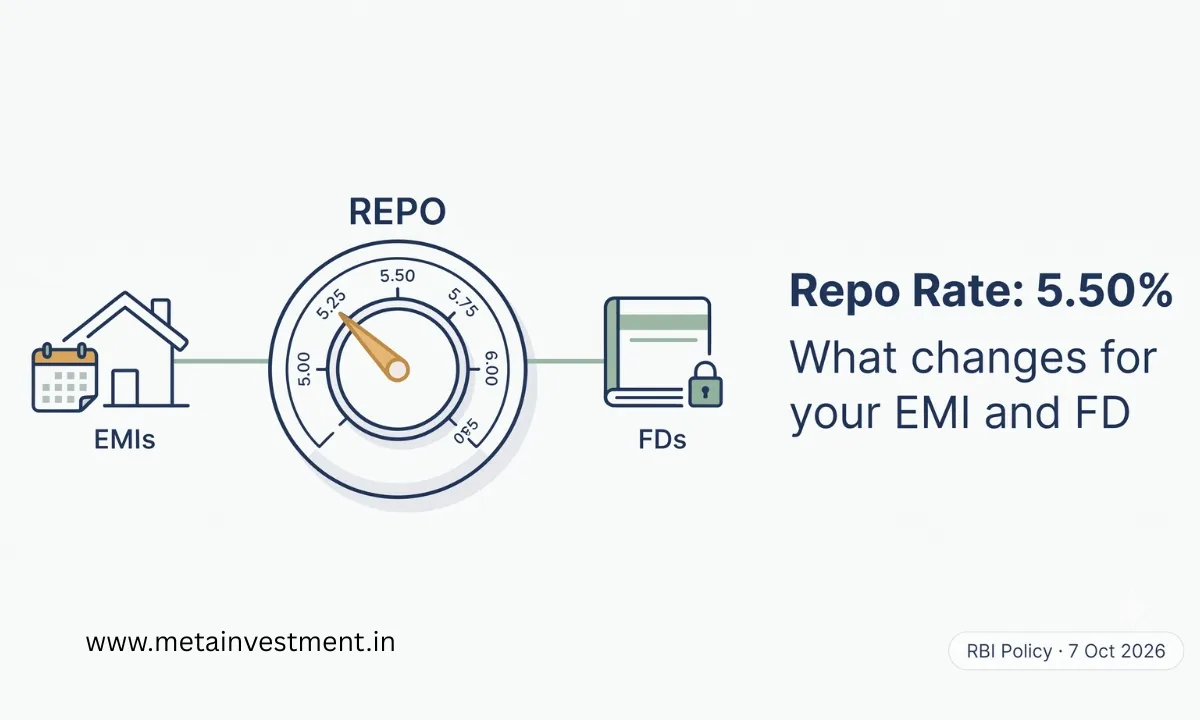
On October 7, 2026, the Monetary Policy Committee (MPC) voted unanimously for the hike and changed its stance to calibrated tightening. Everything below is drawn from the Governor's statement released the same day. It is educational, not a recommendation.
What the RBI Decided Today
| Policy item | After October 7, 2026 |
|---|---|
| Policy repo rate | 5.50% (up 25 bps) |
| Standing Deposit Facility (SDF) | 5.25% |
| Marginal Standing Facility (MSF) and Bank Rate | 5.75% |
| Policy stance | Calibrated tightening |
| MPC vote | Unanimous |
| CPI inflation projection, 2026-27 | 5.2% (Q3: 6.0%, Q4: 5.7%) |
| Core inflation projection, 2026-27 | 4.4% |
| Real GDP growth projection, 2026-27 | 7.1% (revised up by 40 bps) |
The most important line in the statement is not the hike itself. It is the guidance that the next move can only be a hike or a pause, depending on how inflation and growth evolve. The RBI has not committed to how long or how far any tightening cycle runs.
Why the RBI Raised Rates
The statement points to a supply shock that is starting to spread:
- Crude oil: The Indian crude basket averaged US$ 116.1 per barrel in September, against US$ 82.0 in July, after the West Asia conflict re-escalated.
- Monsoon: Southwest monsoon rainfall ended about 13% below the long-period average, with El Niño conditions adding risk to the rabi season.
- Food prices: Price increases have become broad-based. Sugar rose about 34% between early July and end-August; onion prices rose about 85% between end-June and end-September.
- Generalisation: CPI inflation rose to 4.8% in August, core inflation to 4.2%, and the share of items with inflation above 4% rose to about 37%.
At the same time, growth is strong. Real GDP grew 7.8% in Q1 of 2026-27, and bank credit was growing at 18.1% year-on-year as of mid-September. A strong economy with rising, broadening inflation is the classic setting for a rate hike.
What Changes for Loan Borrowers
Which loans move, and when
- Repo-linked (EBLR) home loans: These follow the repo rate most directly. Banks typically reset them at least once every three months, so the change may show up within one reset cycle.
- MCLR-linked loans: These reset only on the loan's reset date, commonly every 6 or 12 months. The hike may reach these loans later, and by an amount that depends on the bank's own MCLR revision.
- Fixed-rate loans: Most personal loans and car loans are fixed. Existing EMIs usually do not change; new loans may be priced higher.
- Credit card balances: Already priced far above any policy rate. The repo change is a minor factor here.
What a 25 bps hike looks like
Illustration: a ₹50 lakh home loan with 20 years remaining, moving from 8.50% to 8.75%, assuming full pass-through.
| Option | Monthly EMI | Effect |
|---|---|---|
| Before the hike | ≈ ₹43,391 | — |
| Raise the EMI | ≈ ₹44,186 | About ₹794 more per month |
| Keep the EMI | ≈ ₹43,391 | Tenure extends by about 12 months |
Many lenders default to extending tenure. That protects monthly cash flow but adds to total interest, sometimes without the borrower noticing.
Key action points for borrowers
- Identify the benchmark. Check the loan sanction letter or statement to see whether the loan is repo-linked, MCLR-linked or fixed.
- Note the next reset date. This tells you when a change may appear.
- Check what the lender does by default. Ask whether the bank will raise the EMI or extend the tenure, and whether you can choose.
- Review the remaining tenure. If tenure keeps stretching across successive hikes, a longer loan can run close to or past retirement age.
- Evaluate part-prepayment against liquidity. Under RBI norms, lenders generally cannot charge prepayment penalties on floating-rate loans taken by individuals for non-business purposes. Prepayment may be weighed against keeping an adequate emergency fund.
- Compare your spread. Borrowers on older loans may compare their spread over the benchmark with current offers before evaluating a switch, including processing fees and other costs.
- Keep an eye on total EMI load. A commonly referenced planning heuristic is total EMIs staying comfortably below about 40% of take-home income.
What Changes for Depositors
FD rates may not rise quickly
This is the part the headlines tend to miss. The RBI's own data shows that during July–August 2026, the average rate on fresh term deposits fell by 28 bps, even as lending rates on fresh loans rose by 8 bps. The reason: surplus liquidity, helped by large non-resident deposit inflows, reduced banks' need to raise bulk deposits.
Deposit rates are driven by each bank's need for funds. A repo hike raises the policy floor, but transmission to FDs can be slower and uneven across banks.
Key action points for depositors
- Existing FDs do not change. The rate locked in at booking applies until maturity.
- Compare at renewal, not before. Renewals and new deposits are priced at the bank's card rate on that day. Rates may differ meaningfully between banks.
- Consider a ladder. Spreading deposits across different maturities is one way to reduce the risk of locking everything in at a single point in the rate cycle.
- Check the deposit insurance limit. DICGC cover is ₹5 lakh per depositor per bank, including principal and interest. NBFC and corporate deposits are not covered.
- Factor in tax. FD interest is taxed at slab rate, which affects post-tax returns more for those in higher brackets. Seniors may check the higher interest exemption and TDS thresholds that apply to them.
- Keep the emergency fund liquid. A higher FD rate on a long tenure is less useful if premature withdrawal penalties apply when the money is needed.
What It Means for Debt Fund Investors
The statement notes that G-sec yields hardened from mid-August to September 2026, driven by geopolitical tensions, higher global bond yields and crude oil prices.
- Interest rate risk: Bond prices move opposite to yields. Long-duration and gilt categories are generally more sensitive to rising yields and may see greater NAV volatility.
- Short-term categories: Liquid and overnight funds hold very short-maturity instruments, so their portfolio yields tend to reflect changes in short-term rates relatively quickly.
- Credit risk: Separate from rate risk. Lower-rated papers carry the risk of default or downgrade regardless of the rate cycle.
Different duration categories may behave differently depending on interest-rate movements and investor objectives. The suitability of any investment category depends on an investor's financial goals, risk appetite, investment horizon and overall financial circumstances.
For equity investors, the RBI's statement includes both a growth upgrade and a list of global risks, including concerns about valuations of AI stocks. Long-term investing principles remain relevant, although outcomes are subject to market risks. Investors may review their asset allocation in line with their goals and risk profile.
A Note for NRIs
Non-resident deposit inflows rose to US$ 119.2 billion during April–August 2026, against US$ 5.6 billion a year earlier, partly supported by measures announced in the June 2026 policy. NRIs comparing NRE or FCNR(B) deposit rates may weigh them alongside rupee movements, since the return in a home currency depends on both. The RBI said it will continue to aim for orderly exchange-rate adjustments in line with fundamentals. More resources are in the NRI Corner.
Two Announcements Worth Noticing
- Account Aggregator interoperability: Financial information will be aggregable across all Account Aggregators from a single one.
- Deposits in your CAS: SEBI-regulated depositories will be able to include deposit account information in the Consolidated Account Statement.
Both are to be implemented by December 31, 2026. Together they may make it easier to see mutual funds, demat holdings and bank deposits in one place.
What Happens Next
Future policy actions will depend on incoming data. The Governor said the duration and extent of the hiking cycle will depend on underlying inflation, how widely price pressures spread, the second-round effects of the supply shock, and demand conditions. A further hike cannot be ruled out if inflation stays elevated; a pause is equally possible if pressures ease. Market participants will continue monitoring developments.
Key Takeaways
- The repo rate is now 5.50%, the SDF 5.25% and the MSF 5.75%, with the stance changed to calibrated tightening.
- The RBI has said rate cuts are off the table in the near term; the next move may be a hike or a pause.
- Repo-linked loans tend to reflect the change faster than MCLR-linked loans; fixed-rate loans are usually unaffected.
- Many lenders extend tenure rather than raise EMI by default, which increases total interest.
- FD rates may not rise in step; fresh deposit rates actually fell in July–August due to surplus liquidity.
- Longer-duration debt categories are generally more sensitive to rising yields.
- Deposit accounts are set to appear in the Consolidated Account Statement by December 31, 2026.
Where to Start
A short review covers most of this: note your loan's benchmark and reset date, check whether your lender is extending tenure, list your FD maturities, and look at the duration profile of any debt fund holdings. How these pieces fit together depends on your goals, cash flow and existing commitments, and that is a conversation worth having.
This post is for educational purposes only and is not a recommendation to borrow, prepay, deposit, invest in or redeem any product. Mutual Fund investments are subject to market risks. Please read all scheme-related documents carefully before investing. If investments are made through a mutual fund distributor, the distributor may receive commissions from Asset Management Companies. Such commissions should not influence suitability-based recommendations. Tax treatment of interest and capital gains depends on individual circumstances and prevailing law; please consult a qualified tax professional. Loan and deposit terms vary by lender, so please verify them with your bank. Policy figures are from the RBI Governor's Statement of October 7, 2026; EMI figures are illustrative.
Interested in Investing? Connect with Meta Investment
Meta Investment is a financial product distribution and services firm. If you'd like to explore whether a financial product is the right fit for your portfolio, our team will walk you through the details, help you assess suitability, and guide you through the onboarding process.
Meta Investment – Your Investment and Insurance Companion
Frequently Asked Questions
What is the RBI repo rate after the October 2026 policy?
On October 7, 2026, the RBI's Monetary Policy Committee unanimously raised the policy repo rate by 25 basis points to 5.50%. The Standing Deposit Facility rate moved to 5.25%, and the Marginal Standing Facility rate and Bank Rate moved to 5.75%.
Why did the RBI raise the repo rate in October 2026?
The MPC cited inflation that is no longer benign, with headline CPI inflation expected to average close to 5.8% over the next three quarters. The drivers it named include a deficient southwest monsoon, El Niño conditions, a sharp rise in crude oil prices after the West Asia conflict re-escalated, and early signs of price pressures spreading across the CPI basket.
What does 'calibrated tightening' mean?
It is the policy stance the MPC adopted in October 2026. The Governor stated that rate cuts are off the table in the near term and the next action can only be a rate hike or a pause, depending on how growth and inflation evolve. The duration and extent of any hiking cycle has not been pre-committed.
Will my home loan EMI go up after the repo rate hike?
It depends on the loan's benchmark and the lender's reset terms. Loans linked to an external benchmark such as the repo rate typically reset within a few months, while MCLR-linked loans reset only on their periodic reset date. Many lenders keep the EMI unchanged and extend the remaining tenure instead, unless the borrower asks for a higher EMI.
How much does a 25 bps hike add to a ₹50 lakh home loan EMI?
As an illustration, a ₹50 lakh loan over 20 years moving from 8.50% to 8.75% sees the EMI rise from about ₹43,391 to about ₹44,186, an increase of roughly ₹794 a month. If the EMI is held constant instead, the tenure extends by about a year. Actual figures depend on the outstanding balance, remaining tenure and the lender's pass-through.
Is it better to increase EMI or extend tenure after a rate hike?
Neither is universally better. A higher EMI keeps total interest lower but tightens monthly cash flow, while a longer tenure protects cash flow but raises total interest paid. Borrowers may evaluate the choice against their income stability, emergency fund and other goals, and check with the lender which option is the default.
Will FD interest rates go up after the RBI rate hike?
Not necessarily, and not immediately. The RBI's own data shows that during July–August 2026 the average rate on fresh term deposits fell by 28 bps, because surplus liquidity reduced banks' need for bulk deposits. Deposit rates depend on each bank's funding needs, so transmission to FDs may be slower and uneven.
Does the repo rate hike change the interest on my existing FD?
No. A fixed deposit carries the rate locked in at booking for its full term. Only new deposits and renewals are priced at the bank's prevailing card rates.
How does a repo rate hike affect debt mutual funds?
Bond prices generally move opposite to yields. When yields rise, longer-duration debt categories tend to see larger NAV declines than short-duration ones, while liquid and overnight categories reflect changes in short-term rates relatively quickly. The RBI noted that G-sec yields hardened from mid-August to September 2026.
What inflation and growth forecasts did RBI give in October 2026?
The RBI projected CPI inflation for 2026-27 at 5.2%, with Q3 at 6.0% and Q4 at 5.7%, and core inflation at 4.4%. Real GDP growth for 2026-27 was projected at 7.1%, an upward revision of 40 bps, after Q1 growth of 7.8%.
Are personal loans and credit card dues affected by the repo rate hike?
Most personal loans carry fixed rates, so existing EMIs usually do not change, though pricing on new loans may. Credit card interest is already high and is set by the issuer rather than directly linked to the repo rate.
Can I prepay a floating-rate home loan without penalty?
Under RBI norms, lenders generally cannot levy foreclosure or prepayment charges on floating-rate term loans taken by individuals for non-business purposes. Borrowers may confirm the exact terms in their loan agreement and with their lender before making a part-prepayment.
What does the rate hike mean for NRIs?
For NRIs, the policy context includes very large non-resident deposit inflows, which reached US$ 119.2 billion during April–August 2026 according to the RBI. Rates on NRE and FCNR(B) deposits are set by individual banks, and returns in a home currency also depend on rupee movement, so these factors may be assessed together.
What other announcements did RBI make on October 7, 2026?
The RBI allowed interoperability among Account Aggregators and enabled SEBI-regulated depositories to include deposit account information in the Consolidated Account Statement, both to be implemented by December 31, 2026. It also announced a Technical Consultative Committee for Financial Markets.
When is the next RBI policy meeting after October 2026?
The RBI publishes the MPC meeting schedule for each financial year on its website, which is the reference for the next date. The Governor indicated that the next action will depend on incoming growth and inflation data, especially underlying inflation and second-round effects of the supply shock.


Mutual fund updates, SIP tips, and what's moving the market. No daily noise — only when there's something worth reading.
Read more about
- Better returns with Bonds
- Earn More Than Traditional Fixed Income with Market-Linked Debentures
- Peer-to-Peer Lending: A New Era for Indian Investors?
- Considering a positive outlook for TCS or Titan? These new MLDs might be for you!
- 10.10% MUTHOOT FINCORP NCD Open for Subscription
- 10.75% Sammaan Capital Ltd NCD Open for Subscription
- Two Great Fixed-Income Investment Opportunities to Lock in High Returns
- RBI Cuts Repo Rate for the First Time in 5 Years
- Unlock High Returns with Sammaan Capital Limited’s Secured NCDs – Tranche III Public Issue Now Open!
- 7-Day Plan for Indian Women to Kickstart Their Financial Journey: From Scarcity to Abundance
- Edelweiss NCDs 2025 – Secure 9.5% to 11% Returns | Best Fixed-Income Investment
- Edelweiss Gold Structured Products: A Smart Way to Invest in Gold with Principal Protection
- Adani Enterprises NCDs 2025 – Safe Investment with 9.3% Returns?
- ManipalCigna Sarvah Uttam Health Insurance Plan: Comprehensive Coverage with Unique Benefits
- Mutual Funds Are the New Status Symbol (Not Your Bank Balance)
- Mutual Fund Scheme Name Changes in India (2025) – Complete List & Reasons
- From Freedom Fighters to Financial Freedom: Gen Z Investing & Independence Day Lessons
- All Weather Gold: A Principal-Protected Way to Bet on Gold (Until Aug 31)
- ESAF SFB NCD Issue: 11.30% Coupon | Basel II Compliant Bonds
- Begin Your Wealth Journey This Ganesh Chaturthi: Ganpati-Inspired Mutual Fund Lessons
- Tata AIA Health SIP Review 2025: A Smart Health + Investment Plan?
- NPCI Raises UPI Transaction Limits: A Complete Guide to High-Value Payments from Sept 2025
- Diwali Investment 2025: Brighten Your Financial Future with Indel Money Secured NCD | High Yield Fixed Income for Pune Investors
- Light Up Your Finances This Diwali: A Guide to Wealth, Wisdom, and Long-Term Prosperity
- Adani Enterprises NCD 2026: 8.9% Yield, Secure Options for Retail Investors | Apply Now
- PFC NCD Issue Jan 2026: AAA Rated Bonds Offering up to 7.30%
- RBI Policy Feb 2026: Repo Rate, New CPI Series & Your Wallet | Analysis
- SEBI Equity Fund Rules 2026: Multi Cap, Flexi Cap Changes
- SEBI Debt Fund Rules 2026: Debt Funds Masterclass - Duration, Credit Risk, Yields Guide
- ICICI Pru Thematic Advantage Fund: What the Recategorization Means for You
- Marcellus Global Equities Fund NFO: Invest in Global Markets via GIFT City
- Short-Term Goals: Where to Park Your Money in India
- NPS Swasthya Explained: Wait for the Health-Linked Pension, or Buy Health Cover Now?
- AMFI Stock Reclassification: What It Means for Your Fund
- FTSE India Index Explained: What It Is & Why It Matters Now
- US Fed Holds Rates: What It Means for Gold, Silver & the Rupee
- Tata Mumbai Marathon 2027 Fee Is ₹5,000: How to Budget for It
- Pune on India's Wealth Map: What the 2026 List Reveals
- Closing Auction Session: Why Arbitrage Fund NAVs Jumped
- Emergency Fund: The Money That Buys the Right to Say No
- The 8 Freedoms Checklist for Financial Independence
- SEBI's Proposed MF-Only PMS: What Investors Should Know
- How to Check an Insurer's Complaint Record Before You Buy
- Your Increment Came Through. Did Your SIP?
- PFRDA's New NPS Scheme Categories: What Actually Changed
- SEBI Mandatory Nomination Rules for Demat and MF Folios
- Financial Green Flags That Matter More Than Salary
- Record SIP Inflows in a Falling Month: Reading August's AMFI Data
- UPI Charges Above ₹2,000: What Changes on October 15
- Fed Rate Hike 2026: What It Means for Indian MF Investors
- Navratri to Diwali 2026: Your Festive-Season Money Calendar
- NPS Sanchay Explained: Who It Is For and How It Differs
- SEBI Credit Risk-o-Meter: What the Bond Colours Mean
- Got a Bonus? Jio IPO or SIP: A Simple Decision Framework
- Gold FoF Pause: What It Means for Your Gold SIP
- IPO Money Blocked vs Debited: What Actually Happens
- Can a 10-Year SIP Lose Money? What the Index Data Shows
- महिलांसाठी आर्थिक यशस्वीतेची 7-दिवसीय नियोजन: टंचाईपासून विपुलतेकडे
- एडलवाइस NCD 2025 – 9.5% ते 11% सुरक्षित परतावा | सर्वोत्तम निश्चित उत्पन्न गुंतवणूक
- एडलवाईस गोल्ड स्ट्रक्चर्ड प्रॉडक्ट्स: मुद्दल सुरक्षित ठेवून सोन्यात गुंतवणूक करण्याचा हुशार मार्ग
- एप्रिल २०२५ पासून भारतातील म्युच्युअल फंड स्कीमच्या नावातील बदल - संपूर्ण यादी आणि कारणे
- Demat आणि MF Folio साठी SEBI चे अनिवार्य Nomination नियम
- ₹2,000 वरील UPI शुल्क: 15 ऑक्टोबरपासून काय बदलते
- नवरात्री ते दिवाळी 2026: सणासुदीच्या काळातील आर्थिक दिनदर्शिका
- NPS Sanchay सोप्या भाषेत: कोणासाठी आणि इतर NPS पेक्षा वेगळे कसे
- RBI ने रेपो दर 5.50% केला: तुमच्या EMI आणि FD वर काय परिणाम?
- SEBI Credit Risk-o-Meter: बाँडच्या रंगांचा अर्थ काय?
- बोनस मिळाला? Jio IPO की SIP: निर्णय घेण्याची सोपी पद्धत
- Gold FoF ला तात्पुरता ब्रेक: तुमच्या गोल्ड SIP वर काय परिणाम?
- IPO चे पैसे ब्लॉक होतात की कापले जातात? प्रत्यक्षात काय होते
- 10 वर्षांच्या SIP मध्ये तोटा होऊ शकतो का? इंडेक्स डेटा काय सांगतो
Related Posts
 ArticleRBI MPC June 2026: Repo Rate Held at 5.25% — What It Means for You
 ArticleRBI’s August 2025 MPC Meeting: Key Highlights & What It Means for You
 ArticleRBI Policy Feb 2026: Repo Rate, New CPI Series & Your Wallet | Analysis
 ArticleRBI Holds Rates Steady: What the October 2025 Policy Means for Your Wallet and Investments
This communication is intended solely for general educational and informational purposes. The information provided is general in nature and does not take into account the specific financial goals, risk profile, investment horizon, financial circumstances or other requirements of any particular investor. It should not be construed as personalised investment advice or as a recommendation to buy, sell or hold any specific financial product.
International investments may carry currency/exchange-rate, foreign-market, geopolitical, taxation, regulatory, remittance and liquidity risks.
Distributor Disclosure: Where this content is provided by a distributor/intermediary, any applicable commission, remuneration, affiliation or other material conflict of interest shall be disclosed separately. The availability of a product through the distributor does not by itself imply that the product is suitable for every investor.
No Guarantee: No statement on this page should be interpreted as a promise, assurance or guarantee of returns or investment outcomes.
Meta Investment – Your Investment and Insurance Companion