UPI Charges Above ₹2,000: What Changes on October 15
The headlines say UPI is no longer free. For the person paying, that is not true. Scanning a QR code, sending money home and paying a SIP all work exactly as before.
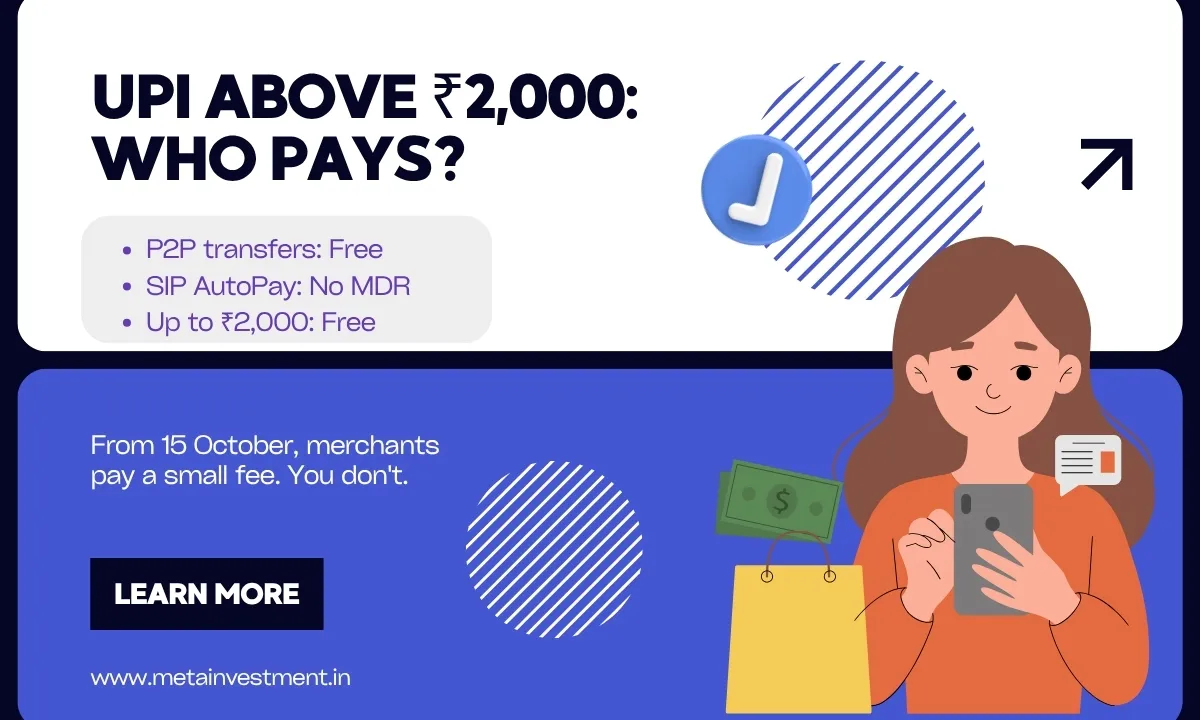
What changes is who pays the system's running costs. From October 15, 2026, larger merchants pay a small fee on UPI payments above ₹2,000. The useful question is not "will I be charged?" It is "will anyone try to make me pay it anyway?"
What the New UPI Charges Actually Are
The National Payments Corporation of India (NPCI), which operates UPI, has announced a Merchant Discount Rate (MDR) of 0.4% on person-to-merchant (P2M) UPI payments above ₹2,000, effective October 15, 2026.
- The cap: the charge stops at ₹300 per transaction. At 0.4%, that ceiling is reached at ₹75,000, so a ₹1 lakh payment carries ₹300, not ₹400.
- The payer: the merchant pays the MDR to its bank. It is not added to the customer's bill.
- The history: this is the first charge on UPI since the zero-MDR policy began in January 2020.
- The scope: government data cited in news reports suggests only about 4% of merchant transactions will be touched, since most fall below ₹2,000 or qualify for the small-vendor exemption.
NPCI's reasoning is straightforward. Industry estimates put UPI's annual running cost at around ₹20,000 crore, covering servers, fraud prevention and technical support. MDR revenue will be distributed among the entities that process each payment.
Who Pays UPI Charges Above ₹2,000, and Who Doesn't
The person paying
- Nothing is charged on P2M payments, on P2P transfers, or on anything under ₹2,000.
- No monthly quota on free UPI transactions exists for individuals. Daily limits set by banks remain risk-management tools, not charge tiers.
- UPI apps are barred from levying platform fees or hidden charges on customers.
Small vendors
- Vendors under NPCI's P2PM (Person-to-Person-Merchant) category stay at zero MDR, even on single payments above ₹2,000.
- P2PM covers small sellers receiving up to ₹1 lakh a month through UPI QR codes directly into their own accounts.
- GST registration is not required to qualify, and no QR upgrade is needed.
- Acquiring banks track inflows. A vendor that consistently crosses ₹1 lakh a month can be moved into the regular P2M category, where MDR applies.
Larger merchants
- Registered merchants pay the MDR to their acquiring bank.
- They are not permitted to pass it on. Banks have been advised to ensure that merchants do not recover MDR from customers.
The UPI MDR Rate Card, by Category
| Payment type | MDR from October 15, 2026 (paid by merchant) | Example |
|---|---|---|
| Any merchant payment up to ₹2,000 | Zero | ₹1,800 grocery bill: ₹0 |
| Standard merchant payment above ₹2,000 | 0.4%, capped at ₹300 | ₹3,000: ₹12. ₹50,000: ₹200. ₹1 lakh: ₹300 |
| Railways, telecom, insurance, fuel, electricity, water, piped gas (above ₹2,000) | Flat ₹5 per transaction | ₹4,000 fuel fill: ₹5 |
| Education fees (above ₹2,000) | Flat fee or capped rate | Exact figure: refer to NPCI FAQ |
| Mutual funds, stockbrokers, securities, broker wallet top-ups | 0.02%, capped at ₹300 | ₹1 lakh lump sum: ₹20 |
| UPI AutoPay / Mandates (SIPs, bills, OTT subscriptions) | No prescribed MDR | Monthly SIP: ₹0 |
| Person-to-person transfers | Zero, any amount | Money sent to family: ₹0 |
| Small P2PM vendors (up to ₹1 lakh a month) | Zero, any amount | ₹2,500 at a local shop: ₹0 |
On education fees, NPCI's framework refers to flat-fee structures or capped processing rates for payments above ₹2,000, covering school tuition, university term fees and entrance examination fees. Some reports quote a specific figure; until NPCI's own FAQ confirms it, any single number is best treated with caution.
What This Means for SIPs and Mutual Fund Payments
SIPs on UPI AutoPay
- Recurring investments registered through UPI Mandates or AutoPay carry no prescribed MDR. NPCI names recurring investments explicitly alongside utility bills and OTT subscriptions.
- A SIP debited through a registered UPI mandate therefore works exactly as before.
- SIPs running on NACH or e-mandates through the bank account sit outside the UPI framework altogether.
Lump-sum purchases
- Capital market payments carry a concessional 0.02% MDR, capped at ₹300.
- That is ₹20 on a ₹1 lakh purchase. The ₹300 cap is reached only at ₹15 lakh.
- The fund house or platform receiving the money bears it. It is not deducted from the amount invested and cannot be passed on as a surcharge.
Credit-linked UPI
- The new MDR applies to direct bank-account-to-merchant UPI payments.
- RuPay credit cards on UPI and pre-sanctioned credit lines follow separate card rules.
None of this changes the underlying investment. Scheme selection, allocation and holding period are unaffected by how the money moves. The suitability of any investment category depends on an investor's financial goals, risk appetite, investment horizon and overall financial circumstances. For more on keeping routine money decisions simple, see Money Moves, and for longer-horizon modelling, the SIP Calculator.
Where Customers Might Still Feel UPI Charges
The official position is that merchants absorb the fee as a normal processing cost, offset by higher volumes. A rule on paper and behaviour at a billing counter are two different things. Three patterns are worth recognising:
- Payment steering. On large bills, some merchants may nudge customers toward cash or another payment mode. The customer is free to pay by UPI at the posted price.
- Disguised surcharges. A "convenience fee" applied only to UPI payments is not permitted. A customer asked to pay one may raise it with the merchant and report it through their UPI app or bank.
- Split bills. Some merchants may break a large bill into several payments under ₹2,000. That costs the customer nothing, but it clutters records. Keeping the full invoice helps with warranties, returns and expense tracking.
Expect a wave of forwarded messages claiming UPI is now paid for consumers. NPCI has pointed people to official releases from the Finance Ministry, the RBI, NPCI and PIB, and to notifications inside their banking apps.
Why UPI Needed a Revenue Model
Zero MDR built UPI's scale, but it left banks and payment companies running critical infrastructure without a direct revenue source.
- Stated use of MDR revenue: infrastructure resilience, cybersecurity, fraud prevention, innovation and customer service.
- Competition argument: a predictable revenue model allows smaller payment providers to compete, rather than only companies able to absorb years of losses.
- Relative cost for merchants: even at 0.4%, UPI remains cheaper than typical card MDRs, which are commonly quoted well above 1% for credit cards.
- Small-merchant support: NPCI is setting up a dedicated fund to support digital payment adoption in smaller towns and underserved regions, with details to be finalised in consultation with the RBI.
The move has drawn political criticism, and some commentators question whether a transaction fee is the right way to fund public digital infrastructure. The practical test over the coming months will be enforcement of the no-pass-through rule.
Key Takeaways
- From October 15, 2026, merchants pay 0.4% MDR on UPI payments above ₹2,000, capped at ₹300. The person paying is not charged.
- P2P transfers and all merchant payments up to ₹2,000 remain free.
- SIPs and other recurring payments on UPI AutoPay carry no prescribed MDR.
- Lump-sum mutual fund purchases carry a 0.02% MDR on the merchant side, which is ₹20 per ₹1 lakh.
- Fuel, insurance, utilities, railways and telecom carry a flat ₹5 above ₹2,000.
- Small P2PM vendors receiving up to ₹1 lakh a month stay at zero MDR.
- Merchants cannot pass MDR on to customers, and UPI apps cannot add platform fees.
The Wallet Being Charged Isn't Yours
This change is about how UPI pays for itself, not about what customers pay. SIPs, family transfers and everyday spends work as before. The one habit worth building is noticing when a merchant tries to turn its cost into the customer's cost.
If the way SIPs and lump-sum investments are set up is due for a review, that's a conversation worth having.
Interested in Investing? Connect with Meta Investment
Meta Investment is a financial product distribution and services firm. If you'd like to explore whether a financial product is the right fit for your portfolio, our team will walk you through the details, help you assess suitability, and guide you through the onboarding process.
Mutual Fund investments are subject to market risks. Please read all scheme-related documents carefully before investing. Past performance may or may not be sustained in the future.
The suitability of any investment category depends on an investor's financial goals, risk appetite, investment horizon and overall financial circumstances. Nothing in this article constitutes a recommendation to buy, sell, or hold any specific product.
Meta Investment is an AMFI-registered Mutual Fund Distributor (ARN-129322) and not a SEBI-registered Investment Adviser. If investments are made through a mutual fund distributor, the distributor may receive commissions from Asset Management Companies. Such commissions should not influence suitability-based recommendations. See our commission disclosure for details.
Payment charges, MDR rates, category classifications and effective dates described above are based on publicly reported NPCI and Government of India announcements as of September 16, 2026, and are subject to change. Readers may verify current details against official NPCI, RBI, Ministry of Finance and PIB releases. Tax treatment depends on individual circumstances and prevailing law; please consult a qualified tax professional.
This communication is intended solely for educational and informational purposes and should not be construed as investment advice, a recommendation, or a solicitation to buy or sell any financial product.
Meta Investment – Your Investment and Insurance Companion
Frequently Asked Questions
Will I be charged for UPI payments above ₹2,000 after October 15, 2026?
No. The 0.4% Merchant Discount Rate (MDR) that applies from October 15, 2026 is borne by the merchant receiving the payment, not by the person paying. NPCI has stated that merchants cannot pass the MDR on to customers and that UPI apps are not permitted to levy platform fees or hidden charges.
What is MDR in UPI?
Merchant Discount Rate (MDR) is the fee a merchant pays to its acquiring bank for processing a digital payment. Under NPCI's new framework, it is distributed among the entities that facilitate the transaction and is intended to fund infrastructure, cybersecurity, innovation and customer service in the UPI system.
How much is the UPI MDR on merchant payments above ₹2,000?
The standard rate is 0.4% of the transaction value on person-to-merchant (P2M) payments above ₹2,000. The charge is capped at ₹300 per transaction, a cap that is reached at ₹75,000. A ₹3,000 payment carries ₹12 of MDR and a ₹50,000 payment carries ₹200, both paid by the merchant.
Is there any charge on UPI payments up to ₹2,000?
No. Merchant payments of ₹2,000 or less carry zero MDR, including at larger registered merchants. According to government data cited in news reports, these small-value payments account for more than 95% of person-to-merchant UPI transaction volume.
Are SIP payments through UPI AutoPay charged after October 15, 2026?
UPI Mandates and AutoPay, which cover recurring investments such as SIPs as well as utility bills and OTT subscriptions, carry no prescribed MDR under the new framework. A SIP debited through a registered UPI AutoPay mandate is therefore not subject to the new charge.
Is there a UPI charge on lump-sum mutual fund purchases?
Capital market payments, including mutual fund purchases, equity purchases and broker wallet top-ups, carry a concessional MDR of 0.02%, capped at ₹300. This is paid on the merchant side, not by the investor. On a ₹1 lakh purchase the MDR works out to ₹20, and the ₹300 cap is reached only at ₹15 lakh.
Is sending money to family or friends through UPI still free?
Yes. Person-to-person (P2P) UPI transfers remain free for any permitted amount, for both sender and receiver. This covers transfers to family members, splitting bills with friends and similar individual-to-individual payments.
Can a shopkeeper add an extra charge if I pay by UPI?
No. NPCI has stated that merchants cannot pass the MDR on to customers, who pay only the posted price, and banks have been advised to ensure this. A customer who is asked to pay a UPI-specific surcharge may raise it with the merchant and report it through their UPI app or bank.
Do small shopkeepers and street vendors have to pay UPI MDR?
Not if they fall under NPCI's Person-to-Person-Merchant (P2PM) category, which covers small vendors receiving up to ₹1 lakh a month through UPI QR codes into their own accounts. They continue at zero MDR even on individual payments above ₹2,000, and GST registration is not required to qualify.
What happens if a small vendor's UPI receipts cross ₹1 lakh a month?
Acquiring banks track inward payments to P2PM vendors. As reported, a vendor whose UPI inflows exceed ₹1 lakh a month on a sustained basis can be reclassified into the regular person-to-merchant category, after which MDR applies to eligible payments above ₹2,000. The exact reclassification conditions should be checked against NPCI's official FAQs.
What UPI MDR applies to fuel, insurance, electricity and railway payments?
For payments above ₹2,000 in specified essential categories, including railways, telecom, insurance, fuel, electricity distribution, municipal water and piped gas, a flat MDR of ₹5 per transaction applies instead of the 0.4% rate. The merchant bears this fee.
Are school and college fees paid by UPI subject to MDR?
Educational fee payments of up to ₹2,000 carry zero MDR. For payments above ₹2,000, NPCI's framework provides for flat-fee structures or capped processing rates rather than a pure percentage charge. Reports differ on the exact figure, so the official NPCI FAQ is the reliable reference.
Does the new UPI MDR apply to RuPay credit cards on UPI?
No. The framework applies to direct bank-account-to-merchant UPI payments. Credit-linked UPI transactions, such as RuPay credit cards on UPI or pre-sanctioned credit lines, follow separate card-based rules.
Is there a monthly limit on free UPI transactions for individuals?
No. The government has stated that there are no monthly quotas, volume limits or tiered caps on free UPI transactions for individuals. Existing daily transaction limits set by banks and NPCI are described as risk-management measures, not commercial charge tiers.
Why is NPCI introducing MDR on UPI now?
UPI has operated at zero MDR since January 2020, with industry estimates putting annual running costs at around ₹20,000 crore. NPCI's position is that a predictable revenue model is needed to fund cybersecurity, fraud prevention, infrastructure resilience and competition among payment providers.
Where can I verify official information on UPI charges?
Official releases from the Ministry of Finance, the Reserve Bank of India, NPCI and the Press Information Bureau, along with notifications inside banking apps, are the reliable sources. Forwarded messages claiming that UPI is now chargeable for consumers are not consistent with the official position.


Mutual fund updates, SIP tips, and what's moving the market. No daily noise — only when there's something worth reading.
Read more about
- EMI vs SIP
- Running, SIP and Coaching!
- The Power of Chai, SIP, and Building Long-Term Wealth
- From Appathon to SIPathon
- Building Your Crorepati Dream
- Unveiling the Secrets of Wealth
- The Cafe vs. The Nest Egg
- This Mother's Day, Give the Gift of Security: Invest for Her Future and Protect Her Health
- Don't Be a Target: Investor Awareness and ARN Verification to avoid Mutual Fund fraud
- Strava and SIPs: How One Cyclist Conquered Both Roads and Finances
- Don't Panic Sell!
- Growing Their Future: Why Mutual Funds Are a Smart Investment for Minors
- How To Lose 1 Crore Rupees
- The Gift That Keeps on Giving
- Navigating The Current Equity Market Correction
- Pre-Budget Portfolio Tune-Up: 3 Things to Consider Now
- Wishing You a Prosperous Gudi Padwa, Ugadi, Cheiraoba, Navreh, and Cheti Chand!
- Master Market Volatility: Krishan Sharma’s Investing Wisdom
- Gold vs. Mutual Funds vs. Multi-Asset Funds: Best Investment for Akshaya Tritiya 2025
- New SEBI-Validated UPI IDs: Secure Payments for Investors Explained
- 📈💰 World Emoji Day Special: Smart Investing, SIP & Wealth Growth Made Fun! 🚀💡
- RBI’s August 2025 MPC Meeting: Key Highlights & What It Means for You
- From Freedom Fighters to Financial Freedom: Gen Z Investing & Independence Day Lessons
- Begin Your Wealth Journey This Ganesh Chaturthi: Ganpati-Inspired Mutual Fund Lessons
- Tata AIA Health SIP Review 2025: A Smart Health + Investment Plan?
- NPCI Raises UPI Transaction Limits: A Complete Guide to High-Value Payments from Sept 2025
- India’s First Specialized Investment Fund (SIF): Bridge Between MF & PMS | quant Guide
- New GST Changes 2025: Impact on Investors, Sectors, and Mutual Fund Opportunities
- Beyond the Market Rollercoaster: A Guide to the Altiva Hybrid Long-Short SIF | Edelweiss MF
- The Investor and The Distributor: A Lesson on SIP Discipline
- Financial Wellness for Men: Boost Health with Smart Investing, SIP & Retirement Planning
- Kotak Market Outlook 2026: India Equity, Debt, Gold & Silver
- SEBI Equity Fund Rules 2026: Multi Cap, Flexi Cap Changes
- SEBI Debt Fund Rules 2026: Debt Funds Masterclass - Duration, Credit Risk, Yields Guide
- ICICI Pru Thematic Advantage Fund: What the Recategorization Means for You
- Marcellus Global Equities Fund NFO: Invest in Global Markets via GIFT City
- AMFI Stock Reclassification: What It Means for Your Fund
- FTSE India Index Explained: What It Is & Why It Matters Now
- US Fed Holds Rates: What It Means for Gold, Silver & the Rupee
- Tata Mumbai Marathon 2027 Fee Is ₹5,000: How to Budget for It
- Pune on India's Wealth Map: What the 2026 List Reveals
- Closing Auction Session: Why Arbitrage Fund NAVs Jumped
- Emergency Fund: The Money That Buys the Right to Say No
- The 8 Freedoms Checklist for Financial Independence
- SEBI's Proposed MF-Only PMS: What Investors Should Know
- Your Increment Came Through. Did Your SIP?
- SEBI Mandatory Nomination Rules for Demat and MF Folios
- Financial Green Flags That Matter More Than Salary
- Record SIP Inflows in a Falling Month: Reading August's AMFI Data
- Fed Rate Hike 2026: What It Means for Indian MF Investors
- Navratri to Diwali 2026: Your Festive-Season Money Calendar
- RBI Hikes Repo Rate to 5.50%: What It Means for EMIs and FDs
- Got a Bonus? Jio IPO or SIP: A Simple Decision Framework
- Gold FoF Pause: What It Means for Your Gold SIP
- IPO Money Blocked vs Debited: What Actually Happens
- Can a 10-Year SIP Lose Money? What the Index Data Shows
- म्युच्युअल फंड: अल्पवयीन मुलांसाठी स्मार्ट गुंतवणूक का आहे?
- तुम्हाला गुढी पाडवा, उगादी, चेइराओबा, नवरेह आणि चेटीचंदच्या हार्दिक शुभेच्छा!
- बाजारातील चढ-उतारांवर मात करा: कृष्ण शर्मा यांच्याकडून महत्त्वाचे धडे
- सोने vs म्युच्युअल फंड vs मल्टी-अॅसेट फंड: अक्षय तृतीया २०२५ साठी सर्वोत्तम गुंतवणूक
- SEBI चे नवीन '@valid' UPI ID: गुंतवणूकदारांसाठी सुरक्षित पेमेंट्स
- 📈💰 वर्ल्ड इमोजी डे स्पेशल: SIP आणि गुंतवणूक मजेशीर पद्धतीने! 🚀💡
- RBI चा ऑगस्ट 2025 MPC बैठक: प्रमुख हायलाइट्स आणि तुमच्यासाठी काय अर्थ आहे
- Demat आणि MF Folio साठी SEBI चे अनिवार्य Nomination नियम
- पगारापेक्षा जास्त महत्त्वाची असणारी आर्थिक हिरवी निशाणे
- ₹2,000 वरील UPI शुल्क: 15 ऑक्टोबरपासून काय बदलते
- नवरात्री ते दिवाळी 2026: सणासुदीच्या काळातील आर्थिक दिनदर्शिका
- RBI ने रेपो दर 5.50% केला: तुमच्या EMI आणि FD वर काय परिणाम?
- बोनस मिळाला? Jio IPO की SIP: निर्णय घेण्याची सोपी पद्धत
- Gold FoF ला तात्पुरता ब्रेक: तुमच्या गोल्ड SIP वर काय परिणाम?
- IPO चे पैसे ब्लॉक होतात की कापले जातात? प्रत्यक्षात काय होते
- 10 वर्षांच्या SIP मध्ये तोटा होऊ शकतो का? इंडेक्स डेटा काय सांगतो
Related Posts
 ArticleNPCI Raises UPI Transaction Limits: A Complete Guide to High-Value Payments from Sept 2025
 ArticleNew SEBI-Validated UPI IDs: Secure Payments for Investors Explained
 ArticleRBI Policy Feb 2026: Repo Rate, New CPI Series & Your Wallet | Analysis
 ArticleP2P Association Pauses Liquid Funds in India: What You Need to Know
This communication is intended solely for general educational and informational purposes. The information provided is general in nature and does not take into account the specific financial goals, risk profile, investment horizon, financial circumstances or other requirements of any particular investor. It should not be construed as personalised investment advice or as a recommendation to buy, sell or hold any specific financial product.
Mutual Fund investments are subject to market risks. Please read all scheme-related documents carefully before investing. Past performance is not indicative of future results and may not be sustained.
The suitability of any mutual fund product, scheme, category or strategy discussed on this page depends on an investor's individual circumstances, including financial goals, risk appetite, investment horizon and liquidity requirements. Investors should independently assess suitability and, where appropriate, seek professional advice before making investment decisions.
Meta Investment is an AMFI-registered Mutual Fund Distributor (ARN-129322) and is not a SEBI-registered Investment Adviser. If investments are made through a mutual fund distributor, the distributor may receive commission from Asset Management Companies in respect of eligible Regular Plan investments. Commission structures may vary across schemes and AMCs. Such commissions should not influence suitability-based recommendations, and applicable conflicts of interest will be disclosed. Please refer to our Commission Disclosure for further details.
Tax treatment of mutual fund investments depends on individual circumstances and prevailing tax laws, which are subject to change. Investors should consult a qualified tax professional for advice specific to their circumstances.
This disclaimer is intended to provide general disclosure and does not replace any scheme-specific disclosures, risk factors, regulatory disclosures or information contained in the applicable Scheme Information Document (SID), Statement of Additional Information (SAI) and Key Information Memorandum (KIM).
Distributor Disclosure: Where this content is provided by a distributor/intermediary, any applicable commission, remuneration, affiliation or other material conflict of interest shall be disclosed separately. The availability of a product through the distributor does not by itself imply that the product is suitable for every investor.
No Guarantee: No statement on this page should be interpreted as a promise, assurance or guarantee of returns or investment outcomes.
Meta Investment – Your Investment and Insurance Companion