NPS Swasthya Guidelines 2026: What PFRDA Just Changed
NPS Swasthya links a dedicated NPS account with a standard super top-up health policy, so part of a subscriber's own pension contributions can be used for eligible medical expenses. Understanding how the two pieces work together is the key to evaluating it.
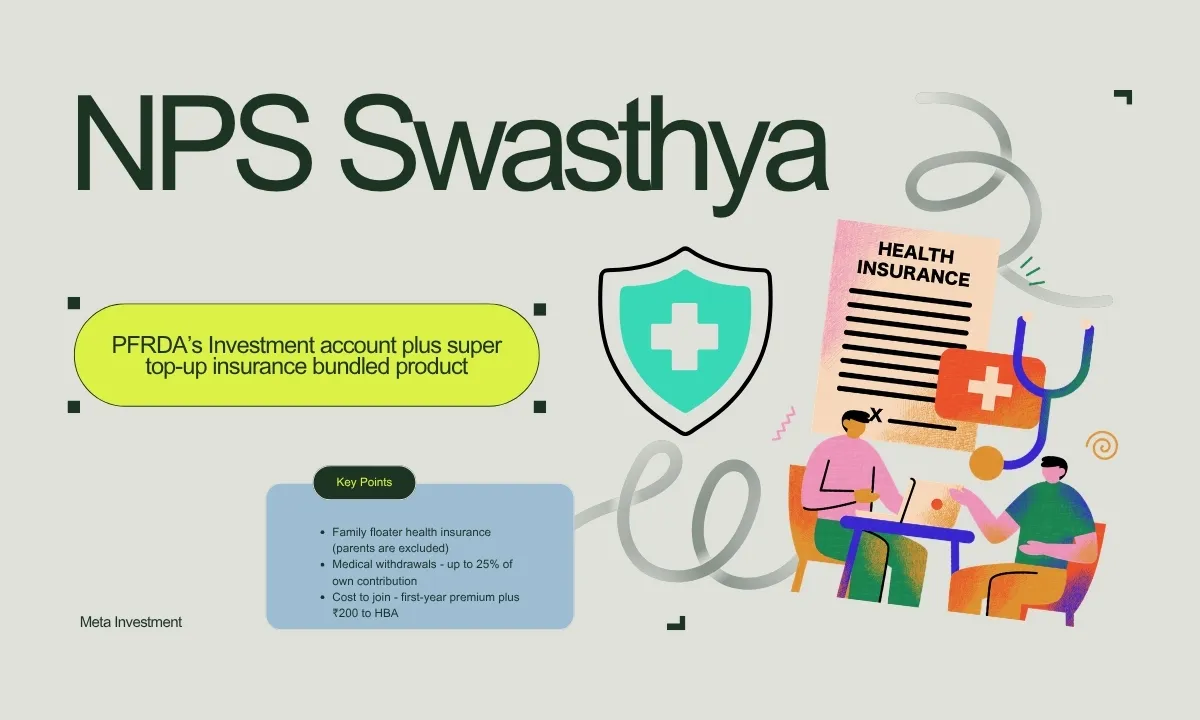
On September 18, 2026, PFRDA issued the Operational Guidelines for NPS Swasthya (Circular No. PFRDA/2026/49/NPS-SWASTHYA/01), effective immediately. The scheme had been running since January 2026 as a proof of concept under PFRDA's regulatory sandbox. The guidelines turn it into a regular offering, to be rolled out by individual pension funds.
For a salaried NPS subscriber, the useful questions are how the structure handles the money, what it costs, and which conditions need attention along the way.
What NPS Swasthya Actually Is
NPS Swasthya has two parts that the guidelines keep legally and operationally distinct:
- An NPS Swasthya investment account — held under the subscriber's existing PRAN, in a separate scheme account at the pension fund.
- A mandatory super top-up health insurance policy — a standard policy issued under a master policy arrangement and governed by IRDAI regulations.
Enrolment in one without the other is not possible.
One detail worth noting: contributions are invested as per the investment pattern prescribed for the Central Government Scheme, not an allocation the subscriber chooses. That pattern is predominantly debt with a limited equity component, and PFRDA may change it over time. The corpus is still market-linked and its value can move.
The healthcare link works through partial withdrawals. When an eligible outpatient or inpatient bill arrives, part of the subscriber's own contributions is used to pay it. A Health Benefit Administrator (HBA) — an entity empanelled by the Association of NPS Intermediaries — verifies eligibility, checks the limit and coordinates settlement.
How Much Can Actually Be Withdrawn
This is the part worth reading twice.
- Partial withdrawals cannot exceed 25% of the contributions made by the subscriber to the NPS Swasthya account. The limit is on contributions, not on the market value of the corpus.
- There is no restriction on the number of partial withdrawals.
- No minimum waiting period applies to the first or any later withdrawal. The ₹50,000 corpus threshold that applied during the pilot does not appear in the final guidelines.
A quick illustration of scale: with ₹2 lakh contributed to the account, the 25% rule caps healthcare withdrawals at ₹50,000. Anything larger has to come from the insurance policy or the premature exit route described below.
The money is never paid to the subscriber. It is settled directly with the hospital or healthcare provider. That is a sensible anti-misuse safeguard, but it also means NPS Swasthya is not a liquidity cushion — it is earmarked money that moves only on a medical trigger.
A less obvious feature works in the subscriber's favour. An "Eligible Healthcare Expense" is defined irrespective of whether the insurance policy admits it. So an eligible expense the insurer does not pay — for instance, one below the deductible — may still be met from the corpus. Even where an insurer declines a claim on grounds of material non-disclosure, that decision does not by itself bar a genuine eligible expense from being paid out of the corpus.
What It Costs to Get In
The entry cost is layered rather than a single number:
- Minimum initial contribution: first year's insurance premium (with taxes) + ₹200 annual maintenance charge payable to the HBA through the pension fund (plus taxes) + ₹1,000 towards the investment account.
- Minimum subsequent contribution: ₹10.
- Ongoing charges: standard NPS All Citizen Model charges, plus up to 0.08% per annum of NPS Swasthya AUM that the pension fund may levy, plus the ₹200 yearly HBA charge.
No other charge may be recovered unless PFRDA permits it, and the insurance premium and its taxes must be shown separately from account charges. Premiums are quoted for three entry-age cohorts — 18–40, above 40–60 and above 60–70 — based on age at first entry. Even so, the real cost of participation is noticeably higher than the headline ₹1,000 suggests, because the premium sits on top every year. From the second year, the renewal premium may be paid out of the NPS Swasthya corpus under a subscriber mandate.
The Insurance Side: What Is Covered
Every pension fund must offer the same standard policy — an insurer-specific variant is not permitted. That makes schemes comparable across pension funds on premium and service rather than on fine print.
| Feature | Detail |
|---|---|
| Coverage type | Family floater (self + spouse + up to 2 dependent children) |
| Parents | Excluded |
| Annual aggregate deductible | ₹10,000 / ₹50,000 / ₹1 lakh / ₹3 lakh |
| Corresponding sum insured | ₹1 lakh / ₹5 lakh / ₹10 lakh / ₹30 lakh |
| How the deductible applies | Cumulative family expenses in the policy year, not per claim |
| Entry age | 18–70 years |
| Renewal age limit | Up to and including 85 years |
| Room and ICU | Single private room; ICU at actuals, within sum insured |
| Pre/post hospitalisation | 30 days / 60 days |
| Co-payment and sub-limits | None; no disease-specific sub-limits |
| Initial waiting period | 30 days (except accidents) |
| Pre-existing and specified disease waiting | 12 months each |
| Max partial withdrawal | 25% of own contributions to the account |
| Transfer from regular NPS | Limited to the amount needed to meet the deductible |
| Pension fund management charge | Up to 0.08% p.a. of NPS Swasthya AUM |
| HBA maintenance charge | ₹200 per year plus taxes |
The policy also covers day-care procedures, domiciliary hospitalisation, AYUSH treatment, prescribed modern treatments, organ-donor expenses and road ambulance up to ₹2,500 per emergency, all subject to the final policy wording.
Underwriting is lighter than a typical retail policy. Enrolment is based on a Good Health Declaration covering 15 listed conditions, without formal medical reports. Where a declaration triggers enhanced underwriting, the insurer applies a premium loading. Controlled Type 2 diabetes, hypertension, hyperlipidaemia and asthma that do not trigger enhanced underwriting are covered after 12 months. If one family member is declined, that does not by itself disqualify the others. Fresh underwriting at renewal is not allowed unless the sum insured is raised, and a renewal premium cannot be increased merely because an individual made a claim.
The design logic is that the NPS Swasthya corpus funds the deductible and the insurer handles the larger bill beyond it. Which slab fits depends on how large a corpus a household can realistically hold against a deductible that applies to the whole family's yearly expenses.
Insurance is the subject matter of solicitation. The linked policy is governed by IRDAI regulations and the respective insurer's terms and conditions, and the final policy wording is the reference for coverage and exclusions.
Service Timelines Written Into the Rules
The guidelines set minimum service standards, which is unusual for a retail product:
- Policy start: within T+1 working day of successful enrolment and receipt of the minimum initial contribution.
- Cashless pre-authorisation: within one hour of a complete request.
- Final discharge authorisation: within three hours of a complete hospital request.
- Planned inpatient corpus authorisation: within one working hour of complete documents.
- Corpus settlement intimation: within 7 working days of final billing documents.
- Reimbursement target: within 15 calendar days of the last necessary document.
Grievances against any participant — pension fund, CRA, HBA or insurer — can be lodged through PFRDA's Pension Sahayak platform. Claim-related grievances remain with the insurer under IRDAI rules.
Exit, Renewal and Switching
Premature exit. If eligible inpatient expenses in a single instance exceed what partial withdrawal allows, the subscriber may exit early. The corpus is first used towards that expense. Any balance is merged into an NPS scheme under the All Citizen Model — one is created if it does not exist. Any insurance policy already in force continues for the rest of its policy period.
Renewal. Where the balance may be insufficient for renewal, the pension fund must, where practicable, alert the subscriber at least 90, 60 and 30 days before renewal and disclose the grace period. If the premium stays unpaid and cover lapses, NPS Swasthya is closed and merged into regular NPS. For anyone contributing irregularly, a missed renewal ends the whole structure, not just the insurance.
Switching. A subscriber may move to another pension fund's NPS Swasthya scheme at renewal, which may change the insurer too. Waiting-period and portability credits are to carry over under IRDAI rules, and the outgoing insurer stays liable for claims from its policy period.
Normal exit, exit on death and nomination follow the rules for non-Government NPS subscribers. Closing NPS Swasthya does not affect the subscriber's other NPS accounts.
If You Joined the Pilot
The sandbox schemes are discontinued once the guidelines are implemented. Pilot subscribers are to be offered a choice: migrate to an NPS Swasthya scheme under the new guidelines, or merge into an NPS scheme under the All Citizen Model, with continuity of records, benefits and applicable insurance coverage.
The pilot rules were materially different. Subscribers above 40 (outside the government sector) could transfer up to 30% of contributions from their common account, premature exit allowed a full lump-sum withdrawal, and the first withdrawal needed a ₹50,000 corpus. Under the final guidelines, transfers are limited to the deductible amount and there is no waiting period. The migration notice from the pension fund is the document to read first.
Seven Things Worth Checking Before Enrolling
- Existing health cover. A super top-up sits above a deductible. How it interacts with employer group cover and any personal policy is the starting point.
- Deductible slab. Whether the corpus can realistically fund a deductible that applies to the family's total yearly expenses.
- Parents' cover. Since parents are excluded, their medical costs still need a separate plan.
- Total annual cost. Premium + ₹200 HBA charge + up to 0.08% AUM charge + standard NPS charges, added together.
- Contribution discipline. Whether contributions will keep renewals funded without triggering closure.
- Investment pattern. Whether a debt-heavy allocation, set by regulation rather than by choice, fits the role this money is meant to play.
- Tax treatment. The guidelines are silent on tax; confirm treatment of contributions, premiums and withdrawals with a qualified tax professional before assuming any deduction.
Where It Fits in a Retirement Plan
The healthcare withdrawals in NPS Swasthya come from the subscriber's own contributions, ring-fenced and released early under specific medical conditions, wrapped around a standardised super top-up policy with lighter underwriting than most retail products.
For someone who wants an earmarked healthcare buffer that cannot be casually dipped into, the withdrawal rules enforce a discipline a savings account does not. The trade-off is a slice of the NPS corpus locked behind medical conditions, a regulator-set debt-heavy investment pattern, layered charges, and a floater that leaves parents out.
The suitability of any investment category depends on an investor's financial goals, risk appetite, investment horizon and overall financial circumstances. This post is for educational purposes only and is not a recommendation to enrol in, or avoid, NPS Swasthya.
Key Takeaways
- NPS Swasthya bundles a restricted NPS investment account with a mandatory, standardised super top-up family floater — one cannot be had without the other.
- Partial withdrawals are capped at 25% of the subscriber's own contributions, with no limit on the number of withdrawals and no waiting period.
- Money goes directly to the hospital or healthcare provider — never to the subscriber.
- An eligible expense the insurer does not pay may still be met from the corpus.
- The deductible is an annual aggregate across the whole family, not per claim.
- Contributions follow the Central Government Scheme investment pattern, not a subscriber-chosen allocation.
- An unpaid renewal after the grace period closes NPS Swasthya and merges the balance into regular NPS.
- Pilot subscribers must choose to migrate or merge — sandbox terms do not carry over.
Before You Commit Contributions
Whether NPS Swasthya belongs alongside an existing NPS Tier I account, health insurance and emergency fund depends on how those pieces already fit together. That is a conversation worth having before contributions go in, not after.
If investments are made through a mutual fund distributor, the distributor may receive commissions from Asset Management Companies. Such commissions should not influence suitability-based recommendations. Mutual Fund investments are subject to market risks. Please read all scheme-related documents carefully before investing.
Interested in Investing? Connect with Meta Investment
Meta Investment is a financial product distribution and services firm. If you'd like to explore whether a financial product is the right fit for your portfolio, our team will walk you through the details, help you assess suitability, and guide you through the onboarding process.
Meta Investment – Your Investment and Insurance Companion
Frequently Asked Questions
What is NPS Swasthya?
NPS Swasthya is a specific-purpose NPS scheme, notified by PFRDA on September 18, 2026, that pairs a dedicated investment account with a mandatory super top-up health insurance policy. It allows a subscriber to use part of their own contributions for eligible outpatient and inpatient medical expenses. It is not a separate pool of free health cover — the money withdrawn is the subscriber's own.
How much can be withdrawn from NPS Swasthya for medical expenses?
Partial withdrawals towards eligible healthcare expenses cannot exceed 25% of the contributions made by the subscriber to the NPS Swasthya account. There is no limit on the number of withdrawals and no minimum waiting period, including for the first withdrawal. The amount is never paid to the subscriber; it is settled directly with the hospital or healthcare provider.
Is NPS Swasthya the same as health insurance?
No. NPS Swasthya bundles two legally and operationally distinct components — an investment account governed by PFRDA and a super top-up insurance policy governed by IRDAI and the insurer's terms. Partial withdrawals come out of the subscriber's own accumulated contributions, while insurance claims are paid by the insurer only after the annual aggregate deductible is crossed.
Who is eligible to join NPS Swasthya?
Any individual eligible to join NPS may enrol in NPS Swasthya, subject to the guidelines. The linked insurance policy accepts subscriber entry between ages 18 and 70, with renewal permitted up to and including age 85, subject to premium, policy terms and applicable law.
Who is covered under the NPS Swasthya insurance policy?
The policy is a family floater covering the subscriber, spouse and up to two dependent children. Parents are explicitly excluded, so the policy does not cover medical costs of parents.
What is the annual aggregate deductible in NPS Swasthya?
The deductible applies to the total insurance-admissible expenses of all covered family members during a policy year, not separately to each claim. The four options are a ₹10,000 deductible with ₹1 lakh sum insured, ₹50,000 with ₹5 lakh, ₹1 lakh with ₹10 lakh, and ₹3 lakh with ₹30 lakh. Once cumulative family expenses in the year cross the deductible, the super top-up policy begins to pay.
How is NPS Swasthya money invested?
Contributions are invested according to the investment pattern prescribed for the Central Government Scheme under PFRDA investment guidelines, and each pension fund maintains a separate NPS Swasthya scheme account. PFRDA may modify the pattern from time to time. NPS investments are market-linked, so the corpus value can fluctuate.
What is the minimum contribution to open NPS Swasthya?
The minimum initial contribution is the first year's insurance premium with applicable taxes, plus a ₹200 annual maintenance charge (plus taxes) payable to the Health Benefit Administrator through the pension fund, plus ₹1,000 towards the investment account. Subsequent contributions can be as low as ₹10.
What charges apply to NPS Swasthya?
Standard NPS All Citizen Model charges apply. In addition, the pension fund may levy up to 0.08% per annum of NPS Swasthya AUM (plus taxes), and a ₹200 annual maintenance charge (plus taxes) is payable to the Health Benefit Administrator. No other charge can be recovered unless permitted by PFRDA, and the insurance premium must be shown separately from these charges.
Can NPS Swasthya pay a medical bill that the insurer does not cover?
Yes, within limits. An eligible healthcare expense is defined irrespective of whether it is admissible under the insurance policy, so an eligible expense not paid by insurance may be considered for payment from the NPS Swasthya corpus. An insurer's decision based on material non-disclosure does not by itself bar payment of a genuine eligible expense from the corpus, but fabricated or fraudulent requests are not paid.
What are the waiting periods under the NPS Swasthya policy?
The standard policy has an initial waiting period of 30 days (except for accidents), a 12-month waiting period for pre-existing diseases, and 12 months for specified diseases or procedures. Controlled Type 2 diabetes, hypertension, hyperlipidaemia and asthma that do not trigger enhanced underwriting under the Good Health Declaration are covered after 12 months.
Can I exit NPS Swasthya early for a large hospital bill?
Premature exit is permitted when eligible inpatient healthcare expenditure in a single instance exceeds the amount permissible through partial withdrawal. The accumulated corpus is first used towards that expense, any balance is merged into an NPS scheme under the All Citizen Model, and an insurance policy already in force continues for its remaining policy period.
What happens if the NPS Swasthya insurance premium cannot be renewed?
Renewal premium may be funded from the NPS Swasthya corpus as per the subscriber's mandate. Where the balance may be insufficient, the pension fund is required, where practicable, to alert the subscriber at least 90, 60 and 30 days before renewal. If the premium stays unpaid after the grace period and cover lapses, NPS Swasthya is closed and merged into an NPS scheme under the All Citizen Model.
Can I switch my NPS Swasthya pension fund or insurer?
A subscriber may change from one NPS Swasthya scheme to another at the time of insurance renewal, which may involve a change of pension fund and insurer. Waiting-period, portability and other continuity credits are to be carried forward as per IRDAI rules, and the outgoing insurer remains responsible for claims arising during its policy period.
What happens to subscribers who joined the NPS Swasthya pilot?
The regulatory sandbox schemes are discontinued once the guidelines are implemented. Existing pilot subscribers are to be offered an option to migrate to an NPS Swasthya scheme under the new guidelines or to merge into an NPS scheme under the All Citizen Model, with continuity of records, benefits and applicable insurance coverage.
Are NPS Swasthya contributions eligible for tax deductions?
The PFRDA guidelines do not address tax treatment. How contributions, premiums and healthcare withdrawals are treated should be confirmed against prevailing tax law, and individual circumstances vary, so a qualified tax professional is the appropriate reference before assuming any deduction.


Mutual fund updates, SIP tips, and what's moving the market. No daily noise — only when there's something worth reading.
Read more about
- Why Young Person Should Take Health Insurance?
- How to Prepare Retirement Plan
- Tips for Buying Electric Car Motor Insurance
- A Comprehensive Guide to Save Tax with Insurance in India
- Lucrative Investment Opportunities Options for NRIs in India
- Group Personal Accident (GPA) @ ₹ 512
- ULIP vs Mutual Funds in India
- Happy Women's Day 2024
- Ensuring Retirement Bliss: Key Factors to Assess Retirement Income Sufficiency
- A Look Back at 10 Years of Performance of Equity schemes of NPS
- De-clutter Your Insurance: Unveiling the Power of eIA in India
- Why a Super Top-Up Plan Can Be Your Healthcare Hero in India?
- World Health Day 2024 - My Health, My Right, My Financial Security
- Why Pawsome Pet Parents Choose Pet Insurance?
- जुनं फर्निचर Juna Furniture (Old Furniture): A Stark Reminder of the Importance of Retirement Planning
- Understanding Surrender Value in Your Insurance Policy
- This Mother's Day, Give the Gift of Security: Invest for Her Future and Protect Her Health
- Kangana Ranaut's Insurance Blooper : A Cautionary Tale in Insurance Buying
- Brewing a Better Future: How Chai Can Teach You About Smart Investments
- Demystifying Annuities: Your Retirement Income Lifeline?
- Ditch the Doctor Drama: Embrace Family Wellness with Even Healthcare
- Secure Your Golden Years: A Guide to Corporate NPS for Employees
- Boost Your Retirement Savings with Enhanced NPS Benefits in Budget 2024
- Meta Investment App Now Available in Google Play Store
- Unified Pension Scheme (UPS) vs NPS: Which is better for your retirement?
- Retirement Planning for Young Indians
- NPS Vatsalya launched today
- Building Blocks of Wealth: A Guide to Investing for Kids
- Building Your Layer Cake
- MOIC: A Comprehensive Guide
- Financial Independence for Our Heroes: Investment Strategies for Indian Army Personnel
- Key Union Budget Announcements - 2025
- World Cancer Day: A Call to Action for Proactive Health and Financial Security
- LIC's Smart Pension Plan: A Comprehensive Review
- Why Critical Illness Insurance is the Missing Piece in Your Health Plan?
- The Importance of Disclosing Existing Life Insurance Policies: Lessons from a Recent Court Ruling
- Tata AIA Shubh Flexi Income Plan: A Comprehensive Guide
- How to Invest Like You Train: Discipline, Consistency, and Growth
- Usain Bolt vs. Eliud Kipchoge: What Runners Can Learn About Trading and Investing
- Unified Pension Scheme (UPS) for Government Employees: A Complete Guide
- World Health Day 2025: Why Health Insurance & Financial Planning Matter for Women
- Understanding Beneficial Nominee in Insurance & Its Role in Estate Planning
- Doctor Malpractice Insurance: Why One Lawsuit Can Ruin Your Career
- LIC & NSE Support for Pahalgam Terror Attack Victims | Claim Process & Financial Aid
- Common Myths About Corporate NPS Debunked
- HDFC Life Click 2 Achieve – Guaranteed Savings Plan with Life Cover
- The Power of a No-Contest Clause: How Ratan Tata's Will Prevented a Legal Battle
- India Surpasses Japan to Become 4th Largest Economy in 2025 | Growth & Challenges
- The Importance of Insurance in Financial Planning
- Why Travel Insurance is Non-Negotiable – A Critical Lesson from Recent Air Disasters
- From Piggy Bank to Portfolio: A Father’s Day Guide to Building Wealth
- The Importance of Personalized, Transparent Financial Advice in Today’s Digital Age
- ManipalCigna Sarvah Uttam Health Insurance Plan: Comprehensive Coverage with Unique Benefits
- Tata AIA Health SIP Review 2025: A Smart Health + Investment Plan?
- NPS Exit Rules 2025: Your Guide to the Major Changes for Withdrawal, Annuity & More
- New NPS Exit Rules 2025: Higher Lump Sum, No Lock-in & Flexible Withdrawals
- NPS Retirement Income Schemes (RIS) & Drawdown Options Explained
- EPS 2026: What the New Employees' Pension Scheme Means for You
- NPS Swasthya Explained: Wait for the Health-Linked Pension, or Buy Health Cover Now?
- Cross-Border Motor Insurance: What the Supreme Court's 2026 Ruling Means
- The 8 Freedoms Checklist for Financial Independence
- How to Check an Insurer's Complaint Record Before You Buy
- Your Increment Came Through. Did Your SIP?
- PFRDA's New NPS Scheme Categories: What Actually Changed
- Financial Green Flags That Matter More Than Salary
- Record SIP Inflows in a Falling Month: Reading August's AMFI Data
- Fed Rate Hike 2026: What It Means for Indian MF Investors
- NPS Sanchay Explained: Who It Is For and How It Differs
- टाटा एआयए शुभ फ्लेक्सी इनकम प्लॅन: एक सविस्तर मार्गदर्शिका
- तुमच्या प्रशिक्षणाप्रमाणे गुंतवणूक कशी करावी: शिस्त, सातत्य आणि वाढ
- उसेन बोल्ट विरुद्ध एलिउड किपचोगे: धावपटू ट्रेडिंग आणि गुंतवणुकीबद्दल काय शिकू शकतात
- सरकारी कर्मचाऱ्यांसाठी एकीकृत पेन्शन योजना (यूपीएस): एक संपूर्ण मार्गदर्शक
- विश्व आरोग्य दिन २०२५: महिलांसाठी आरोग्य विमा आणि आर्थिक नियोजन का महत्त्वाचे आहे
- विमा योजनांमध्ये लाभार्थी नामनिर्देशित व्यक्ती (बेनिफिशियरी नॉमिनी) आणि एस्टेट प्लॅनिंगमधील त्याची भूमिका
- डॉक्टर मालप्रॅक्टिस विमा: एक दावा आपल्या करिअरचा नाश का करू शकतो
- कॉर्पोरेट एनपीएस बद्दलच्या गैरसमजांचे खंडन
- HDFC Life Click 2 Achieve – निश्चित बचत योजना आणि जीवन विमा संरक्षण
- पिगी बँक ते पोर्टफोलिओ: वडिल दिनासाठी संपत्ती निर्मितीची मार्गदर्शिका
- पगारापेक्षा जास्त महत्त्वाची असणारी आर्थिक हिरवी निशाणे
- NPS Swasthya मार्गदर्शक तत्त्वे 2026: PFRDA ने नेमके काय बदलले
- NPS Sanchay सोप्या भाषेत: कोणासाठी आणि इतर NPS पेक्षा वेगळे कसे
Related Posts
This communication is intended solely for general educational and informational purposes. The information provided is general in nature and does not take into account the specific financial goals, risk profile, investment horizon, financial circumstances or other requirements of any particular investor. It should not be construed as personalised investment advice or as a recommendation to buy, sell or hold any specific financial product.
Insurance products are regulated by the Insurance Regulatory and Development Authority of India (IRDAI) and are distributed subject to applicable licensing and regulatory requirements. Coverage, waiting periods, exclusions, sub-limits, claim conditions and other terms are governed by the respective policy document. Please read the policy wording and related documents carefully before purchasing an insurance product.
NPS is a defined-contribution retirement product regulated by PFRDA; investment outcomes depend on the selected investment option and market performance, and applicable exit/withdrawal conditions should be reviewed.
Distributor Disclosure: Where this content is provided by a distributor/intermediary, any applicable commission, remuneration, affiliation or other material conflict of interest shall be disclosed separately. The availability of a product through the distributor does not by itself imply that the product is suitable for every investor.
No Guarantee: No statement on this page should be interpreted as a promise, assurance or guarantee of returns or investment outcomes.
Meta Investment – Your Investment and Insurance Companion