Can NRIs Apply for Indian IPOs? NRE vs NRO Explained
Yes, NRIs can generally apply for Indian IPOs. The real questions are which account to use, what happens when you sell, and how tax works in two countries. Here's the plain-English version.
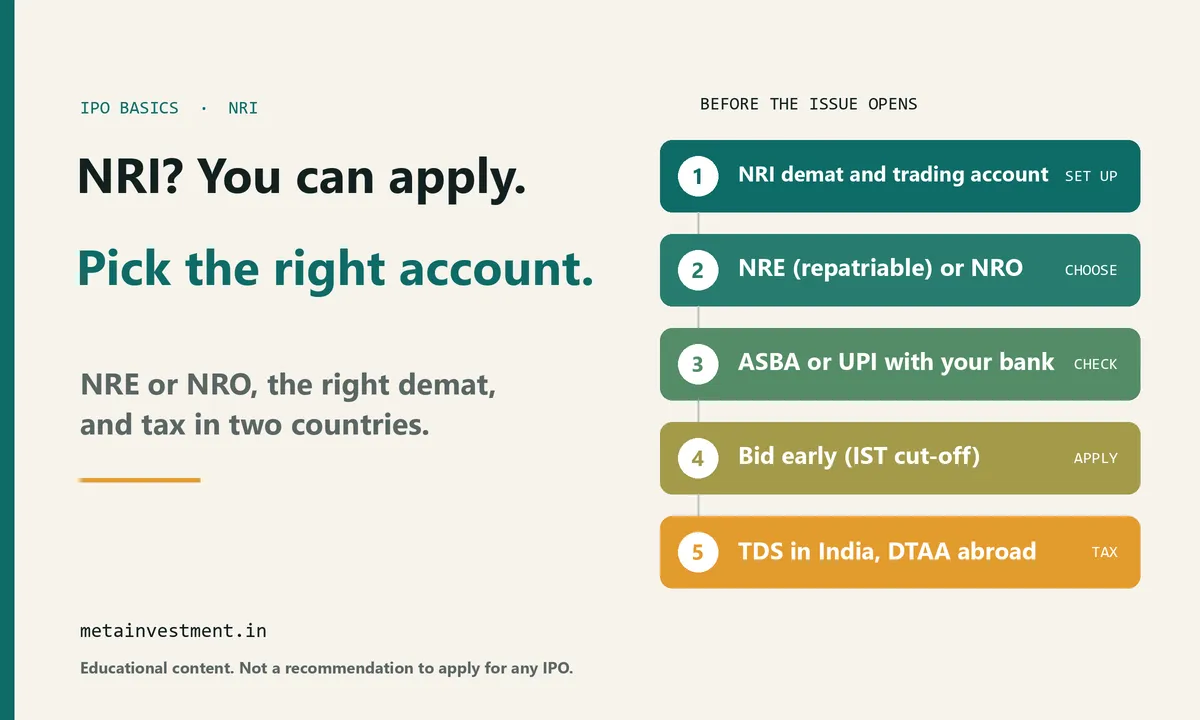
Many NRIs working in the US, UK, Gulf or Singapore watch Indian IPOs closely. When a big issue comes up, the same questions arrive on WhatsApp: "Can I apply? From which account? What about tax?"
This post answers them in order. It doesn't discuss any particular issue.
The Short Answer
NRIs can generally apply for Indian IPOs, subject to each offer document's terms. You need three things:
- An NRI demat and trading account — not your old resident account.
- An NRE or NRO bank account that supports ASBA for IPO bids.
- A PAN and completed NRI KYC with your broker and bank.
Some issues restrict non-resident applicants, often because of foreign investment limits in certain sectors. The red herring prospectus says who can apply.
NRE vs NRO for IPOs
This is the choice most NRIs get stuck on. It comes down to where the money came from and where you want the sale proceeds to go.
| Point | NRE account | NRO account |
|---|---|---|
| What money it holds | Income earned abroad, sent to India | Income earned in India — rent, dividends, pension, old savings |
| Investment basis | Repatriable | Non-repatriable |
| Sale proceeds | Can be sent abroad after tax | Stay in NRO; repatriation within RBI limits and with paperwork |
| Interest on balance in India | Tax-free in India | Taxable in India |
| Demat account linked | NRI repatriable demat | NRI non-repatriable demat |
| Good fit when | Money is from overseas earnings and may go back | Money is already in India and will likely stay |
Each row stands on its own. Many NRIs keep both accounts for exactly this reason.
What "repatriable" really means
With an NRE-funded application, if you get shares and later sell them, the proceeds after tax can be sent back abroad freely.
With an NRO-funded application, proceeds go back to the NRO account. From there, repatriation is allowed only within RBI's limit of USD 1 million per financial year, with tax forms (15CA) and a CA certificate (15CB). It's possible, but slower.
Your Demat Account Must Match Your Status
Once you become a non-resident, resident accounts should be converted or closed. Holding or applying through a resident demat after becoming an NRI isn't in line with FEMA rules.
- An NRE-linked application needs a repatriable NRI demat.
- An NRO-linked application needs a non-repatriable NRI demat.
A Portfolio Investment Scheme (PIS) permission isn't needed to apply in an IPO, but it applies when you later sell listed shares on the stock exchange. Ask your bank how it handles the sale before the issue opens. Setting up NRI accounts can take a couple of weeks — far longer than a three-day IPO window.
US and Canada residents
Fewer Indian brokers onboard US and Canada residents because of extra compliance requirements. If you live there, check broker eligibility early. Also check local tax reporting rules for foreign shares. The NRI Corner covers this in more detail.
How the Application Works for NRIs
The process is the same as for residents, with a few differences.
- ASBA through net banking is the most common route. Your NRE or NRO account blocks the bid amount.
- UPI may or may not be available. Some banks allow UPI on NRE and NRO accounts, including with certain international mobile numbers. Many NRIs still use net banking.
- Retail limit: bids up to ₹2 lakh can generally go in the retail category. Above that, the non-institutional category applies.
- One PAN, one application per category, as for everyone.
For how the block and debit work, see IPO money blocked vs debited. If you miss out, here's why that happens.
Tax: In India and Where You Live
In India
IPO shares become listed equity shares on listing. When you sell, gains are taxed based on how long you held them.
- Held 12 months or less: short-term capital gain, generally taxed at 20%.
- Held more than 12 months: long-term capital gain; gains above ₹1.25 lakh in a financial year generally taxed at 12.5%.
- Surcharge and cess apply on top.
For NRIs, tax is usually deducted at source when shares are sold. If more TDS is deducted than your actual liability, you may need to file a return in India to claim the excess back.
Residents can adjust certain gains against their unused basic exemption limit. NRIs generally can't.
Where you live
Your country of residence may also tax the gain. India has Double Taxation Avoidance Agreements (DTAAs) with many countries. Depending on the treaty and local law, you may be able to claim credit for tax paid in India.
This part varies a lot by country. Tax treatment depends on individual circumstances and prevailing law; please consult a qualified tax professional in both countries.
A Timing Checklist for NRIs
NRIs usually run into trouble with timing, not rules. Work backwards from the issue dates.
- Weeks before: confirm your NRI demat and NRE or NRO account are active, linked and enabled for IPO bids.
- Days before: check whether your bank supports ASBA or UPI for NRI accounts, and note its cut-off times in Indian Standard Time.
- During the window: place the bid early enough to fix any problem before the closing-day cut-off. Time zones make last-minute bids risky.
- After allotment: keep your allotment and contract notes for tax filing in India and abroad.
A Planning View for NRIs
An IPO is a single-company bet with uncertain allotment. For an NRI, there are extra layers: currency movement, repatriation rules and two tax systems.
A few questions are worth answering first:
- Is this money from overseas earnings that may need to go back? NRE may fit better.
- Is it money already sitting in India? NRO may be simpler.
- Do you have a plan for India-side goals — a parent's care, a future home, retirement in India?
- Is your overall India exposure already high through property or family holdings?
For broader options — including GIFT City funds for NRIs — see our Alchemy GIFT City NRI guide and the NRI Corner.
If a bonus abroad prompted the question, our bonus decision framework gives a calm order for deciding.
Key Takeaways
- NRIs can generally apply for Indian IPOs through NRE or NRO accounts and an NRI demat, subject to each offer document.
- NRE supports repatriable investment; NRO is non-repatriable, with repatriation within RBI limits.
- Resident accounts should not be used once you become an NRI.
- Setting up NRI accounts takes time, so do it well before any issue opens.
- Gains are taxed in India, usually with TDS, and may also be taxed where you live, subject to DTAA relief.
- US and Canada residents should check broker eligibility early.
Get the Plumbing Right First
For NRIs, the account set-up matters more than the bid. Get the right demat, the right bank account and the tax picture clear before any issue opens.
If you'd like help with the application process, see how our IPO application help works.
Interested in Investing? Connect with Meta Investment
Meta Investment is a financial product distribution and services firm. If you'd like to explore whether a financial product is the right fit for your portfolio, our team will walk you through the details, help you assess suitability, and guide you through the onboarding process.
Investments in the securities market are subject to market risks. Please read the red herring prospectus and all offer documents carefully before applying. This post is for educational purposes only and is not a recommendation to subscribe, or not to subscribe, to any IPO. The suitability of any investment depends on an investor's financial goals, risk appetite, investment horizon and overall financial circumstances. Tax treatment depends on individual circumstances and prevailing law; please consult a qualified tax professional. Mutual Fund investments are subject to market risks. Please read all scheme-related documents carefully before investing. As a mutual fund distributor, Meta Investment may receive commissions from Asset Management Companies. Tushar Paturde is an AMFI-registered Mutual Fund Distributor (ARN-129322) and a CFP® professional, and is not a SEBI-registered Investment Adviser or Research Analyst.
Meta Investment – Your Investment and Insurance Companion
Frequently Asked Questions
Can NRIs apply for IPOs in India?
Yes. NRIs can generally apply for Indian IPOs through an NRE or NRO bank account linked to an NRI demat account, subject to the terms in each offer document. Some issues restrict or exclude non-resident applicants, so the red herring prospectus should always be checked.
Should an NRI use an NRE or NRO account for an IPO?
It depends on where the money came from and whether you want to take sale proceeds abroad freely. NRE accounts hold money earned abroad and support repatriable investments. NRO accounts hold income earned in India and support non-repatriable investments, with repatriation subject to limits and paperwork.
What is the difference between repatriable and non-repatriable IPO investment?
A repatriable investment, funded from an NRE account, lets you transfer the sale proceeds abroad after tax. A non-repatriable investment, funded from an NRO account, keeps proceeds in the NRO account, from where repatriation is allowed only within RBI's limit of USD 1 million per financial year and with the required documentation, including Forms 15CA and 15CB.
Can an NRI use a resident demat account to apply for an IPO?
No. Once you become a non-resident, you should convert or close resident accounts and hold investments in NRI demat and bank accounts. Applying through resident accounts after becoming an NRI is not in line with FEMA rules.
Can NRIs apply in the retail category of an IPO?
Yes. NRIs who bid up to ₹2 lakh can generally apply as retail individual investors. Bids above ₹2 lakh fall in the non-institutional category. The categories open to non-residents are stated in each offer document.
Can NRIs use UPI to apply for an IPO?
It depends on the bank and broker. Some banks allow UPI on NRE and NRO accounts, including with certain international mobile numbers, while many NRIs apply through ASBA on their bank's net banking. Check with your bank and broker before the issue opens.
Do NRIs need a PIS account to apply for an IPO?
Not for the IPO application itself. SEBI's investor-education material states that a Portfolio Investment Scheme (PIS) permission is not required for IPOs. PIS applies to buying and selling listed shares on the stock exchange, so when you later sell the allotted shares, your bank may need the sale routed through a PIS account. Ask your bank how it handles this before the issue opens.
How are IPO gains taxed for NRIs in India?
Listed equity gains are taxed in India based on the holding period. Gains on shares sold within 12 months are generally short-term and taxed at 20%; gains on shares held longer are long-term, with gains above ₹1.25 lakh a year generally taxed at 12.5%, plus surcharge and cess. Tax is usually deducted at source for NRIs.
Is TDS deducted on an NRI's IPO share sale?
Yes, generally. When an NRI sells listed shares, tax is typically deducted at source on the capital gain by the broker or the bank. The TDS rate depends on whether the gain is short-term or long-term. A tax return may be needed to claim any excess back.
Will I be taxed twice on IPO gains as an NRI?
Not necessarily. India has Double Taxation Avoidance Agreements with many countries. Depending on the treaty and your country's rules, you may be able to claim credit abroad for tax paid in India. The outcome depends on your country of residence.
Can US or Canada based NRIs apply for Indian IPOs?
Generally yes, but fewer Indian brokers onboard US and Canada residents because of extra compliance requirements. US and Canada residents should also check local tax reporting rules for foreign shares before applying.
Is the ₹1.25 lakh LTCG exemption available to NRIs?
The ₹1.25 lakh annual exemption on long-term gains from listed equity is generally available to NRIs as well. However, NRIs cannot set off capital gains against the basic exemption limit the way residents can. Confirm the current position with a tax professional.
Can NRIs apply for IPOs with a joint account?
The first holder's PAN and details are used for the application. The demat and bank account must belong to the applicant. Joint holding rules and the treatment of a resident joint holder should be checked with the bank and broker.
Are some IPOs closed to NRIs?
Some issues restrict non-resident participation, for example because of foreign investment limits in certain sectors. The red herring prospectus states who is eligible to apply, so check it before placing a bid.
What documents does an NRI need to apply for an IPO?
You generally need a PAN, an NRI demat and trading account, an NRE or NRO bank account that supports ASBA, KYC documents including passport and overseas address proof, and FATCA declarations. Your broker and bank will list their exact requirements.


Mutual fund updates, SIP tips, and what's moving the market. No daily noise — only when there's something worth reading.
Read more about
- Taxation on Liquid Funds - Updated for Finance Bill 2023 (Budget 2023)
- A Comprehensive Guide to Save Tax with Insurance in India
- All About AIFs (Alternative Investment Funds)
- Lucrative Investment Opportunities Options for NRIs in India
- PMS in India: A Guide to Portfolio Management Services
- Using Capital Gains Bonds in India to Maximizing Wealth Growth
- The Tax Harvesting Garden - Cultivating Wealth with Care
- Invest in this Nifty 50 Index Fund to Save Tax
- A Fresh Perspective on Portfolio Management Services (PMS) for NRI/HNI Investors
- Abans Global Arbitrage Fund: A Deep Dive
- Boost Your Retirement Savings with Enhanced NPS Benefits in Budget 2024
- Taxation- Capital Gains- Revised Rates vs Previous Rate
- Equity Linked Savings Schemes
- How to Become an Accredited Investor in India: A Guide for HNIs | SEBI Framework
- Estate Planning in India: Wills, Trusts & Tax Tips for NRIs & Residents
- Mutual Will: Why Married Couples Must Have One | Estate Planning Guide
- Understanding Beneficial Nominee in Insurance & Its Role in Estate Planning
- NRI Mutual Fund Taxation: How DTAA Can Save You Tax (Anushka Shah Case)
- Mirae Asset Global Allocation Fund - Invest in Global Markets via GIFT City | Tax Benefits for NRIs & HNIs
- HDFC Life Click 2 Achieve – Guaranteed Savings Plan with Life Cover
- The Power of a No-Contest Clause: How Ratan Tata's Will Prevented a Legal Battle
- India Surpasses Japan to Become 4th Largest Economy in 2025 | Growth & Challenges
- Diviniti Equity Long Short Fund NFO 2025 | Investment for Indian HNIs & NRIs
- The Investor and The Distributor: A Lesson on SIP Discipline
- Financial Wellness for Men: Boost Health with Smart Investing, SIP & Retirement Planning
- Kotak Market Outlook 2026: India Equity, Debt, Gold & Silver
- US Fed Holds Rates: What It Means for Gold, Silver & the Rupee
- Pune on India's Wealth Map: What the 2026 List Reveals
- Fed Rate Hike 2026: What It Means for Indian MF Investors
- Alchemy India Long Term Fund: GIFT City Guide for NRIs
- Navratri to Diwali 2026: Your Festive-Season Money Calendar
- Got a Bonus? Jio IPO or SIP: A Simple Decision Framework
- Gold FoF Pause: What It Means for Your Gold SIP
- GIFT City Funds vs International Funds of Funds: Key Differences
- भारतात एस्टेट प्लॅनिंग: NRI आणि रहिवाशांसाठी इच्छापत्र, ट्रस्ट आणि कर टिप्स
- म्युच्युअल विलः विवाहित जोडप्यांसाठी का आवश्यक? | एस्टेट प्लॅनिंग मार्गदर्शक
- विमा योजनांमध्ये लाभार्थी नामनिर्देशित व्यक्ती (बेनिफिशियरी नॉमिनी) आणि एस्टेट प्लॅनिंगमधील त्याची भूमिका
- NRI म्युच्युअल फंड कर: DTAA मदतीने कसे कर बचत करू शकता (अनुष्का शहा केस)
- मिराए अॅसेट ग्लोबल अलोकेशन फंड - गिफ्ट सिटी मार्गे जागतिक बाजारात गुंतवणूक | एनआरआय आणि एचएनआय साठी कर फायदे
- HDFC Life Click 2 Achieve – निश्चित बचत योजना आणि जीवन विमा संरक्षण
- स्काय वन कॉर्पोरेट पार्क: HNIs आणि NRIs साठी एक उत्तम गुंतवणूक संधी
- नवरात्री ते दिवाळी 2026: सणासुदीच्या काळातील आर्थिक दिनदर्शिका
- बोनस मिळाला? Jio IPO की SIP: निर्णय घेण्याची सोपी पद्धत
- Gold FoF ला तात्पुरता ब्रेक: तुमच्या गोल्ड SIP वर काय परिणाम?
- NRI भारतीय IPO साठी अर्ज करू शकतात का? NRE आणि NRO मधील फरक
Related Posts

This communication is intended solely for general educational and informational purposes. The information provided is general in nature and does not take into account the specific financial goals, risk profile, investment horizon, financial circumstances or other requirements of any particular investor. It should not be construed as personalised investment advice or as a recommendation to buy, sell or hold any specific financial product.
International investments may carry currency/exchange-rate, foreign-market, geopolitical, taxation, regulatory, remittance and liquidity risks.
Distributor Disclosure: Where this content is provided by a distributor/intermediary, any applicable commission, remuneration, affiliation or other material conflict of interest shall be disclosed separately. The availability of a product through the distributor does not by itself imply that the product is suitable for every investor.
No Guarantee: No statement on this page should be interpreted as a promise, assurance or guarantee of returns or investment outcomes.
Meta Investment – Your Investment and Insurance Companion