IPO Money Blocked vs Debited: What Actually Happens
When you apply for an IPO, your money doesn't leave your bank account straight away. It gets blocked, and what happens next depends on the allotment. Here is the full journey, step by step.
A large IPO is in the news, and many people are applying for the first time. The most common question we hear is simple: "Has my money gone?"
The short answer is no. It has been blocked. That one word explains most of the IPO payment process.
Blocked Is Not the Same as Debited
Think of a hotel booking. The hotel puts a hold on your card at check-in. The money is still yours, but you can't spend it. At checkout, the actual bill is charged and the rest of the hold is released.
An IPO application works in a similar way.
- Blocked means the bid amount stays in your bank account, but it is frozen. You can't spend it, transfer it or use it for an EMI.
- Debited means the money actually leaves your account and goes to the issue. This happens only for shares you are allotted.
Until allotment is decided, nothing is debited.
ASBA and the UPI Mandate: Two Ways to Block
SEBI requires every IPO application to be supported by a blocked amount. This is called ASBA — Application Supported by Blocked Amount. There are two common ways to set it up.
1. ASBA through net banking. You apply from your bank's net banking or app. The bank blocks the amount directly in your account.
2. UPI mandate through a broker. You place the bid with your stock broker. A mandate request is then sent to your UPI app. When you approve it with your UPI PIN, your bank blocks the amount.
If you're an individual bidding up to ₹5 lakh through a broker, depository participant or registrar, SEBI requires you to use UPI. Your UPI app may have its own, separate limit for IPO mandates. Check it before the window opens, not on the last afternoon.
A bid without an approved mandate is not a valid bid. Since September 2022, stock exchanges accept an IPO bid only once the money is confirmed as blocked. Placing the order in the broker app is only half the job.
The Full Timeline: Bid to Credit
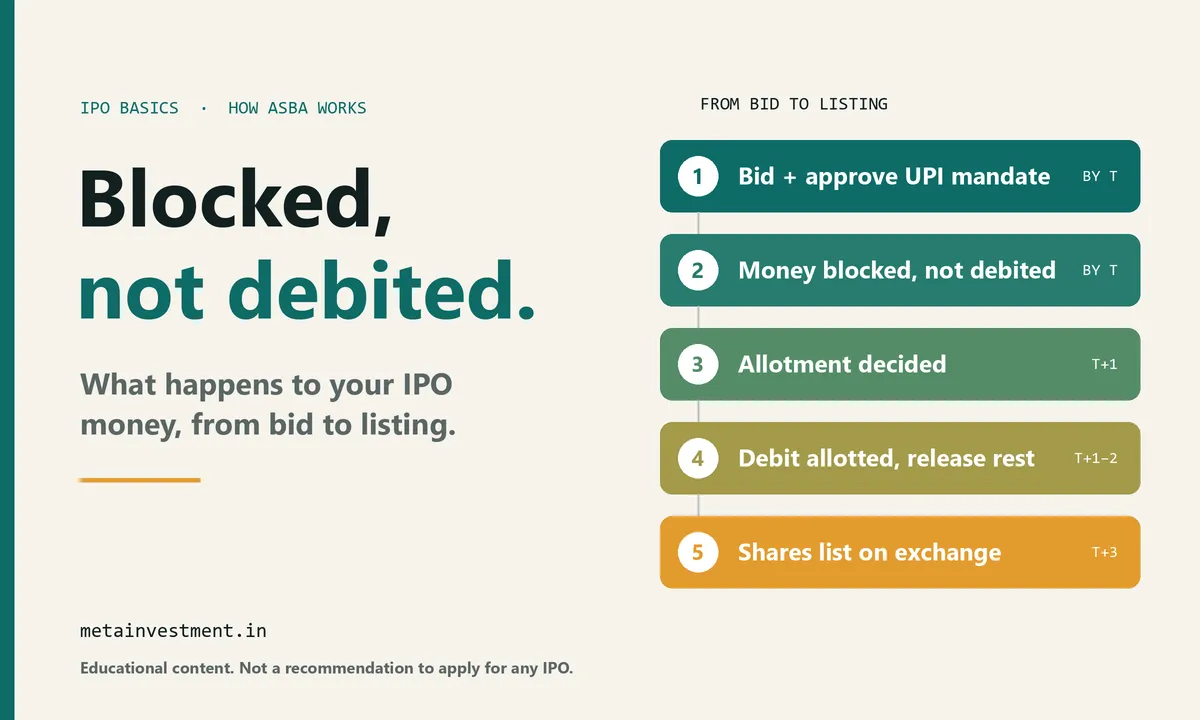
SEBI's T+3 timeline has been mandatory since 1 December 2023. "T" is the day the issue closes. Here is how one application moves through it.
- Bid (during the subscription window). You place a bid in lots within the price band, usually over three working days.
- Block (same day or soon after). You approve the UPI mandate, or your bank blocks the amount through ASBA. The money stays in your account, frozen.
- Issue closes (T). No new bids or changes after the cut-off. The UPI mandate must be approved before the cut-off on this day.
- Allotment (T+1). The registrar and stock exchange finalise the basis of allotment. If the issue is oversubscribed, retail allotment is usually decided by lottery.
- Debit or release (T+1 to T+2). If you got shares, only that amount is debited. If you got fewer shares, the rest is released. If you got none, the whole block is released.
- Credit (around T+2). Allotted shares are credited to your demat account.
- Listing (T+3). The shares start trading on the stock exchange.
Each issue's exact dates are printed in its offer document and issue advertisements.
Three Possible Outcomes
Once allotment is decided, your blocked amount goes one of three ways.
| Your allotment | What gets debited | What gets released |
|---|---|---|
| Full allotment | Full bid amount | Nothing |
| Partial allotment | Amount for allotted shares only | The balance |
| No allotment | Nothing | The full blocked amount |
In a heavily oversubscribed issue, "no allotment" is the most common outcome for retail applicants. That isn't an error. It's how the lottery works.
A worked example
Hypothetical numbers, for illustration only.
Anita bids for 1 lot of 13 shares at ₹1,100 each. Her bank blocks ₹14,300.
- If she is allotted 13 shares, ₹14,300 is debited.
- If she is not allotted any shares, the full ₹14,300 is released.
Retail allotment is usually in whole lots. Partial allotment is more common when someone bids for several lots in a less heavily subscribed issue.
What You Can't Do While Money Is Blocked
The blocked amount is out of reach for a few days. Plan around that.
- Upcoming SIP debits or EMIs. If they fall during the IPO window, keep enough free balance for them as well. A bounced SIP or EMI costs more than it seems.
- Large payments. Rent, school fees or a planned purchase in the same week need their own balance.
- Another application from the same PAN. Only one application per PAN is valid in a category. A second one can get both rejected.
Money that is earmarked for a goal, or for a payment due this week, is usually better left out of an IPO bid.
Common Mistakes With the Mandate
Most "money stuck" panic comes from a few small mistakes.
- Not approving the mandate. The bid is placed, but the UPI request is ignored. The bid is not valid.
- Approving after the cut-off. On the closing day, mandates approved after the cut-off time are not considered.
- Wrong UPI ID. If the UPI ID entered in the bid is wrong, the mandate goes nowhere.
- Someone else's UPI ID or bank account. Using a family member's UPI ID or bank account for your application can lead to rejection.
- Mandate amount above your UPI app's limit. The request fails. Check the limit beforehand.
If something looks wrong, open the mandates section of your UPI app first. It shows whether the request is pending, approved, revoked or completed.
How to Check the Release
After allotment, three places tell you what happened.
- Your bank SMS. Banks are required to send an SMS when the amount is blocked, debited or unblocked.
- Your UPI app. The mandate status changes to completed (debited) or revoked (released).
- The registrar's website. Every issue has a registrar. Its allotment-status page shows whether you got shares.
If the registrar says "not allotted" and your money is still blocked a couple of working days later, contact your bank and the registrar.
Key Takeaways
- IPO money is blocked in your own account, not debited, until allotment is final.
- ASBA through net banking and a UPI mandate through a broker are the two common ways to block.
- A bid is valid only after the UPI mandate is approved, before the closing-day cut-off.
- Only the amount for allotted shares is debited; everything else is released.
- Under T+3, shares list three working days after the issue closes.
- Keep enough free balance for SIPs, EMIs and bills during the IPO window.
Before the Window Opens
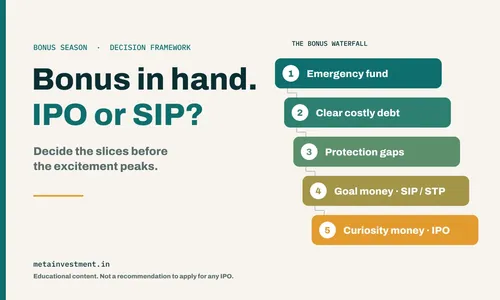
The mechanics are the easy part. The harder question is whether an IPO fits your plans at all, and how much of your money it deserves. If you're working that out with a fresh bonus, our bonus decision framework sets out a calm order to follow.
If you'd like help with the application process, see how our IPO application help works.
Interested in Investing? Connect with Meta Investment
Meta Investment is a financial product distribution and services firm. If you'd like to explore whether a financial product is the right fit for your portfolio, our team will walk you through the details, help you assess suitability, and guide you through the onboarding process.
Investments in the securities market are subject to market risks. Please read the red herring prospectus and all offer documents carefully before applying. This post is for educational purposes only and is not a recommendation to subscribe, or not to subscribe, to any IPO. The suitability of any investment depends on an investor's financial goals, risk appetite, investment horizon and overall financial circumstances. Mutual Fund investments are subject to market risks. Please read all scheme-related documents carefully before investing. As a mutual fund distributor, Meta Investment may receive commissions from Asset Management Companies. Tushar Paturde is an AMFI-registered Mutual Fund Distributor (ARN-129322) and a CFP® professional, and is not a SEBI-registered Investment Adviser or Research Analyst.
Meta Investment – Your Investment and Insurance Companion
Frequently Asked Questions
Is my money debited when I apply for an IPO?
No. When you apply for an IPO through ASBA or a UPI mandate, the bid amount is blocked in your own bank account. It stays in your account but you cannot spend it until the allotment is finalised. Only the amount for shares actually allotted is later debited.
What does ASBA mean in an IPO?
ASBA stands for Application Supported by Blocked Amount. It is the SEBI-mandated way to pay for an IPO bid. Instead of sending money to the company, you authorise your bank to block the bid amount in your account until allotment is decided.
What is a UPI mandate in an IPO application?
A UPI mandate is a request sent to your UPI app after you place an IPO bid through a broker. When you approve it with your UPI PIN, your bank blocks the bid amount. If you do not approve it before the cut-off time, the bid is not valid.
Does blocked IPO money earn interest?
Blocked money stays in your savings account, so it generally continues to earn the account's normal savings interest until it is debited or released. Confirm the exact treatment with your bank.
When is the IPO block released if I don't get shares?
Under SEBI's T+3 timeline, where T is the issue closing day, the basis of allotment is finalised on T+1 and instructions to debit or unblock funds are issued soon after. In most cases the block is released within a day or two of allotment, before the shares list.
What happens to my money if I get a partial allotment?
If you receive fewer shares than you bid for, only the amount for the allotted shares is debited. The balance of the blocked amount is released back into your account for normal use.
Can I use blocked IPO money for other payments?
No. While the amount is blocked, it is not available for other payments, EMIs, SIP debits or UPI transfers. Keep enough free balance for any payments due during the IPO window.
What is the UPI limit for IPO applications?
Individual investors bidding up to ₹5 lakh through a broker, depository participant or registrar must use UPI, under a SEBI circular in force since May 2022. Your bank or UPI app may also have its own limit for IPO mandates, so check it in the app before the subscription window opens.
What is the cut-off time to approve an IPO UPI mandate?
The UPI mandate must be approved before the cut-off on the issue closing day, which has generally been 5 pm. A bid whose mandate is not approved in time is not considered. Check the time stated in the offer document for each issue.
Why does my UPI app show the IPO mandate as pending?
A pending mandate means it has been sent but not yet approved. Open the mandates section of your UPI app, check the amount and IPO name, and approve it with your PIN before the cut-off. If no mandate appears, check the UPI ID entered in your bid.
Can I cancel or modify an IPO bid after the money is blocked?
You can usually modify or cancel a bid during the subscription window through the same broker or bank platform. A cancelled bid releases the block. After the issue closes, bids cannot be changed.
How do I know my IPO block has been released?
Your bank is required to send an SMS when the blocked amount is released, and your UPI app's mandates section shows the mandate as revoked or completed. Your available balance in the bank account will also go back up.
When will IPO shares appear in my demat account?
Under the T+3 timeline, allotted shares are credited to your demat account before listing, usually around T+2, and trading starts on T+3. The exact dates are given in the offer document and issue advertisements.
What is the T+3 timeline for IPOs?
SEBI made the T+3 listing timeline mandatory for public issues opening from 1 December 2023. T is the issue closing day. Allotment, debit or release of funds and share credit happen in the days after T, and shares start trading on T+3.
What should I do if the blocked amount is not released?
First check the allotment status on the registrar's website and your bank SMS. If you got no allotment and the amount is still blocked after the expected date, contact your bank and the registrar. If the issue is not resolved, you can escalate through SEBI's SCORES portal.


Mutual fund updates, SIP tips, and what's moving the market. No daily noise — only when there's something worth reading.
Read more about
- 7-Day Plan for Indian Women to Kickstart Their Financial Journey: From Scarcity to Abundance
- New SEBI-Validated UPI IDs: Secure Payments for Investors Explained
- ManipalCigna Sarvah Uttam Health Insurance Plan: Comprehensive Coverage with Unique Benefits
- Mutual Funds Are the New Status Symbol (Not Your Bank Balance)
- Mutual Fund Scheme Name Changes in India (2025) – Complete List & Reasons
- From Freedom Fighters to Financial Freedom: Gen Z Investing & Independence Day Lessons
- All Weather Gold: A Principal-Protected Way to Bet on Gold (Until Aug 31)
- ESAF SFB NCD Issue: 11.30% Coupon | Basel II Compliant Bonds
- Begin Your Wealth Journey This Ganesh Chaturthi: Ganpati-Inspired Mutual Fund Lessons
- Tata AIA Health SIP Review 2025: A Smart Health + Investment Plan?
- NPCI Raises UPI Transaction Limits: A Complete Guide to High-Value Payments from Sept 2025
- NPS Swasthya Explained: Wait for the Health-Linked Pension, or Buy Health Cover Now?
- AMFI Stock Reclassification: What It Means for Your Fund
- FTSE India Index Explained: What It Is & Why It Matters Now
- Tata Mumbai Marathon 2027 Fee Is ₹5,000: How to Budget for It
- Pune on India's Wealth Map: What the 2026 List Reveals
- Emergency Fund: The Money That Buys the Right to Say No
- The 8 Freedoms Checklist for Financial Independence
- How to Check an Insurer's Complaint Record Before You Buy
- Your Increment Came Through. Did Your SIP?
- PFRDA's New NPS Scheme Categories: What Actually Changed
- SEBI Mandatory Nomination Rules for Demat and MF Folios
- Financial Green Flags That Matter More Than Salary
- Record SIP Inflows in a Falling Month: Reading August's AMFI Data
- UPI Charges Above ₹2,000: What Changes on October 15
- Navratri to Diwali 2026: Your Festive-Season Money Calendar
- NPS Sanchay Explained: Who It Is For and How It Differs
- RBI Hikes Repo Rate to 5.50%: What It Means for Your EMI and FD
- Got a Bonus? Jio IPO or SIP: A Simple Decision Framework
- महिलांसाठी आर्थिक यशस्वीतेची 7-दिवसीय नियोजन: टंचाईपासून विपुलतेकडे
- SEBI चे नवीन '@valid' UPI ID: गुंतवणूकदारांसाठी सुरक्षित पेमेंट्स
- एप्रिल २०२५ पासून भारतातील म्युच्युअल फंड स्कीमच्या नावातील बदल - संपूर्ण यादी आणि कारणे
- Demat आणि MF Folio साठी SEBI चे अनिवार्य Nomination नियम
- ₹2,000 वरील UPI शुल्क: 15 ऑक्टोबरपासून काय बदलते
- नवरात्री ते दिवाळी 2026: सणासुदीच्या काळातील आर्थिक दिनदर्शिका
- NPS Sanchay सोप्या भाषेत: कोणासाठी आणि इतर NPS पेक्षा वेगळे कसे
- RBI ने रेपो दर 5.50% केला: तुमच्या EMI आणि FD वर काय परिणाम?
- बोनस मिळाला? Jio IPO की SIP: निर्णय घेण्याची सोपी पद्धत
- IPO चे पैसे ब्लॉक होतात की कापले जातात? प्रत्यक्षात काय होते
Related Posts

This communication is intended solely for general educational and informational purposes. The information provided is general in nature and does not take into account the specific financial goals, risk profile, investment horizon, financial circumstances or other requirements of any particular investor. It should not be construed as personalised investment advice or as a recommendation to buy, sell or hold any specific financial product.
Mutual Fund investments are subject to market risks. Please read all scheme-related documents carefully before investing. Past performance is not indicative of future results and may not be sustained.
The suitability of any mutual fund product, scheme, category or strategy discussed on this page depends on an investor's individual circumstances, including financial goals, risk appetite, investment horizon and liquidity requirements. Investors should independently assess suitability and, where appropriate, seek professional advice before making investment decisions.
Meta Investment is an AMFI-registered Mutual Fund Distributor (ARN-129322) and is not a SEBI-registered Investment Adviser. If investments are made through a mutual fund distributor, the distributor may receive commission from Asset Management Companies in respect of eligible Regular Plan investments. Commission structures may vary across schemes and AMCs. Such commissions should not influence suitability-based recommendations, and applicable conflicts of interest will be disclosed. Please refer to our Commission Disclosure for further details.
Tax treatment of mutual fund investments depends on individual circumstances and prevailing tax laws, which are subject to change. Investors should consult a qualified tax professional for advice specific to their circumstances.
This disclaimer is intended to provide general disclosure and does not replace any scheme-specific disclosures, risk factors, regulatory disclosures or information contained in the applicable Scheme Information Document (SID), Statement of Additional Information (SAI) and Key Information Memorandum (KIM).
Distributor Disclosure: Where this content is provided by a distributor/intermediary, any applicable commission, remuneration, affiliation or other material conflict of interest shall be disclosed separately. The availability of a product through the distributor does not by itself imply that the product is suitable for every investor.
No Guarantee: No statement on this page should be interpreted as a promise, assurance or guarantee of returns or investment outcomes.
Meta Investment – Your Investment and Insurance Companion