GIFT City Funds vs International Funds of Funds: Key Differences
Indian investors can now reach the same kind of global stocks through two very different wrappers. The holdings may overlap. The rules, costs, tax and paperwork do not.
In late October 2026, Jio BlackRock International AMC (IFSC) launched the JioBlackRock Advantage World Equity Fund (IFSC) — an open-ended fund of funds based in GIFT City that invests in a global developed-market equity fund. It is one of the first GIFT City funds set up as a retail scheme aimed at resident Indians.
The question many investors are asking is simple: I can already buy an international fund in India. Why does this exist, and is it the same thing?
This post uses the launch as a dated example to explain how the two routes differ. It is not a view on the fund, and it does not suggest either route is better. Fund details below come from the fund house's launch presentation and should be confirmed in the offer document.
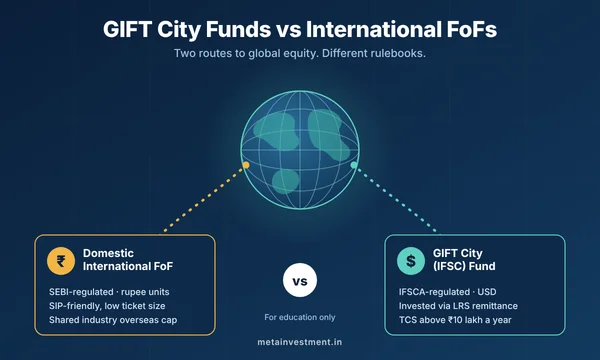
Two Routes, One Goal
Route A: Domestic international fund of funds
- A SEBI-regulated Indian mutual fund scheme that invests in overseas funds or securities.
- Units are in rupees. The fund house handles currency conversion.
- Low ticket sizes and SIPs are generally available when the scheme is open.
- Subject to an industry-wide overseas investment cap shared by every Indian fund house.
Route B: GIFT City (IFSC) outbound fund
- Set up in the International Financial Services Centre and regulated by IFSCA, not SEBI.
- Investment is typically in US dollars, remitted by the investor.
- Higher minimums — USD 5,000 initial and USD 1,000 additional for the JioBlackRock fund.
- Sits outside the domestic mutual fund overseas cap, but each investor's money moves under their personal Liberalised Remittance Scheme (LRS) limit.
Both routes can end up owning the same global companies. The difference is the wrapper — and the wrapper decides how money gets in, what it costs, how gains are taxed, and where a grievance goes.
Side-by-Side Comparison
| Feature | Domestic international FoF | GIFT City (IFSC) outbound fund |
|---|---|---|
| Regulator | SEBI | IFSCA |
| Currency of investment | Indian rupee | Usually US dollar |
| How money goes in | Normal rupee payment | LRS remittance from a bank account |
| Typical minimum | Low; SIP-friendly | Higher; e.g. USD 5,000 initial, USD 1,000 additional |
| SIP availability | Generally yes, when open | Check offer document; each top-up is typically a remittance |
| Industry overseas cap | Yes — USD 7 bn for MFs, USD 1 bn for ETFs | No fund-level cap per fund house; personal LRS limit applies |
| TCS at entry | Not applicable | Applies to LRS remittances above ₹10 lakh a year |
| Taxation | Indian mutual fund rules for non-equity-oriented FoFs | Per scheme document; trust-level taxation possible |
| Grievance route | AMC, then SEBI SCORES | FME, then IFSCA |
Why the Plumbing Matters
The domestic cap can interrupt a SIP
Indian mutual funds as a group can invest only up to USD 7 billion overseas, with a separate USD 1 billion limit for overseas ETFs. Every rupee in an international scheme draws from that single shared pool.
When the pool runs low, fund houses pause fresh lump sums and new SIP registrations. In some cases, even SIP instalments registered earlier are suspended until headroom returns. Several fund houses paused, capped or reopened international schemes at different points in 2026.
For an investor, the practical effect is that a regular investment plan into global equity can stop for months for reasons unrelated to the investor or the fund's performance.
The GIFT City route runs through LRS
Under LRS, a resident individual can remit up to USD 2,50,000 per financial year for permitted purposes. A GIFT City investment counts towards this limit — the same limit that covers overseas travel, a child's foreign education, gifts to relatives abroad and direct foreign stock purchases.
Two points are worth checking before using this route:
- TCS above ₹10 lakh. Tax Collected at Source applies once a person's total LRS remittances in a financial year cross ₹10 lakh. For investment remittances, current reported rules apply 20% on the excess. TCS is adjustable against income tax or refundable through the return, but it ties up cash until then.
- Family-level planning. If a household is also funding overseas education or travel in the same year, the threshold and the limit are shared, not separate.
For entities such as corporates, LLPs and family offices, the presentation describes a separate Overseas Portfolio Investment (OPI) route, with a limit linked to net worth.
Reading the Cost of a Feeder Fund
A fund of funds has two cost layers — the feeder scheme and the underlying fund it buys into.
For the JioBlackRock IFSC fund, the launch presentation shows:
- Indicative TER: 0.90% (Direct Plan) and 1.40% (Regular Plan).
- A footnote stating that this indicative TER includes the fees of the underlying scheme.
- The underlying fund's own ongoing charge listed at 0.40% for its D USD share class.
- Nil exit load at launch — a feature of this scheme, not a rule for the category.
"Indicative" matters. The actual TER is published after the NFO and can differ, within the maximum stated in the offer document.
The difference between Direct and Regular plans is distribution cost. A Regular plan includes a commission paid to the distributor; a Direct plan does not.
What Sits Inside This Particular Fund
As an example of what a GIFT City feeder can hold, the presentation describes:
- 90–100% in units of BlackRock Advantage World Equity Fund, an Ireland-domiciled UCITS fund; up to 10% in temporary money-market-type investments.
- Benchmark: MSCI World Index.
- Style: actively managed using a systematic, model-driven approach, targeting around 2% tracking error against the benchmark.
- Geographic tilt: about 72% United States, with Japan and Europe making up most of the rest; information technology was the largest sector, as of 30 September 2026.
Two cautions apply. First, a heavy US and technology weighting means global diversification here is still concentrated in one market and one sector. Second, the feeder is new. The underlying fund's history excludes the feeder's own costs, trust-level tax and the investor's currency conversion, and the presentation itself notes that the underlying fund's INR returns are shown gross of fees. Past performance may or may not be sustained in the future.
How Tax Treatment Differs
Domestic international FoFs
These are taxed under Indian mutual fund rules for funds that are not equity-oriented. The holding-period and rate rules for this category have changed more than once in recent budgets, so the current position for a specific purchase date is worth confirming.
GIFT City outbound fund (as presented)
- Short-term: redemption within 24 months — 30%, excluding surcharge and cess.
- Long-term: redemption after 24 months — 12.5%, excluding surcharge and cess.
- The scheme is a trust, and certain income may be taxed at the trust level. The presentation notes this may result in a higher effective tax than if the investor had bought the underlying investment directly.
- The presentation also states that the structure avoids the US estate tax exposure that can arise when non-US persons hold US assets directly.
Tax treatment depends on individual circumstances and prevailing law. A qualified tax professional is the appropriate reference before relying on any of the above.
Seven Questions to Ask Before Looking at Any Overseas Fund
- Who regulates it, and where does a grievance go? SEBI for domestic schemes, IFSCA for GIFT City funds.
- What currency is the investment in, and how will USD-INR movement show up in returns? A dollar fund changes currency exposure; it does not remove it.
- What is the total cost across both layers? Check whether the stated TER already includes the underlying fund's fees.
- How does money get in, and what does it do to this year's LRS limit and TCS for the family?
- How is it taxed, and does a tax professional agree with the scheme document's view?
- Can I invest regularly, or is each top-up a separate remittance? And can the domestic route pause my SIP if the industry cap is reached?
- Is it active or passive, what is the benchmark, and how concentrated is it by country and sector?
What This Launch Does and Does Not Tell You
It does show that fund houses are now building retail-style GIFT City products for resident Indians, creating a second access route when domestic international schemes are capacity-constrained.
It does not indicate suitability, expected returns, or that anyone needs to move money. It is one launch, early in its life, described here from the fund house's own presentation. NFO dates, final eligibility and the actual TER should be confirmed in the offer document.
The larger question is not which wrapper to use. It is whether a global equity allocation belongs in a particular plan, how large it would be, and how it interacts with existing assets, future foreign-currency expenses and taxes. The suitability of any investment category depends on an investor's financial goals, risk appetite, investment horizon and overall financial circumstances. A risk profiling exercise is a practical starting point.
Key Takeaways
- Domestic international FoFs and GIFT City outbound funds can hold similar global stocks but operate under different regulators and rulebooks.
- Domestic schemes are rupee-based and SIP-friendly, but the shared USD 7 billion industry cap can pause subscriptions.
- GIFT City funds sit outside that cap, but resident individuals invest through LRS, with its USD 2,50,000 annual limit and TCS above ₹10 lakh.
- Feeder funds carry two cost layers; check whether the stated TER includes the underlying fund.
- Tax treatment differs by route, and trust-level taxation can raise the effective tax in an IFSC fund.
- A dollar-denominated investment still carries currency risk for a rupee-spending household.
Before Choosing a Route
Same goal, two rulebooks. Regulator, currency, ticket size, SIP access and tax treatment are the differences to understand before anything else. If you are working out whether global equity has a place in your plan, and through which route, that is a conversation worth having.
Interested in Investing? Connect with Meta Investment
Meta Investment is a financial product distribution and services firm. If you'd like to explore whether a financial product is the right fit for your portfolio, our team will walk you through the details, help you assess suitability, and guide you through the onboarding process.
This post is for educational purposes only and is not investment advice, an offer, or a recommendation to invest in any scheme, including the fund named above. Fund details are taken from the fund house's launch presentation and are as of 29 October 2026; please read the offer document and all scheme-related documents carefully before investing.
Mutual Fund investments are subject to market risks. Please read all scheme-related documents carefully before investing. Investments in IFSC funds are subject to market risks, including currency risk and possible loss of principal. Past performance may or may not be sustained in the future.
Meta Investment is an AMFI-registered Mutual Fund Distributor (ARN-129322) and APMI-registered PMS Distributor (APRN01448), and is not a SEBI-registered Investment Adviser. If investments are made through a distributor, the distributor may receive commissions or distribution fees from Asset Management Companies or Fund Management Entities. Such commissions should not influence suitability-based recommendations.
LRS limits, TCS rates and tax treatment are subject to change and depend on individual circumstances. Please confirm current rules with your bank and a qualified tax professional.
Meta Investment – Your Investment and Insurance Companion
Frequently Asked Questions
What is a GIFT City fund?
A GIFT City fund is an investment scheme set up in the International Financial Services Centre (IFSC) at Gandhinagar, Gujarat, and regulated by the International Financial Services Centres Authority (IFSCA) rather than SEBI. Outbound GIFT City funds take money from investors, typically in US dollars, and invest it in overseas securities or in an overseas fund.
Is a GIFT City fund the same as an international fund of funds in India?
No. A domestic international fund of funds is a SEBI-regulated Indian mutual fund scheme with rupee-denominated units that invests overseas within an industry-wide limit. A GIFT City outbound fund is IFSCA-regulated, usually accepts investments in US dollars, and for resident individuals is funded through the Liberalised Remittance Scheme. Both can end up holding similar global stocks, but the regulator, currency, ticket size, tax treatment and access rules differ.
Can resident Indians invest in a GIFT City fund?
Yes, for funds registered to accept them. According to the JioBlackRock launch presentation, resident individuals typically invest in GIFT City funds through the Liberalised Remittance Scheme (LRS), while Indian entities such as corporates, LLPs and family offices use the Overseas Portfolio Investment (OPI) route. Eligibility for any specific scheme is set out in its offer document.
What is LRS and how does it apply to GIFT City funds?
The Liberalised Remittance Scheme of the RBI allows a resident individual to remit up to USD 2,50,000 per financial year for permitted purposes, including overseas investment. Money moving from an Indian rupee account into a GIFT City fund is treated as an LRS remittance, so it counts against the same annual limit as overseas travel, education, gifts and other foreign spending.
Is TCS charged when investing in a GIFT City fund?
Tax Collected at Source applies to LRS remittances above ₹10 lakh in a financial year, aggregated across all purposes. For investment remittances, widely reported current rules apply 20% TCS on the amount above that threshold. TCS is not a final tax; it can be adjusted against income tax liability or claimed as a refund in the return. Current rates should be confirmed with the remitting bank or a tax professional.
Why do domestic international funds sometimes stop accepting new investments?
The Indian mutual fund industry as a whole can invest only up to USD 7 billion in overseas securities, with a separate USD 1 billion limit for overseas ETFs. When the shared headroom runs low, fund houses pause fresh lump sums, new SIPs and sometimes existing SIP instalments until room opens up again. Several fund houses paused or capped such inflows at different points during 2026.
Do GIFT City funds face the same SEBI overseas limit?
According to the fund house's presentation, an IFSC outbound fund does not have a regulatory limit at the fund level, because it sits outside the domestic mutual fund industry's overseas cap. The binding limit for a resident individual is instead the personal LRS ceiling of USD 2,50,000 a year.
Can I start a SIP in a GIFT City fund?
Domestic international funds of funds generally allow SIPs from small amounts when they are open for subscriptions. For GIFT City funds, each investment usually requires a separate foreign-currency remittance, and minimums are higher, for example USD 5,000 initial and USD 1,000 additional for the JioBlackRock IFSC fund. Whether a systematic facility exists for a particular scheme should be checked in its offer document.
What is the minimum investment in the JioBlackRock Advantage World Equity Fund (IFSC)?
The fund house's launch presentation lists a minimum initial investment of USD 5,000 and a minimum additional investment of USD 1,000, with nil exit load. These details are as presented at launch and should be confirmed in the scheme's offer document.
How is a GIFT City outbound fund taxed for resident Indians?
The JioBlackRock presentation indicates short-term capital gains at 30% if units are redeemed within 24 months and long-term capital gains at 12.5% after 24 months, excluding surcharge and cess. It also notes that the scheme is a trust and certain income may be taxed at the trust level, which may result in a higher effective tax than direct investment. Individual treatment should be confirmed with a qualified tax professional.
What does indicative TER mean for a feeder fund?
A feeder fund has two cost layers, the feeder itself and the underlying fund it invests in. For the JioBlackRock IFSC fund, the presentation states an indicative total expense ratio of 0.90% for the Direct Plan and 1.40% for the Regular Plan, and its footnote says this figure includes the fees of the underlying scheme. Indicative TER is not the actual TER, which is published after the NFO.
Does a USD-denominated fund remove currency risk?
No. A US dollar fund converts currency risk rather than removing it. For an Indian resident whose expenses are in rupees, returns depend on both the underlying global stocks and the USD-INR exchange rate. A weaker rupee raises the rupee value of dollar holdings, and a stronger rupee lowers it.
Does the underlying fund's track record tell me how the GIFT City feeder will perform?
Not directly. A newly launched feeder has no track record of its own, and the underlying fund's history does not include the feeder's costs, tax at the trust level or currency conversion at the investor's end. The presentation itself notes that INR performance figures for the underlying fund are gross of fees. Past performance may or may not be sustained in the future.
Is investing in the US through a GIFT City fund exposed to US estate tax?
The fund house's presentation states that the GIFT City route avoids the US estate or inheritance tax exposure that can apply when non-US persons hold US-situs assets directly. Estate and succession treatment depends on individual circumstances and should be confirmed with qualified tax and legal professionals.
How much of a portfolio is usually discussed for global equity?
There is no prescribed figure. The share of global equity in a portfolio depends on an investor's goals, time horizon, risk appetite, existing assets, and any future foreign-currency expenses such as overseas education. The suitability of any investment category depends on an investor's financial goals, risk appetite, investment horizon and overall financial circumstances.


Mutual fund updates, SIP tips, and what's moving the market. No daily noise — only when there's something worth reading.
Read more about
- Taxation on Liquid Funds - Updated for Finance Bill 2023 (Budget 2023)
- A Comprehensive Guide to Save Tax with Insurance in India
- Using Capital Gains Bonds in India to Maximizing Wealth Growth
- The Tax Harvesting Garden - Cultivating Wealth with Care
- Invest in this Nifty 50 Index Fund to Save Tax
- A Fresh Perspective on Portfolio Management Services (PMS) for NRI/HNI Investors
- Abans Global Arbitrage Fund: A Deep Dive
- Boost Your Retirement Savings with Enhanced NPS Benefits in Budget 2024
- Taxation- Capital Gains- Revised Rates vs Previous Rate
- Equity Linked Savings Schemes
- Phillip Income Builder Portfolio Review: Fixed Income PMS for HNIs & Stable Returns
- CAT III AIF in India: Top Performing Funds, Oldest Funds, and Key Insights for Investors (2025)
- How to Become an Accredited Investor in India: A Guide for HNIs | SEBI Framework
- NRI Mutual Fund Taxation: How DTAA Can Save You Tax (Anushka Shah Case)
- Mirae Asset Global Allocation Fund - Invest in Global Markets via GIFT City | Tax Benefits for NRIs & HNIs
- HDFC Life Click 2 Achieve – Guaranteed Savings Plan with Life Cover
- The Power of a No-Contest Clause: How Ratan Tata's Will Prevented a Legal Battle
- India Surpasses Japan to Become 4th Largest Economy in 2025 | Growth & Challenges
- Sky One Corporate Park: A Prime Investment Opportunity for HNIs and NRIs
- From Freedom Fighters to Financial Freedom: Gen Z Investing & Independence Day Lessons
- Diviniti Equity Long Short Fund NFO 2025 | Investment for Indian HNIs & NRIs
- The Investor and The Distributor: A Lesson on SIP Discipline
- Financial Wellness for Men: Boost Health with Smart Investing, SIP & Retirement Planning
- Kotak Market Outlook 2026: India Equity, Debt, Gold & Silver
- SEBI Equity Fund Rules 2026: Multi Cap, Flexi Cap Changes
- SEBI Debt Fund Rules 2026: Debt Funds Masterclass - Duration, Credit Risk, Yields Guide
- ICICI Pru Thematic Advantage Fund: What the Recategorization Means for You
- Ametra PMS Review: FactorCapro & FactorIncome Explained
- Marcellus Global Equities Fund NFO: Invest in Global Markets via GIFT City
- AMFI Stock Reclassification: What It Means for Your Fund
- FTSE India Index Explained: What It Is & Why It Matters Now
- US Fed Holds Rates: What It Means for Gold, Silver & the Rupee
- Pune on India's Wealth Map: What the 2026 List Reveals
- Closing Auction Session: Why Arbitrage Fund NAVs Jumped
- Emergency Fund: The Money That Buys the Right to Say No
- The 8 Freedoms Checklist for Financial Independence
- SEBI's Proposed MF-Only PMS: What Investors Should Know
- Your Increment Came Through. Did Your SIP?
- SEBI Mandatory Nomination Rules for Demat and MF Folios
- Record SIP Inflows in a Falling Month: Reading August's AMFI Data
- UPI Charges Above ₹2,000: What Changes on October 15
- Fed Rate Hike 2026: What It Means for Indian MF Investors
- Alchemy India Long Term Fund: GIFT City Guide for NRIs
- Navratri to Diwali 2026: Your Festive-Season Money Calendar
- RBI Hikes Repo Rate to 5.50%: What It Means for EMIs and FDs
- Got a Bonus? Jio IPO or SIP: A Simple Decision Framework
- Gold FoF Pause: What It Means for Your Gold SIP
- Can a 10-Year SIP Lose Money? What the Index Data Shows
- फिलिप इनकम बिल्डर पोर्टफोलिओ पुनरावलोकन: HNIs आणि स्थिर परताव्यासाठी फिक्स्ड इनकम PMS
- NRI म्युच्युअल फंड कर: DTAA मदतीने कसे कर बचत करू शकता (अनुष्का शहा केस)
- मिराए अॅसेट ग्लोबल अलोकेशन फंड - गिफ्ट सिटी मार्गे जागतिक बाजारात गुंतवणूक | एनआरआय आणि एचएनआय साठी कर फायदे
- HDFC Life Click 2 Achieve – निश्चित बचत योजना आणि जीवन विमा संरक्षण
- स्काय वन कॉर्पोरेट पार्क: HNIs आणि NRIs साठी एक उत्तम गुंतवणूक संधी
- Demat आणि MF Folio साठी SEBI चे अनिवार्य Nomination नियम
- ₹2,000 वरील UPI शुल्क: 15 ऑक्टोबरपासून काय बदलते
- नवरात्री ते दिवाळी 2026: सणासुदीच्या काळातील आर्थिक दिनदर्शिका
- RBI ने रेपो दर 5.50% केला: तुमच्या EMI आणि FD वर काय परिणाम?
- बोनस मिळाला? Jio IPO की SIP: निर्णय घेण्याची सोपी पद्धत
- Gold FoF ला तात्पुरता ब्रेक: तुमच्या गोल्ड SIP वर काय परिणाम?
- 10 वर्षांच्या SIP मध्ये तोटा होऊ शकतो का? इंडेक्स डेटा काय सांगतो
Related Posts
- GuideGIFT City Funds Explained: The IFSC Route for NRI Investors | Meta Investment
 ArticleInvest in S&P 500 from India: Parag Parikh IFSC Fund Guide
 ArticleMirae Asset Global Allocation Fund - Invest in Global Markets via GIFT City | Tax Benefits for NRIs & HNIs
 ArticleMarcellus Global Equities Fund NFO: Invest in Global Markets via GIFT City
This communication is intended solely for general educational and informational purposes. The information provided is general in nature and does not take into account the specific financial goals, risk profile, investment horizon, financial circumstances or other requirements of any particular investor. It should not be construed as personalised investment advice or as a recommendation to buy, sell or hold any specific financial product.
International investments may carry currency/exchange-rate, foreign-market, geopolitical, taxation, regulatory, remittance and liquidity risks.
GIFT City / IFSC products may carry product-specific regulatory, jurisdictional, currency, liquidity, market, counterparty and taxation risks; investors should review the relevant IFSC/product documentation.
Specialized Investment Funds (SIF) are a distinct SEBI-regulated category, separate from traditional mutual funds, with their own eligibility, minimum-investment and risk-disclosure requirements. Investors should review the Investment Strategy Information Document (ISID) and applicable risk factors before investing.
Distributor Disclosure: Where this content is provided by a distributor/intermediary, any applicable commission, remuneration, affiliation or other material conflict of interest shall be disclosed separately. The availability of a product through the distributor does not by itself imply that the product is suitable for every investor.
No Guarantee: No statement on this page should be interpreted as a promise, assurance or guarantee of returns or investment outcomes.
Meta Investment – Your Investment and Insurance Companion