Gold FoF Pause: What It Means for Your Gold SIP
Dhanteras is a few days away, and many families have a gold purchase planned. This year, anyone hoping to start a new Gold Fund of Funds SIP will find that door closed for now. Here is what changed, what still works, and why.
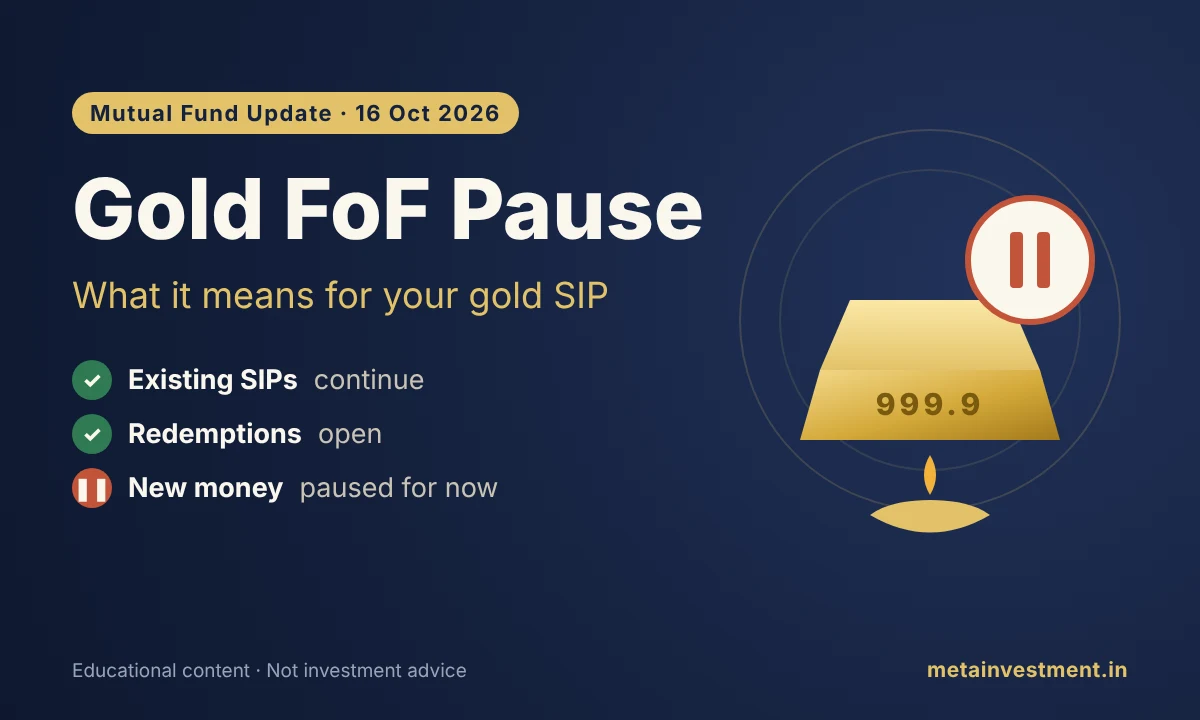
From 16 October 2026, several mutual fund houses temporarily stopped accepting fresh money into their Gold ETF Fund of Funds (Gold FoFs). Reports name HDFC Mutual Fund, ICICI Prudential Mutual Fund and Tata Mutual Fund, with DSP and Invesco India also reported to have issued notices.
The short version:
- Money already invested stays invested. Units are still valued daily.
- Existing SIPs continue. Redemptions are open.
- New money is paused. No new lump sums or new SIP registrations for now.
For most households, Dhanteras is about the auspicious purchase itself, and that tradition is unaffected. What has changed is one specific route into gold funds.
What Has Stopped, and What Still Works
The exact scope differs a little between fund houses. Based on the notices reported so far, this is the general picture:
| Stopped for now | Still working |
|---|---|
| Fresh lump-sum investments | Instalments of SIPs registered before 16 Oct |
| New SIP and STP registrations | Instalments of existing STPs |
| Top-ups and step-ups on existing SIPs | Redemptions |
| Switch-ins from other schemes | Switch-outs to other schemes |
| (Some AMCs) new IDCW-related registrations | Buying and selling Gold ETFs on NSE/BSE |
A couple of practical details from the notices:
- Applications received after the cut-off time on 15 October may be rejected, with money returned.
- One fund house described the suspension as temporary in nature. None has given a reopening date.
The notice or addendum from your own fund house is the final word on what applies to your folio.
Why This Is Happening: Gold Imports and the Rupee
India produces very little gold. Almost all of it is imported and paid for in US dollars. So when Indians buy more gold, in any form, the country needs more dollars, which adds pressure on the rupee.
A few numbers put this in context:
- India's gold import bill reached a record of about $72 billion in FY26, up roughly 24% from the year before, according to Commerce Ministry data.
- Gold ETF inflows jumped about 71% in one month: ₹4,450.61 crore in September 2026 against ₹2,596.70 crore in August, as per AMFI data.
- Festive demand around Dussehra, Dhanteras and Diwali typically pushes gold buying higher still.
A gold fund is not exempt from this chain. Money that enters a Gold ETF through fresh unit creation ends up as physical gold bought by the fund, and that gold is largely imported.
Reports describe the October step as industry-wide, following regulatory consultations. As of writing, no formal SEBI circular on this has been published, so the fund house notices remain the primary reference.
How We Got Here: The 2026 Timeline
The pause did not come out of nowhere. It is the latest in a series of steps through the year:
- May 2026: The government raised the effective import duty on gold and silver to 15% from 6%. The Prime Minister appealed to people to defer non-essential gold purchases. HDFC Mutual Fund withdrew a planned Gold-Silver FoF NFO a day after the duty change.
- June 2026: Several fund houses capped lump sums and switch-ins in Gold FoFs at ₹10 lakh per PAN per month, and some limited very large direct subscriptions into Gold ETFs.
- September 2026: Gold ETF inflows hit a seven-month high.
- 16 October 2026: Fresh money into Gold FoFs paused across several fund houses.
Gold ETF vs Gold FoF, Explained Simply
This is the part most people find confusing. Why can you still buy a Gold ETF, but not a Gold FoF?
Think of a Gold ETF as a shop that sells gold-backed units. A Gold FoF is a mutual fund that buys units from that shop on your behalf.
- When you buy a Gold ETF on the stock exchange, you are buying units that another investor is selling. No new gold needs to be bought for that trade.
- When you invest in a Gold FoF, the FoF takes your money and buys new units from the ETF. Those new units need new physical gold behind them.
That is why the pause targets the FoF route. According to industry estimates reported this week, about a third of Gold ETF assets in India come through FoFs, so it is a large channel.
| Feature | Gold ETF | Gold FoF |
|---|---|---|
| Demat account needed | Yes | No |
| SIP convenience | Possible via broker; not a standard MF SIP | Standard MF SIP |
| Price you pay | Market price during trading hours | End-of-day NAV |
| Can the price drift from value? | Yes, can trade at a premium or discount to iNAV | No, NAV-based |
| Costs | ETF expense ratio + brokerage | FoF expense + underlying ETF expense |
| Status from 16 Oct 2026 | Trading as usual on NSE/BSE | Fresh money paused |
One point worth knowing about ETFs right now: when demand on the exchange is strong and fresh unit creation is limited, an ETF's market price can move above its indicative NAV (iNAV). Comparing the two before placing an order shows whether a premium is being paid.
Has This Happened Before?
Yes, twice in a form that offers useful context.
- 2013: During a period of high current account deficit and a sharply weaker rupee, Reliance Mutual Fund suspended fresh subscriptions to its Gold Savings Fund from 1 August 2013. It reopened on 23 October 2013, citing an improved macroeconomic environment. Existing SIPs continued throughout.
- October 2025: Several fund houses paused fresh money into silver ETF FoFs when a domestic silver shortage pushed ETF prices to steep premiums. Most reopened between 20 and 28 October 2025, once premiums normalised.
The pattern is that these pauses have been temporary. The reopening, though, followed a change in underlying conditions, not a date on the calendar. Whether this episode follows a similar path will depend on how the rupee, gold imports and festive demand evolve, which no one can predict with certainty.
What This Means for You: Points to Check
These are educational pointers, not recommendations. What fits depends on individual circumstances.
1. If you already have a gold SIP running
- Your SIP instalments continue as registered.
- Before cancelling, note that a cancelled SIP cannot be re-registered while the pause lasts. A pause in the SIP mandate, where offered, is a different action from cancellation.
- A planned step-up on that SIP may not go through. Checking the fund house notice clarifies this.
2. If you were planning to start one
- New Gold FoF SIPs are not available for now.
- Gold ETFs remain available through a demat account. Points to weigh: brokerage, the need to place orders yourself, and the gap between market price and iNAV.
- Multi-asset allocation funds hold some gold alongside equity and debt. They are a different product with a different risk profile, and the gold share is usually a minority of the portfolio.
3. If you are thinking of redeeming out of worry
- The pause restricts money coming in. It does not by itself change the NAV of units already held.
- The NAV continues to move with domestic gold prices, which can go up or down.
- Redemption may carry exit loads and capital gains tax. A decision to redeem is better tied to goals and allocation than to the news cycle.
4. If you are an NRI
- Many NRIs used Gold FoFs precisely because they did not need a demat account or a Portfolio Investment Scheme (PIS) arrangement.
- With FoF subscriptions paused, the remaining routes involve account-type and repatriation conditions that vary by country of residence and bank. This is worth checking before Diwali transfers are planned. Our NRI Corner covers the broader options.
The bigger picture
Gold is often discussed as one part of a diversified allocation rather than a one-time festive purchase. A risk profiling exercise and an asset allocation review are the usual starting points for deciding how much gold, if any, fits a portfolio. The suitability of any investment category depends on an investor's financial goals, risk appetite, investment horizon and overall financial circumstances.
Key Takeaways
- From 16 October 2026, several fund houses paused fresh money into Gold FoFs; existing SIPs, STPs and redemptions continue.
- The move is linked to India's gold import bill and rupee pressure, and is described as industry-wide following regulatory consultations.
- Gold ETFs still trade on the exchange because buying them does not require fresh gold to be imported.
- A cancelled Gold FoF SIP cannot be restarted until fresh registrations reopen.
- Past pauses in 2013 and 2025 were temporary, but reopening followed changes in conditions, not a fixed date.
Not Sure How This Affects Your Portfolio?
If you hold Gold FoFs, have a SIP running, or were planning a gold allocation this festive season, it may help to look at the whole portfolio rather than the single fund. As an NRI, the available routes also depend on your account setup.
Message us on WhatsApp at 9309806281 or email info@metainvestment.in for a conversation about your situation.
Interested in Investing? Connect with Meta Investment
Meta Investment is a financial product distribution and services firm. If you'd like to explore whether a financial product is the right fit for your portfolio, our team will walk you through the details, help you assess suitability, and guide you through the onboarding process.
Mutual Fund investments are subject to market risks. Please read all scheme-related documents carefully before investing. Past performance may or may not be sustained in the future.
Fund house notices referred to in this article describe the suspension as temporary. The scope varies by scheme and fund house; the scheme's own addendum or notice is the authoritative reference. Information is based on public reports as of 16 October 2026 and may change.
If investments are made through a mutual fund distributor, the distributor may receive commissions from Asset Management Companies. Such commissions should not influence suitability-based recommendations. Meta Investment is an AMFI-registered Mutual Fund Distributor (ARN-129322) and not a SEBI-registered Investment Adviser.
Tax treatment of gold funds, Gold ETFs and physical gold depends on individual circumstances and prevailing tax law. Please consult a qualified tax professional.
This content is for educational and informational purposes only and is not investment advice, a recommendation, or a solicitation to buy or sell any financial product.
Meta Investment – Your Investment and Insurance Companion
Frequently Asked Questions
Why have Gold FoFs stopped taking new investments?
From 16 October 2026, several fund houses temporarily paused fresh money into their Gold ETF Fund of Funds. The move is industry-wide and, as reported, follows regulatory consultations. It is linked to India's gold import bill and pressure on the rupee during the festive season, when gold demand usually rises. It is not a statement about the value of gold or about any fund's holdings.
Which fund houses have paused fresh investments in Gold FoFs?
Reports name HDFC Mutual Fund, ICICI Prudential Mutual Fund and Tata Mutual Fund, with DSP and Invesco India also reported to have issued notices. Other fund houses may have taken similar steps. Investors can check the addendum or notice published by their own fund house for the exact scope and dates.
Is my money in a Gold FoF safe?
The pause applies to new money coming in, not to units already held. Existing units continue to be valued at the daily NAV, which moves with domestic gold prices like before. Gold prices themselves can rise or fall, so the value of a holding is market-linked and not assured.
Will my existing gold SIP continue?
According to fund house notices, instalments under SIPs and STPs registered before the effective date continue to be processed at the applicable NAV. What has stopped is the registration of new SIPs and STPs, and in most cases top-ups or step-ups on existing ones. Scope differs slightly by fund house, so the specific notice is the reference.
Can I still redeem my Gold FoF units?
Yes. Redemptions and switch-outs remain open under the notices issued. The pause only restricts money flowing in. Exit loads, if any, and capital gains tax apply as usual on redemption.
If I cancel my gold SIP now, can I restart it later?
Not while the pause lasts. A cancelled SIP would need a fresh registration, and new SIP registrations are among the transactions that have been stopped. Anyone considering a cancellation may want to factor this in before acting.
Can I still buy Gold ETFs?
Yes. Gold ETFs continue to trade on NSE and BSE through a demat and trading account. Buying on the exchange means buying units from another investor, so the pause on FoF subscriptions does not stop exchange trading. Prices on the exchange can sometimes move away from the fund's indicative NAV.
What is the difference between a Gold ETF and a Gold FoF?
A Gold ETF is a fund that holds physical gold and is traded on the stock exchange, so it needs a demat account. A Gold FoF is a regular mutual fund scheme that invests in a Gold ETF, so it can be bought without a demat account and suits SIPs. When money flows into a FoF, the FoF buys new ETF units, which can require the ETF to buy new physical gold.
What is iNAV and why does it matter for Gold ETFs right now?
iNAV, or indicative NAV, is an estimate of a Gold ETF's per-unit value published during market hours. When demand on the exchange is strong and fresh creation of units is limited, the market price can trade at a premium to iNAV. Comparing the two before placing an order helps an investor see whether they are paying above the underlying value.
When will Gold FoFs reopen for fresh investments?
No reopening date has been announced. Fund house notices describe the suspension as temporary. In past episodes, such as 2013 and the silver FoF pause of October 2025, schemes reopened once the underlying conditions eased, but the timing depended on those conditions rather than a fixed date.
Does this pause mean gold prices will fall?
The pause is about the route through which money enters gold funds, not a forecast on gold prices. Domestic gold prices depend on global bullion prices, the rupee-dollar exchange rate and import duties, among other factors. No one can predict how prices will move, and past trends may or may not continue.
Does this also apply to silver funds?
Reports focus on Gold ETF FoFs, and some also mention Gold-Silver FoFs. Whether a particular silver or multi-metal FoF is affected depends on the notice issued by that fund house. Silver ETFs listed on the exchange are a separate product and continue to trade.
How does this affect NRIs who invest in gold funds?
Many NRIs used Gold FoFs because they do not need a demat account or a PIS arrangement. With new FoF investments paused, the remaining routes in India, such as exchange-traded Gold ETFs, involve account and repatriation conditions that vary by residence status and bank. NRIs may want to check which routes are workable for their specific accounts.
Has a gold fund been paused like this before in India?
Yes. In 2013, during a period of high current account deficit and a weak rupee, Reliance Mutual Fund suspended new subscriptions in its Gold Savings Fund from 1 August and reopened it on 23 October 2013. In October 2025, several fund houses paused silver ETF FoFs due to a domestic supply shortage and reopened them within about two weeks.
Are there other ways to hold gold in a portfolio during the pause?
Commonly discussed routes include exchange-traded Gold ETFs through a demat account, and multi-asset allocation funds that hold some gold alongside equity and debt. Each differs in cost, taxation, liquidity and how much gold exposure it actually provides. The suitability of any route depends on an investor's goals, risk appetite, investment horizon and overall financial circumstances.
Is buying physical gold on Dhanteras affected by this?
No. The pause applies only to fresh subscriptions in Gold FoFs. Buying jewellery or coins from a jeweller, and buying Gold ETFs on the exchange, are not covered by these mutual fund notices. Import duty changes made earlier in 2026 do affect the price of physical gold.


Mutual fund updates, SIP tips, and what's moving the market. No daily noise — only when there's something worth reading.
Read more about
- Welcome to Meta Investment blogFunds
- EMI vs SIP
- Happy Akshaya Trithiya
- Running, SIP and Coaching!
- All About AIFs (Alternative Investment Funds)
- Lucrative Investment Opportunities Options for NRIs in India
- PMS in India: A Guide to Portfolio Management Services
- The Power of Chai, SIP, and Building Long-Term Wealth
- Gold vs FD: Exploring the Pros and Cons
- Asset Allocation with Sovereign Gold Bonds (SGBs)
- Sovereign Gold Bond 2023 Tranch II
- Sovereign Gold Bond 2023-24 Series III is now open for subscription.
- From Appathon to SIPathon
- Building Your Crorepati Dream
- Unveiling the Secrets of Wealth
- The Cafe vs. The Nest Egg
- A Fresh Perspective on Portfolio Management Services (PMS) for NRI/HNI Investors
- Gold: A Timeless Investment - How Mutual Funds Make It Easier
- This Mother's Day, Give the Gift of Security: Invest for Her Future and Protect Her Health
- Don't Be a Target: Investor Awareness and ARN Verification to avoid Mutual Fund fraud
- Strava and SIPs: How One Cyclist Conquered Both Roads and Finances
- Don't Panic Sell!
- Growing Their Future: Why Mutual Funds Are a Smart Investment for Minors
- Abans Global Arbitrage Fund: A Deep Dive
- How To Lose 1 Crore Rupees
- The Gift That Keeps on Giving
- Don't invest this Diwali
- 📢📢 Buy gold in a new avatar, this Dhanteras!
- The Ever-Shifting Sands: Why Asset Allocation is Key to Investment Success
- Navigating The Current Equity Market Correction
- Pre-Budget Portfolio Tune-Up: 3 Things to Consider Now
- Gold Investments: A Casual WhatsApp Group Discussion of Friends (Ft. Bachat Babu’s Wisdom)
- From Cricket to Code to Fitness: Investment Lessons from India’s ICC Champions Trophy 2025 Win
- How to Become an Accredited Investor in India: A Guide for HNIs | SEBI Framework
- Wishing You a Prosperous Gudi Padwa, Ugadi, Cheiraoba, Navreh, and Cheti Chand!
- Master Market Volatility: Krishan Sharma’s Investing Wisdom
- Edelweiss Gold Structured Products: A Smart Way to Invest in Gold with Principal Protection
- Estate Planning in India: Wills, Trusts & Tax Tips for NRIs & Residents
- Mutual Will: Why Married Couples Must Have One | Estate Planning Guide
- Understanding Beneficial Nominee in Insurance & Its Role in Estate Planning
- NRI Mutual Fund Taxation: How DTAA Can Save You Tax (Anushka Shah Case)
- Gold vs. Mutual Funds vs. Multi-Asset Funds: Best Investment for Akshaya Tritiya 2025
- Mirae Asset Global Allocation Fund - Invest in Global Markets via GIFT City | Tax Benefits for NRIs & HNIs
- The Ultimate Guide to Investing in Silver: Digital, ETFs, and Physical Options
- 📈💰 World Emoji Day Special: Smart Investing, SIP & Wealth Growth Made Fun! 🚀💡
- RBI’s August 2025 MPC Meeting: Key Highlights & What It Means for You
- From Freedom Fighters to Financial Freedom: Gen Z Investing & Independence Day Lessons
- All Weather Gold: A Principal-Protected Way to Bet on Gold (Until Aug 31)
- Begin Your Wealth Journey This Ganesh Chaturthi: Ganpati-Inspired Mutual Fund Lessons
- Tata AIA Health SIP Review 2025: A Smart Health + Investment Plan?
- NPCI Raises UPI Transaction Limits: A Complete Guide to High-Value Payments from Sept 2025
- India’s First Specialized Investment Fund (SIF): Bridge Between MF & PMS | quant Guide
- New GST Changes 2025: Impact on Investors, Sectors, and Mutual Fund Opportunities
- Beyond the Market Rollercoaster: A Guide to the Altiva Hybrid Long-Short SIF | Edelweiss MF
- Diviniti Equity Long Short Fund NFO 2025 | Investment for Indian HNIs & NRIs
- The Investor and The Distributor: A Lesson on SIP Discipline
- Financial Wellness for Men: Boost Health with Smart Investing, SIP & Retirement Planning
- Kotak Market Outlook 2026: India Equity, Debt, Gold & Silver
- SEBI Equity Fund Rules 2026: Multi Cap, Flexi Cap Changes
- SEBI Debt Fund Rules 2026: Debt Funds Masterclass - Duration, Credit Risk, Yields Guide
- ICICI Pru Thematic Advantage Fund: What the Recategorization Means for You
- Electronic Gold Receipts (EGR): NSE's New Way to Own Gold Digitally
- Marcellus Global Equities Fund NFO: Invest in Global Markets via GIFT City
- AMFI Stock Reclassification: What It Means for Your Fund
- FTSE India Index Explained: What It Is & Why It Matters Now
- US Fed Holds Rates: What It Means for Gold, Silver & the Rupee
- Tata Mumbai Marathon 2027 Fee Is ₹5,000: How to Budget for It
- Pune on India's Wealth Map: What the 2026 List Reveals
- Closing Auction Session: Why Arbitrage Fund NAVs Jumped
- Emergency Fund: The Money That Buys the Right to Say No
- The 8 Freedoms Checklist for Financial Independence
- SEBI's Proposed MF-Only PMS: What Investors Should Know
- Your Increment Came Through. Did Your SIP?
- SEBI Mandatory Nomination Rules for Demat and MF Folios
- Financial Green Flags That Matter More Than Salary
- Record SIP Inflows in a Falling Month: Reading August's AMFI Data
- UPI Charges Above ₹2,000: What Changes on October 15
- Fed Rate Hike 2026: What It Means for Indian MF Investors
- Alchemy India Long Term Fund: GIFT City Guide for NRIs
- Navratri to Diwali 2026: Your Festive-Season Money Calendar
- RBI Hikes Repo Rate to 5.50%: What It Means for Your EMI and FD
- Got a Bonus? Jio IPO or SIP: A Simple Decision Framework
- म्युच्युअल फंड: अल्पवयीन मुलांसाठी स्मार्ट गुंतवणूक का आहे?
- तुम्हाला गुढी पाडवा, उगादी, चेइराओबा, नवरेह आणि चेटीचंदच्या हार्दिक शुभेच्छा!
- बाजारातील चढ-उतारांवर मात करा: कृष्ण शर्मा यांच्याकडून महत्त्वाचे धडे
- भारतात एस्टेट प्लॅनिंग: NRI आणि रहिवाशांसाठी इच्छापत्र, ट्रस्ट आणि कर टिप्स
- म्युच्युअल विलः विवाहित जोडप्यांसाठी का आवश्यक? | एस्टेट प्लॅनिंग मार्गदर्शक
- विमा योजनांमध्ये लाभार्थी नामनिर्देशित व्यक्ती (बेनिफिशियरी नॉमिनी) आणि एस्टेट प्लॅनिंगमधील त्याची भूमिका
- NRI म्युच्युअल फंड कर: DTAA मदतीने कसे कर बचत करू शकता (अनुष्का शहा केस)
- सोने vs म्युच्युअल फंड vs मल्टी-अॅसेट फंड: अक्षय तृतीया २०२५ साठी सर्वोत्तम गुंतवणूक
- मिराए अॅसेट ग्लोबल अलोकेशन फंड - गिफ्ट सिटी मार्गे जागतिक बाजारात गुंतवणूक | एनआरआय आणि एचएनआय साठी कर फायदे
- स्काय वन कॉर्पोरेट पार्क: HNIs आणि NRIs साठी एक उत्तम गुंतवणूक संधी
- 📈💰 वर्ल्ड इमोजी डे स्पेशल: SIP आणि गुंतवणूक मजेशीर पद्धतीने! 🚀💡
- RBI चा ऑगस्ट 2025 MPC बैठक: प्रमुख हायलाइट्स आणि तुमच्यासाठी काय अर्थ आहे
- Demat आणि MF Folio साठी SEBI चे अनिवार्य Nomination नियम
- पगारापेक्षा जास्त महत्त्वाची असणारी आर्थिक हिरवी निशाणे
- ₹2,000 वरील UPI शुल्क: 15 ऑक्टोबरपासून काय बदलते
- नवरात्री ते दिवाळी 2026: सणासुदीच्या काळातील आर्थिक दिनदर्शिका
- RBI ने रेपो दर 5.50% केला: तुमच्या EMI आणि FD वर काय परिणाम?
- बोनस मिळाला? Jio IPO की SIP: निर्णय घेण्याची सोपी पद्धत
- Gold FoF ला तात्पुरता ब्रेक: तुमच्या गोल्ड SIP वर काय परिणाम?
Related Posts
- GuideInvestment Options in India (2026): Where Should Your Money Go?
 ArticleSEBI Mutual Fund Changes 2026: The Big Picture Explained
 ArticleGold Investments: A Casual WhatsApp Group Discussion of Friends (Ft. Bachat Babu’s Wisdom)
 ArticleRecord SIP Inflows in a Falling Month: Reading August's AMFI Data
This communication is intended solely for general educational and informational purposes. The information provided is general in nature and does not take into account the specific financial goals, risk profile, investment horizon, financial circumstances or other requirements of any particular investor. It should not be construed as personalised investment advice or as a recommendation to buy, sell or hold any specific financial product.
International investments may carry currency/exchange-rate, foreign-market, geopolitical, taxation, regulatory, remittance and liquidity risks.
Distributor Disclosure: Where this content is provided by a distributor/intermediary, any applicable commission, remuneration, affiliation or other material conflict of interest shall be disclosed separately. The availability of a product through the distributor does not by itself imply that the product is suitable for every investor.
No Guarantee: No statement on this page should be interpreted as a promise, assurance or guarantee of returns or investment outcomes.
Meta Investment – Your Investment and Insurance Companion