RBI Stop Switch & Trusted Person: Draft Rules Explained
RBI has proposed an emergency brake for your bank account: a Stop Switch that freezes every outgoing digital debit, and an optional trusted person who must approve large transfers. Here is how both would work, what is already decided for January 2027, and what you can do today.
Most fraud advice tells you to be careful. Careful is not enough when a caller claiming to be from the police keeps you on video for three hours. What helps in that moment is a brake you can pull, and a second person who has to say yes.
On 23 November 2026, the Reserve Bank of India released draft rules that would give bank customers exactly that. Comments are open until 14 December 2026. Nothing in the draft is final yet.
Why should an investor care? Your SIP debits, insurance premiums, NPS contributions and mutual fund redemptions all run through the same bank account a fraudster is trying to empty. Protecting that account is part of protecting a long-term plan.
Two Separate RBI Moves: Keep Them Apart
It is easy to blur these together. They do different jobs.
- Move 1 (final, effective 1 January 2027): the June 2026 directions on who bears the loss after a fraud. Liability, refunds, timelines and a compensation scheme.
- Move 2 (draft, proposed from 1 July 2027): the November 2026 proposals on preventing fraud. Stop Switch, channel controls and the Trusted Person Mechanism.
RBI's own framing is simple. The June directions strengthened customer protection after the event. The November draft adds a preventive layer, and aims for uniform practice across banks.
The draft covers seven types of banks: commercial, small finance, payments, local area, regional rural, urban co-operative and rural co-operative banks. It proposes that the new controls apply from 1 July 2027, or earlier if a bank chooses to implement them sooner.
The RBI Stop Switch, in Plain Language
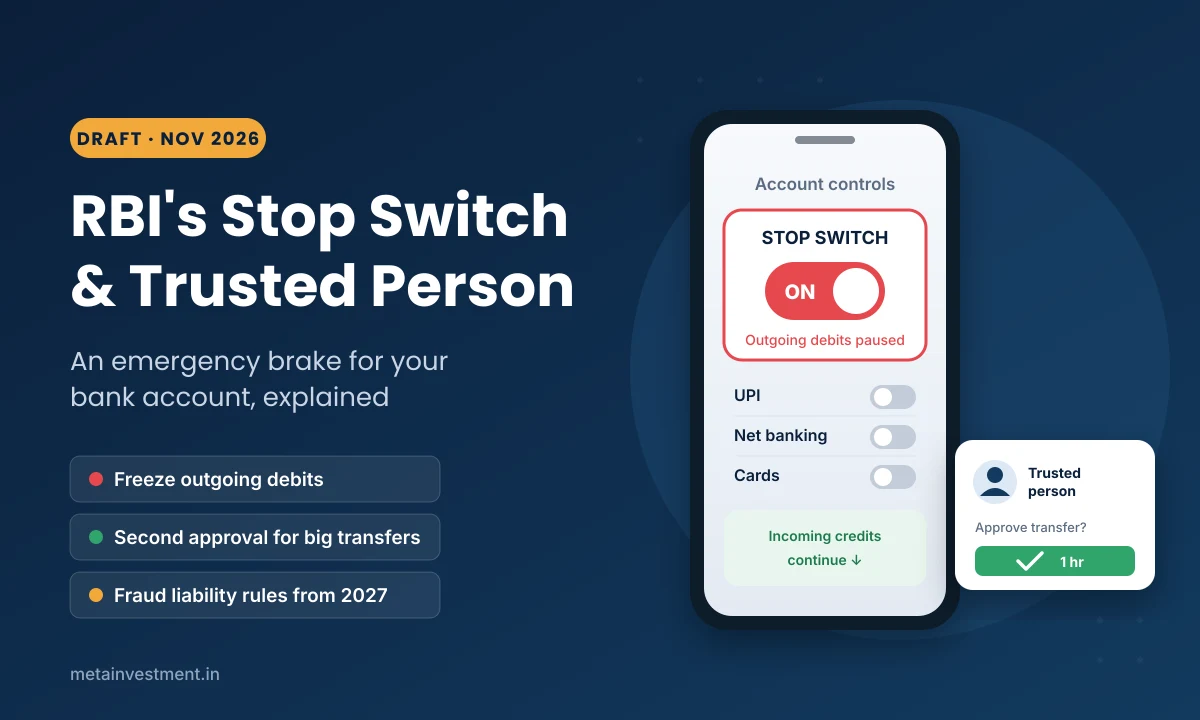
When you turn the Stop Switch on, the bank must immediately disable all future customer-initiated outgoing debits from your account.
While it is on, the draft blocks:
- New payments you initiate, on any channel
- Creation of new payment mandates or standing instructions
- Registering your account on a new third-party UPI app
What keeps working:
- Incoming credits: salary, dividends, mutual fund redemptions
- Ongoing recurring mandates and standing instructions already in place
- Liens marked by the bank
- Bank-initiated recovery of dues, such as loan instalments and charges
What this means for your SIP
The draft does not mention SIPs by name. An existing SIP auto-debit runs on a recurring mandate, and recurring mandates are outside the switch, so it would appear to continue. A new SIP mandate could not be registered while the switch is on. Worth confirming once the final text is out.
Where you could pull it
The draft requires banks to offer the Stop Switch through branches, ATMs, internet banking, mobile banking and IVR. Every activation, change or reactivation must trigger an immediate notification to you.
When would someone use it? A stolen phone. OTPs arriving that you never requested. The sinking feeling of "I think I've just been scammed." The switch buys you time while you call your bank and 1930.
Finer Controls: Turning Channels and Limits On or Off
The Stop Switch is the blunt tool. The draft also proposes finer ones.
- Channel switches: disable one or more digital payment channels and re-enable them later. Re-enabling needs authentication at least as strong as enabling did, and banks may add a cooling-off period.
- Limits: per transaction, per beneficiary and per day for each channel, plus an overall daily cap across channels.
- Time windows: keep selected channels switched off during set hours, for example overnight.
- Cards: turn domestic and international use on or off, and set limits for PoS, ATM, online and contactless use.
Defaults would also change:
- New accounts: digital payment channels start disabled until you give explicit consent.
- New cards: enabled only for contact-based ATM and PoS use within India.
- First 24 hours after activating a channel: the bank sets a risk-based ceiling on total transfers. You can change it only after 24 hours.
Card on/off toggles are not new; RBI mandated them for cards in 2020. The draft extends the same idea to every digital channel and makes a fuller set standard across banks.
The Trusted Person Mechanism: A Second Pair of Eyes
This is the more unusual idea, and the one that targets the scams that do the most damage.
How it would work:
- Voluntary. Both you and the trusted person must consent.
- Eligible accounts: individual accounts and certain joint accounts with a survivorship clause.
- You set the threshold. Covered transfers above it go to your trusted person for approval.
- One-hour window. The trusted person sees the amount, beneficiary and narration. No response, or a rejection, means the transaction is rejected.
- 24-hour cooling-off before the mechanism starts, and again before any change or opt-out.
That last point matters. A scammer who pressures you into removing your trusted person still has to wait a full day, and the bank must notify both you and the outgoing trusted person before the change takes effect.
What the trusted person can and cannot do
- Must be 18 or older, with identity verified through an officially valid document
- Must have a verified mobile number different from yours
- Cannot see balances, deposits, investments or insurance details
- Cannot operate the account or start transactions
- Is not a joint holder, nominee, mandate holder or signatory
What is excluded
The draft keeps UPI payments, merchant payments on any channel, and recurring payments through standing instructions, e-mandates or NACH outside the mechanism. In practice it covers large one-off fund transfers through other channels. That is the route typically used in "digital arrest" and fake investment-platform scams, where victims are talked into moving lakhs in one go.
The honest trade-off
A genuine urgent transfer could be delayed or rejected if your trusted person is unreachable. Who to nominate is a family trust decision, not a technical one. It may suit elderly parents, people less comfortable with technology, or families who want a check on big transfers. Whether it fits depends on your own circumstances.
Two ideas from RBI's April 2026 discussion paper did not make it into the draft: a one-hour delay on certain high-value transfers, and an annual credit ceiling. The paper had also floated mandatory trusted-person approval for customers aged 70 and above. The draft makes it voluntary, with the customer choosing the threshold.
If Fraud Does Happen: The Rules From 1 January 2027
These directions were notified on 24 June 2026 and apply to electronic banking transactions on or after 1 January 2027.
A broader definition. A "fraudulent" transaction now includes ones you were tricked or coerced into making, not only ones done without your knowledge.
| Situation | Who bears the loss (from 1 Jan 2027) | What you need to do |
|---|---|---|
| Bank negligence (e.g. missing mandatory alert, no 24x7 reporting channel, breach at bank's end) | Bank. Customer liability is zero. | Report anyway, to start the process |
| Breach elsewhere; neither customer nor bank at fault | Bank, with zero customer liability | Report within 5 calendar days |
| Customer negligence (e.g. sharing OTP or PIN, installing a malicious app, ignoring a clear bank warning, not updating mobile or email) | Customer, up to the moment of reporting. Bank, after reporting. | Report immediately; every hour counts |
| Customer negligence, gross loss up to ₹50,000 | One-time compensation: 85% of net loss or ₹25,000, whichever is lower | Report to 1930 or cybercrime.gov.in and to your bank within 5 calendar days |
A few more points:
- Resolution timelines: 45 calendar days for domestic cases and 60 for cross-border ones, from receipt of the complaint.
- Shadow reversal: a provisional credit while the bank investigates. You cannot withdraw it yet, but it shows the amount is under review.
- Alerts: SMS alerts are mandatory for transactions above ₹500.
- Compensation is once in a lifetime, available to individuals including sole proprietors, and covers frauds in the year starting 1 January 2027.
Worked example from the directions: ₹40,000 lost, ₹15,000 recovered. Net loss ₹25,000. Compensation at 85% is ₹21,250.
The November draft also proposes a wider definition of "negligence by a bank." It would include failing to provide the Stop Switch, channel controls or the Trusted Person Mechanism once those apply.
These are summaries. Actual outcomes depend on the bank's investigation and the official RBI text.
What You Can Do Today
None of the new controls exist yet. These habits work right now.
- Save 1930 and cybercrime.gov.in in your phone. Find your bank's 24x7 fraud number from the back of your card or the official app, never from a search result.
- Update your mobile and email with every bank, AMC or RTA, NPS account and insurer. Alerts are your early warning, and an outdated number can count against you.
- Never share an OTP, PIN or UPI PIN. The UPI PIN is needed to pay, never to receive.
- There is no such thing as a "digital arrest." No police agency or regulator asks you to move money to a "safe account."
- Use the card toggles you already have. Keep international usage off unless you are travelling.
- Check before trusting an "investment" platform. Pitches promising fixed high returns and WhatsApp or Telegram tip groups are common fraud patterns. SEBI's intermediary registers and AMFI's ARN search are public.
- Know how real redemptions work. Mutual fund redemptions are paid only to your registered bank account. Anyone asking for "fees" to release your money is not your fund house. When paying a SEBI-registered intermediary by UPI, check for its SEBI-validated "@valid" UPI ID.
- Review your family's setup. Check alerts and limits on elderly parents' accounts, and discuss whether a trusted person would help once the option is available.
What Is Still Open
- The draft may change after comments close on 14 December 2026.
- The proposed 1 July 2027 start date is not final.
- Banks may offer controls beyond the minimum, and implementation will differ in detail.
We will update this post when RBI issues final directions.
Related reading: how to escalate a mutual fund complaint, SEBI's nomination rules for demat accounts and mutual fund folios and up to four nominees in your bank account.
Pull the Brake Before You Need It
The liability rules decide who pays after a fraud. The Stop Switch and trusted person aim to stop it in the first place. Under both, speed of reporting decides a lot.
If you want help keeping your investment paperwork, nominations and contact details in order across banks, fund houses and NPS, that is a conversation worth having.
Interested in Investing? Connect with Meta Investment
Meta Investment is a financial product distribution and services firm. If you'd like to explore whether a financial product is the right fit for your portfolio, our team will walk you through the details, help you assess suitability, and guide you through the onboarding process.
Details as of 24 November 2026, based on RBI's draft amendment directions of 23 November 2026 and the amendment directions of 24 June 2026.
Meta Investment – Your Investment and Insurance Companion
Frequently Asked Questions
What is RBI's proposed Stop Switch?
The Stop Switch is a facility proposed in RBI's draft directions of 23 November 2026. When a customer turns it on, the bank must immediately disable all future customer-initiated outgoing debits from the account. Incoming credits continue. It is a draft, open for comments until 14 December 2026.
Will the RBI Stop Switch stop my SIP auto-debit?
As drafted, the Stop Switch excludes debits under ongoing recurring payment mandates and standing instructions, so an existing SIP mandate would appear to continue. The draft does not name SIPs specifically. While the switch is on, a new mandate or standing instruction cannot be set up.
What keeps working when the Stop Switch is on?
Under the draft, incoming credits such as salary, dividends and mutual fund redemptions are not affected. Ongoing recurring mandates, standing instructions, liens marked by the bank and bank-initiated recovery of dues such as loan instalments and charges also stay outside the switch.
Where will I be able to turn on the Stop Switch?
The draft requires banks to offer the Stop Switch and other payment controls through branches, ATMs, internet banking, mobile banking and IVR. Banks must notify the customer immediately whenever a control is activated, changed, deactivated or reactivated.
What is the Trusted Person Mechanism proposed by RBI?
It is an optional safeguard in RBI's November 2026 draft. A customer names a trusted person and sets an amount. Covered transfers above that amount need the trusted person's approval within one hour, or the transaction is rejected. Both the customer and the trusted person must consent.
Can a trusted person see my bank balance or investments?
No. As drafted, the trusted person sees only the amount, beneficiary and narration of the transaction awaiting approval. They cannot see balances, deposits, investments or insurance details, cannot operate the account, and are not a joint holder, nominee, mandate holder or signatory.
Who can be a trusted person for my bank account?
Under the draft, the trusted person must be at least 18 years old, have identity verified through an officially valid document, and have a verified mobile number and email. Their mobile number must be different from the account holder's.
Do UPI payments need trusted-person approval under RBI's draft?
No. The draft excludes UPI payments, merchant payments through any channel, and recurring payments through standing instructions, e-mandates or NACH from the Trusted Person Mechanism. It mainly applies to large one-off fund transfers through other physical and digital channels.
Is the trusted person mechanism compulsory for senior citizens?
Not in the November 2026 draft. RBI's April 2026 discussion paper had floated mandatory trusted-person approval for customers aged 70 and above on transfers over Rs 50,000. The draft makes it voluntary for eligible individual accounts, with the customer choosing the threshold.
When will the RBI Stop Switch and trusted person rules come into effect?
The draft proposes 1 July 2027, or an earlier date if a bank chooses to implement sooner. These are proposals; the final directions and dates may change after the comment period that closes on 14 December 2026.
What is a fraudulent electronic banking transaction under RBI's 2027 rules?
From 1 January 2027, it covers transactions done by a third party using credentials obtained from the customer by fraud, transactions the customer was coerced or pressured into making, and unauthorised transactions. This is broader than the earlier focus on unauthorised transactions alone.
If I share my OTP by mistake, will I get my money back?
Sharing an OTP is generally treated as customer negligence. Under the rules effective 1 January 2027, the customer bears the loss up to the time the fraud is reported to the bank, and the bank bears losses after that. A limited one-time compensation may apply for losses up to Rs 50,000. Outcomes depend on the bank's investigation.
What is the Rs 25,000 cyber fraud compensation and how do I claim it?
For individuals, including sole proprietors, who lose up to Rs 50,000 in a fraudulent electronic banking transaction caused by customer negligence, compensation is 85% of the net loss or Rs 25,000, whichever is lower. It is available once in a lifetime and requires reporting to helpline 1930 or the National Cyber Crime Reporting Portal and to the bank within 5 calendar days.
How long does a bank have to resolve a digital fraud complaint from 2027?
Under the directions effective 1 January 2027, banks must resolve complaints within 45 calendar days for domestic fraudulent electronic banking transactions and 60 calendar days for cross-border ones, counted from receipt of the complaint.
When do I have zero liability for a digital banking fraud?
From 1 January 2027, the customer has zero liability when the fraud arises from bank negligence, whether or not it was reported. Where neither the bank nor the customer is at fault and the breach lies elsewhere, zero liability applies if the customer reports within 5 calendar days.
How can I comment on RBI's draft digital payment safeguards?
RBI has invited comments until 14 December 2026 through the Connect 2 Regulate section of its website or by email to mcsdorfeedback@rbi.org.in, with the subject line starting 'Feedback on' followed by the name of the draft.


Mutual fund updates, SIP tips, and what's moving the market. No daily noise — only when there's something worth reading.
Read more about
- 7-Day Plan for Indian Women to Kickstart Their Financial Journey: From Scarcity to Abundance
- New SEBI-Validated UPI IDs: Secure Payments for Investors Explained
- ManipalCigna Sarvah Uttam Health Insurance Plan: Comprehensive Coverage with Unique Benefits
- Mutual Funds Are the New Status Symbol (Not Your Bank Balance)
- Mutual Fund Scheme Name Changes in India (2025) – Complete List & Reasons
- From Freedom Fighters to Financial Freedom: Gen Z Investing & Independence Day Lessons
- All Weather Gold: A Principal-Protected Way to Bet on Gold (Until Aug 31)
- ESAF SFB NCD Issue: 11.30% Coupon | Basel II Compliant Bonds
- Begin Your Wealth Journey This Ganesh Chaturthi: Ganpati-Inspired Mutual Fund Lessons
- Tata AIA Health SIP Review 2025: A Smart Health + Investment Plan?
- NPCI Raises UPI Transaction Limits: A Complete Guide to High-Value Payments from Sept 2025
- NPS Swasthya Explained: Wait for the Health-Linked Pension, or Buy Health Cover Now?
- AMFI Stock Reclassification: What It Means for Your Fund
- FTSE India Index Explained: What It Is & Why It Matters Now
- Tata Mumbai Marathon 2027 Fee Is ₹5,000: How to Budget for It
- Pune on India's Wealth Map: What the 2026 List Reveals
- Emergency Fund: The Money That Buys the Right to Say No
- The 8 Freedoms Checklist for Financial Independence
- How to Check an Insurer's Complaint Record Before You Buy
- Your Increment Came Through. Did Your SIP?
- PFRDA's New NPS Scheme Categories: What Actually Changed
- SEBI Mandatory Nomination Rules for Demat and MF Folios
- Financial Green Flags That Matter More Than Salary
- Record SIP Inflows in a Falling Month: Reading August's AMFI Data
- UPI Charges Above ₹2,000: What Changes on October 15
- Navratri to Diwali 2026: Your Festive-Season Money Calendar
- NPS Sanchay Explained: Who It Is For and How It Differs
- RBI Hikes Repo Rate to 5.50%: What It Means for EMIs and FDs
- Got a Bonus? Jio IPO or SIP: A Simple Decision Framework
- IPO Money Blocked vs Debited: What Actually Happens
- IPO Refund or Unblock Not Received: What to Check
- Didn't Get an IPO Allotment? Here's Why
- Have a Problem With Your Mutual Fund? Here's How a Complaint Works, Step by Step
- Investing in Your Child's Name: Mutual Funds vs NPS Vatsalya
- EPFO SWP: Take Your PF as Monthly Income After Retirement
- महिलांसाठी आर्थिक यशस्वीतेची 7-दिवसीय नियोजन: टंचाईपासून विपुलतेकडे
- SEBI चे नवीन '@valid' UPI ID: गुंतवणूकदारांसाठी सुरक्षित पेमेंट्स
- एप्रिल २०२५ पासून भारतातील म्युच्युअल फंड स्कीमच्या नावातील बदल - संपूर्ण यादी आणि कारणे
- Demat आणि MF Folio साठी SEBI चे अनिवार्य Nomination नियम
- ₹2,000 वरील UPI शुल्क: 15 ऑक्टोबरपासून काय बदलते
- नवरात्री ते दिवाळी 2026: सणासुदीच्या काळातील आर्थिक दिनदर्शिका
- NPS Sanchay सोप्या भाषेत: कोणासाठी आणि इतर NPS पेक्षा वेगळे कसे
- RBI ने रेपो दर 5.50% केला: तुमच्या EMI आणि FD वर काय परिणाम?
- बोनस मिळाला? Jio IPO की SIP: निर्णय घेण्याची सोपी पद्धत
- IPO चे पैसे ब्लॉक होतात की कापले जातात? प्रत्यक्षात काय होते
- IPO रिफंड किंवा अनब्लॉक झाले नाही: काय तपासायचे
- IPO वाटप मिळाले नाही? त्याची कारणे
Related Posts
 ArticleRBI Policy Feb 2026: Repo Rate, New CPI Series & Your Wallet | Analysis
 ArticleRBI's New Conduct Rules for Banks: What Investors Must Know
 ArticleSEBI's New Voluntary Lock-in for Mutual Fund Folios: What Every Investor Must Know
 ArticleUp to 4 Nominees in Your Bank Account? What RBI’s 2025 Circular Means for Your Legacy
This communication is intended solely for general educational and informational purposes. The information provided is general in nature and does not take into account the specific financial goals, risk profile, investment horizon, financial circumstances or other requirements of any particular investor. It should not be construed as personalised investment advice or as a recommendation to buy, sell or hold any specific financial product.
Mutual Fund investments are subject to market risks. Please read all scheme-related documents carefully before investing. Past performance is not indicative of future results and may not be sustained.
The suitability of any mutual fund product, scheme, category or strategy discussed on this page depends on an investor's individual circumstances, including financial goals, risk appetite, investment horizon and liquidity requirements. Investors should independently assess suitability and, where appropriate, seek professional advice before making investment decisions.
Meta Investment is an AMFI-registered Mutual Fund Distributor (ARN-129322) and is not a SEBI-registered Investment Adviser. If investments are made through a mutual fund distributor, the distributor may receive commission from Asset Management Companies in respect of eligible Regular Plan investments. Commission structures may vary across schemes and AMCs. Such commissions should not influence suitability-based recommendations, and applicable conflicts of interest will be disclosed. Please refer to our Commission Disclosure for further details.
Tax treatment of mutual fund investments depends on individual circumstances and prevailing tax laws, which are subject to change. Investors should consult a qualified tax professional for advice specific to their circumstances.
This disclaimer is intended to provide general disclosure and does not replace any scheme-specific disclosures, risk factors, regulatory disclosures or information contained in the applicable Scheme Information Document (SID), Statement of Additional Information (SAI) and Key Information Memorandum (KIM).
Distributor Disclosure: Where this content is provided by a distributor/intermediary, any applicable commission, remuneration, affiliation or other material conflict of interest shall be disclosed separately. The availability of a product through the distributor does not by itself imply that the product is suitable for every investor.
No Guarantee: No statement on this page should be interpreted as a promise, assurance or guarantee of returns or investment outcomes.
Meta Investment – Your Investment and Insurance Companion