Your Guid to Safeguarding Against Financial Frauds
As an investor in India, it is crucial to be aware of the risks associated with financial fraud. Unfortunately, there are unscrupulous individuals and organizations that prey on unsuspecting investors, making false promises of high returns to lure them into fraudulent schemes. In this post, we will shed light on the issue of financial fraud and provide guidance on how Indian investors can protect themselves from falling victim to such scams.
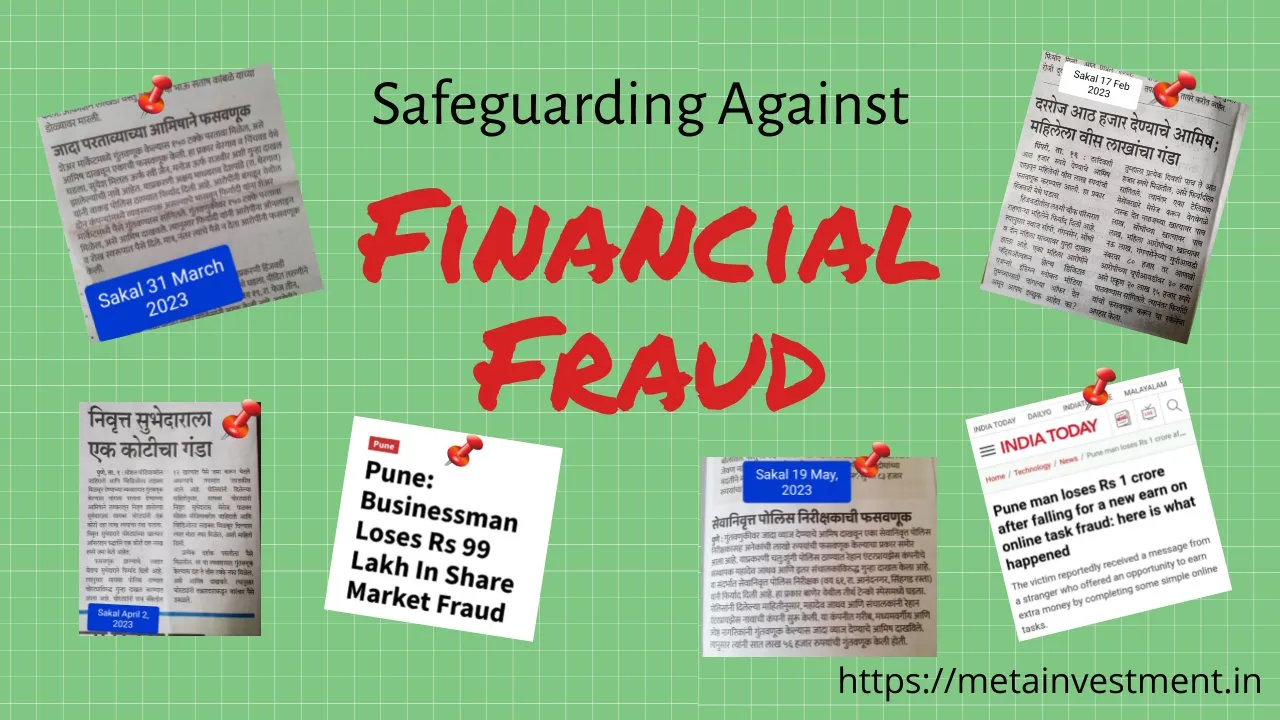
Financial fraud can take various forms, including Ponzi schemes, pyramid schemes, Multi-Level Marketing (MLM) Scams, fake investment plans, unauthorized collective investment schemes, online tasks, WhatsApp phishing, YouTube Link Click Fraud, Online Share Market Fraud, etc. These fraudsters often target investors by offering attractive investment opportunities that promise unusually high returns within a short period or a chance to earn huge money without requiring much skills or time. However, behind these enticing promises lie hidden risks and deceitful intentions.
Ponzi Schemes
One of the most notorious examples of financial fraud is the case of the Saradha Group in West Bengal. This Ponzi scheme defrauded thousands of investors, promising high returns on investments in real estate, tourism, and other ventures. Eventually, the scheme collapsed, leading to substantial losses for investors and widespread legal repercussions.
Multi-Level Marketing (MLM) Scams
MLM scams, also known as pyramid schemes, often target individuals looking to earn quick money through referrals and recruitment. One notable case is the SpeakAsia Online scam, where investors were promised high returns for completing surveys. The company collapsed, leaving investors empty-handed and highlighting the risks associated with such pyramid schemes.
Unregulated Collective Investment Schemes (UCIS)
Several fraudulent investment schemes in India have operated outside the purview of regulatory bodies like SEBI, targeting investors with false promises of high returns. The case of Rose Valley is a prominent example where the company raised funds by offering a range of investment products, including land, real estate, and holiday packages. The scheme eventually collapsed, causing significant losses for investors.
WhatsApp Frauds in India
WhatsApp is one of the most popular messaging apps in India, with over 400 million users. This popularity has made it a target for scammers, who are constantly devising new ways to defraud users.
One of the most common WhatsApp scams is the “phishing” scam. In this scam, the scammer sends a message that appears to be from a legitimate source, such as a bank or a government agency. The message will often contain a link that, if clicked, will take the user to a fake website that looks like the real website. Once the user is on the fake website, they will be asked to enter their personal information, such as their bank account number or credit card number. This information can then be used by the scammer to steal the user’s money.
Another common WhatsApp scam is the “romance” scam. In this scam, the scammer will create a fake profile and pose as someone who is interested in the user. The scammer will then build a relationship with the user and eventually ask for money. The money is usually requested for a specific reason, such as to pay for medical expenses or to help a family member in need. Once the money is sent, the scammer will disappear.
WhatsApp fraud can be very costly for users. In 2022, Indian WhatsApp users lost over ₹57 crore to scams. This is a significant amount of money, and it is important to be aware of the risks of WhatsApp fraud.
YouTube Link Click Fraud
YouTube is one of the most popular websites in the world, with over 2 billion active users. This popularity has made it a target for scammers, who are constantly devising new ways to defraud users.
One of the most common ways that scammers defraud users on YouTube is through link click fraud. In this scam, the scammer will create a fake YouTube video that appears to be from a legitimate source. The video will often contain a link that, if clicked, will take the user to a malicious website. Once the user is on the malicious website, they may be asked to enter their personal information, such as their bank account number or credit card number. This information can then be used by the scammer to steal the user's money.
Another way that scammers defraud users on YouTube is through fake contests and giveaways. In this scam, the scammer will create a fake contest or giveaway that appears to be from a legitimate source. The scammer will then ask users to click on a link to enter the contest or giveaway. Once the user clicks on the link, they will be taken to a malicious website where they may be asked to enter their personal information. This information can then be used by the scammer to steal the user's money.
YouTube link click fraud can be very costly for users. In 2022, YouTube users lost over $1 billion to scams. This is a significant amount of money, and it is important to be aware of the risks of YouTube link click fraud.
Online Share Market Fraud
The advent of technology has revolutionized the way we trade and invest in the share market. While this has undoubtedly brought convenience and accessibility, it has also opened new avenues for fraudsters to exploit unsuspecting investors. Many people fall prey to the promise of high returns on minimal investment and initial success based on the tips offered by scammers. Such scammers are neither SEBI registered nor they have any authentic background to justify their recommendations. Recently Pune police arrested a person named Milan Jenendra Jain for his involvement in online share market fraud.
To safeguard your investments and protect yourself from financial fraud, consider the following precautions:
Research and Due Diligence
Before investing, thoroughly research the investment opportunity and the entity offering it. Verify the credentials of the company or individual, their track record, and regulatory compliance. Look for any red flags such as unverifiable claims, lack of proper documentation, or absence of a valid license to operate.
Regulatory Compliance
Ensure that the investment opportunity is in compliance with relevant regulations and guidelines. In India, financial institutions and investment advisors must be registered with regulatory bodies like the Securities and Exchange Board of India (SEBI) or other authorized regulators. Verify the legitimacy of the investment scheme by checking if it is approved by the appropriate regulatory authority.
Diversify Your Investments
Avoid putting all your eggs in one basket. Diversify your investment portfolio across different asset classes and sectors. By spreading your investments, you can reduce the risk of being heavily exposed to a single investment that could potentially be fraudulent.
Beware of Unrealistic Promises
Be cautious of investment opportunities that promise unusually high returns with little or no risk. Remember the old adage: "If it sounds too good to be true, it probably is." Legitimate investments carry risks, and high returns typically come with higher levels of risk. Exercise caution and skepticism when faced with promises that seem too good to be believable.
Seek Professional Advice
Engage the services of qualified and trustworthy financial advisors or investment professionals. They can help you navigate the investment landscape, provide expert advice, and conduct thorough due diligence on your behalf. A professional advisor can guide you towards legitimate investment opportunities and help identify potential red flags.
Report Suspected Fraud
If you come across a suspicious investment opportunity or suspect financial fraud, report it to the relevant authorities immediately. Notify the police, regulatory agencies like SEBI, and any other appropriate government bodies. By reporting such activities, you contribute to protecting other potential victims and assist in the fight against financial fraud.
Remember, the primary goal of fraudulent schemes is to exploit investors and their hard-earned money. By staying vigilant, conducting proper research, seeking professional advice, and reporting suspicious activities, you can protect yourself from falling victim to financial fraud.
Conclusion
In conclusion, Indian investors must be cautious and proactive in safeguarding their investments. Financial fraud is a real threat, and fraudsters can be persuasive in their deceptive tactics. By being informed, conducting due diligence, seeking professional advice, and staying alert to warning signs, you can mitigate the risks and protect your investments. Stay informed, stay vigilant, and safeguard your financial future.


Mutual fund updates, SIP tips, and what's moving the market. No daily noise — only when there's something worth reading.
Read more about
- Shield Your Savings
- Don't Be a Target: Investor Awareness and ARN Verification to avoid Mutual Fund fraud
- Mutual Fund Mystery: Online Platform, Missing Money?
Related Posts



This communication is intended solely for general educational and informational purposes. The information provided is general in nature and does not take into account the specific financial goals, risk profile, investment horizon, financial circumstances or other requirements of any particular investor. It should not be construed as personalised investment advice or as a recommendation to buy, sell or hold any specific financial product.
Mutual Fund investments are subject to market risks. Please read all scheme-related documents carefully before investing. Past performance is not indicative of future results and may not be sustained.
The suitability of any mutual fund product, scheme, category or strategy discussed on this page depends on an investor's individual circumstances, including financial goals, risk appetite, investment horizon and liquidity requirements. Investors should independently assess suitability and, where appropriate, seek professional advice before making investment decisions.
Meta Investment is an AMFI-registered Mutual Fund Distributor (ARN-129322) and is not a SEBI-registered Investment Adviser. If investments are made through a mutual fund distributor, the distributor may receive commission from Asset Management Companies in respect of eligible Regular Plan investments. Commission structures may vary across schemes and AMCs. Such commissions should not influence suitability-based recommendations, and applicable conflicts of interest will be disclosed. Please refer to our Commission Disclosure for further details.
Tax treatment of mutual fund investments depends on individual circumstances and prevailing tax laws, which are subject to change. Investors should consult a qualified tax professional for advice specific to their circumstances.
This disclaimer is intended to provide general disclosure and does not replace any scheme-specific disclosures, risk factors, regulatory disclosures or information contained in the applicable Scheme Information Document (SID), Statement of Additional Information (SAI) and Key Information Memorandum (KIM).
Distributor Disclosure: Where this content is provided by a distributor/intermediary, any applicable commission, remuneration, affiliation or other material conflict of interest shall be disclosed separately. The availability of a product through the distributor does not by itself imply that the product is suitable for every investor.
No Guarantee: No statement on this page should be interpreted as a promise, assurance or guarantee of returns or investment outcomes.
Meta Investment – Your Investment and Insurance Companion