Safe Investments with High Returns in India (2026): 8 Options Compared
The information on this page is for educational purposes only and should not be construed as investment advice. Interest rates shown are for October–December 2026 unless stated otherwise.
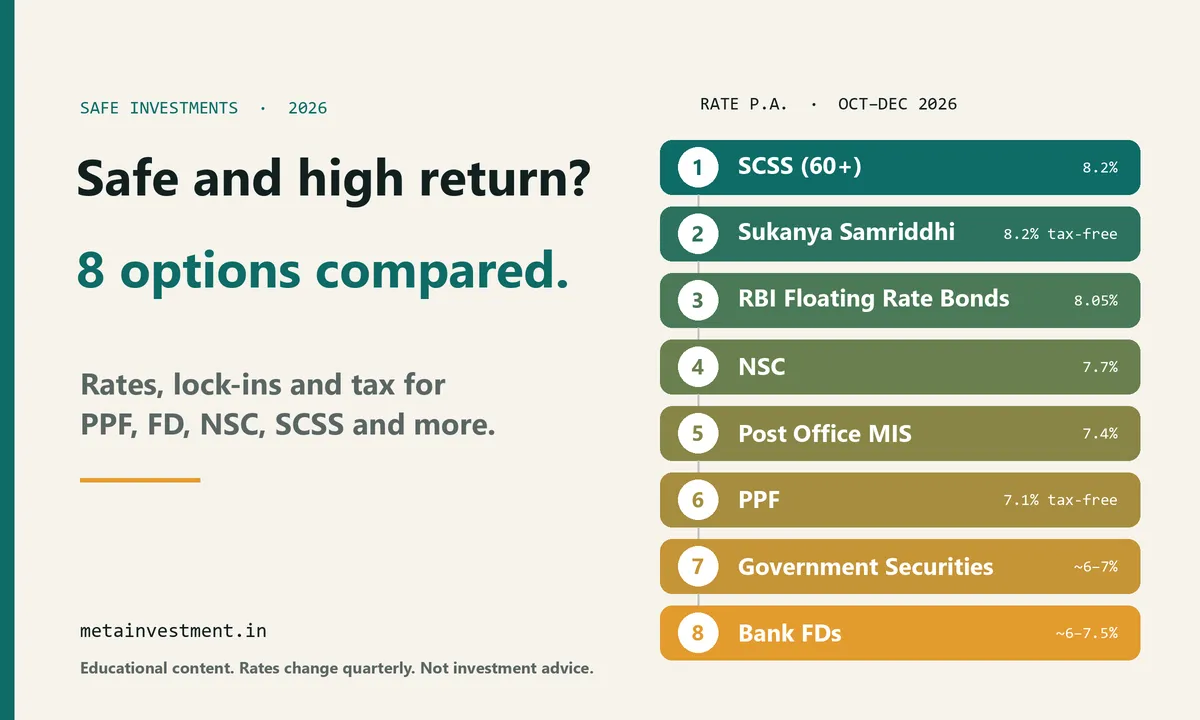
Short answer: no investment gives you both full safety and high returns. Government-backed schemes protect your capital, but they pay roughly 7–8.2% a year today. The highest-paying safe options are SCSS and Sukanya Samriddhi Yojana (8.2%) and RBI Floating Rate Savings Bonds (8.05%). For long-term savings, PPF's 7.1% tax-free often beats all of them once tax is counted.
Anything promising "guaranteed" returns well above these rates is taking risk somewhere, even if it isn't obvious.
1. The 8 Safe Investment Options at a Glance
| Option | Current rate (p.a.) | Lock-in / tenure | Who backs it | Tax on returns | Best for |
|---|---|---|---|---|---|
| Senior Citizens Savings Scheme (SCSS) | 8.2%, paid quarterly | 5 years (+3) | Government of India | Taxable at slab | Retirees 60+ |
| Sukanya Samriddhi Yojana (SSY) | 8.2%, compounded yearly | Till girl turns 21 | Government of India | Tax-free | Daughter's education and marriage |
| RBI Floating Rate Savings Bonds | 8.05%, paid half-yearly | 7 years | Government of India | Taxable at slab | Larger sums, no upper limit |
| National Savings Certificate (NSC) | 7.7%, compounded yearly | 5 years | Government of India | Taxable (deduction on deposit, old regime) | 5-year goals, tax saving |
| Post Office Monthly Income Scheme (POMIS) | 7.4%, paid monthly | 5 years | Government of India | Taxable at slab | Monthly income top-up |
| Public Provident Fund (PPF) | 7.1%, compounded yearly | 15 years | Government of India | Tax-free | Long-term, tax-free savings |
| Government Securities (G-Secs, T-Bills) | Market-linked, roughly 6–7% | 91 days to 40 years | Government of India | Taxable at slab | Any tenure, tradable |
| Bank Fixed Deposits (FDs) | About 6–7.5% (varies by bank) | 7 days to 10 years | Bank (DICGC cover up to ₹5 lakh) | Taxable at slab | Flexibility, short-term money |
Small savings rates are set by the Government every quarter. See the latest on our National Savings Schemes rates page. G-Sec yields change daily and FD rates differ by bank and tenure.
2. What "Safe" Actually Means
"Safe" usually means one thing: you will get your money back, with the promised interest. On that test there are two levels:
- Sovereign guarantee: PPF, NSC, SCSS, SSY, POMIS, RBI Bonds and G-Secs are backed by the Government of India. This is the lowest default risk available in India.
- Deposit insurance: Bank FDs are insured by DICGC up to ₹5 lakh per depositor per bank. Above that, your safety depends on the bank itself.
Safe does not mean free of every risk. Three risks remain:
- Inflation risk: if your return after tax is below inflation, your money buys less each year. Read: how inflation erodes fixed income returns.
- Liquidity risk: most of these lock your money in for 5–21 years, with penalties for leaving early.
- Reinvestment risk: when a 5-year deposit matures, rates may be lower than when you started. The RBI raised the repo rate to 5.50% in October 2026 (what that means for FDs), but rates move in both directions.
3. Each Option in Detail
Public Provident Fund (PPF)
PPF is the best-known long-term safe investment, and for good reason: it is fully tax-free (EEE).
- Rate: 7.1% a year, compounded annually.
- Deposit: ₹500 to ₹1.5 lakh a year.
- Tenure: 15 years, extendable in 5-year blocks.
- Access: loan from year 3, partial withdrawal from year 7.
- Tax: deposits qualify for a deduction under Section 123 of the Income-tax Act, 2025 (formerly Section 80C) in the old regime. Interest and maturity are tax-free under both regimes.
Example: ₹1.5 lakh a year for 15 years at 7.1% grows to about ₹40.7 lakh, all tax-free.
Read more: PPF guide · PPF scheme details · PPF Calculator
Fixed Deposits (FDs)
FDs are the most flexible safe option: any amount, any tenure from 7 days to 10 years, and you can break them if needed (with a small penalty).
- Rate: about 6–7.5% at large banks; senior citizens usually get 0.25–0.50% more. Small finance banks often pay more, but stay within the ₹5 lakh DICGC limit per bank.
- Tax-saver FD: a 5-year FD qualifies for the Section 123 deduction (old regime) but cannot be broken early.
- Post Office Time Deposit: the government-backed alternative, currently 6.9% (1 year) to 7.5% (5 years). See POTD 5-year details.
- Tax: interest is taxed every year at your slab rate. Banks deduct TDS above ₹50,000 of interest a year (₹1 lakh for senior citizens). If your income is below the taxable limit, submit Form 121 (which replaced Forms 15G and 15H from April 2026).
Best for: emergency funds and money you need in the next 1–3 years.
National Savings Certificate (NSC)
- Rate: 7.7% a year, compounded annually and paid at maturity.
- Deposit: from ₹1,000, no upper limit.
- Tenure: 5 years. Early encashment only in special cases (death, court order).
- Tax: deposit qualifies for the Section 123 deduction (old regime). Interest for years 1–4 is treated as reinvested and also qualifies; the interest is taxable.
Example: ₹1 lakh grows to about ₹1,44,900 in 5 years.
Read more: NSC scheme details
Senior Citizens Savings Scheme (SCSS)
The highest-paying safe option for retirees.
- Rate: 8.2% a year, paid every quarter.
- Eligibility: 60 and above (55+ for those who took VRS, with conditions).
- Limit: ₹30 lakh per person; ₹60 lakh for a couple in separate accounts.
- Tenure: 5 years, extendable by 3 years.
- Tax: interest is fully taxable; TDS applies above ₹1 lakh of interest a year. Deposit qualifies for the Section 123 deduction (old regime).
Example: ₹30 lakh pays about ₹61,500 every quarter (about ₹20,500 a month).
Read more: SCSS scheme details · SCSS rules from July 2026 · Monthly income after retirement
RBI Floating Rate Savings Bonds
Government of India bonds whose rate moves with the NSC rate.
- Rate: NSC rate + 0.35%, reset every 6 months (1 January and 1 July). Currently 8.05%.
- Deposit: from ₹1,000, no upper limit. This is what makes them useful for large sums after SCSS and PPF limits are used up.
- Tenure: 7 years. Early exit only for people aged 60+ (after 6 years for ages 60–70, 5 years for 70–80, 4 years for 80+).
- Payout: interest every six months; there is no cumulative option.
- Tax: interest is taxable at your slab rate, and TDS applies.
- Where to buy: designated banks (SBI, other major banks) and RBI Retail Direct. Open to resident individuals and HUFs; NRIs cannot invest.
Read more: RBI Floating Rate Savings Bonds explained
Government Bonds and Securities (G-Secs, T-Bills, SDLs)
These are the bonds the Government borrows through. You can now buy them directly.
- Types: Treasury Bills (91, 182 and 364 days), dated Government of India bonds (up to 40 years), and State Development Loans issued by state governments.
- Return: market-linked. Yields change daily with interest rates; recently roughly 6–7% depending on tenure. If you hold to maturity you get the stated yield; if you sell early, the price may be higher or lower than you paid.
- How to buy: a free Retail Direct Gilt account at rbiretaildirect.org.in, or through a broker in your demat account.
- Tax: interest is taxable at your slab rate.
Best for: people who want sovereign safety for a specific tenure (say, a 3-year or 10-year goal) and are comfortable with a demat or Retail Direct account.
Read more: Bonds explained · Coupon vs yield · Fixed income investing in India
Sukanya Samriddhi Yojana (SSY)
The highest-paying tax-free option, but only for a girl child.
- Rate: 8.2% a year, compounded annually.
- Eligibility: a girl child under 10; up to two accounts per family (three for twins).
- Deposit: ₹250 to ₹1.5 lakh a year, for 15 years.
- Maturity: when she turns 21. Up to 50% can be withdrawn after 18 for education.
- Tax: fully tax-free (EEE), like PPF.
Example: ₹1.5 lakh a year for 15 years at 8.2% grows to about ₹72 lakh by age 21, tax-free (assuming the rate stays unchanged).
Read more: SSY scheme details
Post Office Monthly Income Scheme (POMIS)
- Rate: 7.4% a year, paid monthly.
- Limit: ₹9 lakh (single), ₹15 lakh (joint).
- Tenure: 5 years. No exit in year 1; 2% penalty in years 1–3, 1% in years 3–5.
- Tax: interest is taxable; no TDS, so you must declare it in your return.
Example: ₹9 lakh pays about ₹5,550 a month; ₹15 lakh joint pays about ₹9,250.
Read more: POMIS scheme details
4. After Tax, the Ranking Changes
A headline rate is not what you keep. Here is the approximate post-tax return if you are in the 30% slab (31.2% with cess):
| Option | Headline rate | Post-tax return (30% slab) |
|---|---|---|
| SSY | 8.2% | 8.2% (tax-free) |
| PPF | 7.1% | 7.1% (tax-free) |
| SCSS | 8.2% | ~5.6% |
| RBI Floating Rate Bonds | 8.05% | ~5.5% |
| NSC | 7.7% | ~5.3% |
| POMIS | 7.4% | ~5.1% |
| Bank FD | ~7% | ~4.8% |
For a taxpayer in the 30% slab, PPF's tax-free 7.1% equals about 10.3% from a taxable investment. If your income is low enough to pay little or no tax, the taxable options are worth their full headline rate. Read: how fixed income is taxed.
5. Which Safe Investment Suits You?
| Your situation | Options to look at first |
|---|---|
| Retired, need regular income | SCSS, then POMIS, then RBI Bonds and FDs. See monthly income after retirement |
| Saving for a daughter | SSY |
| Long-term, tax-free savings | PPF |
| 5-year goal, old tax regime | NSC, tax-saver FD, POTD 5-year |
| Large sum after SCSS/PPF limits are full | RBI Floating Rate Savings Bonds, G-Secs |
| Emergency fund or money needed within 1–3 years | Bank FDs, T-Bills, liquid funds |
| A fixed date in the future (e.g. fees in 2030) | A G-Sec or FD maturing near that date |
Most families use two or three of these together, not one.
6. Want More Than 8%? Low-Risk, Not Guaranteed Options
Above about 8%, nothing is government-guaranteed. These options carry more risk than the eight above, but are used by many investors for part of their safe money:
- Debt mutual funds: invest in government and corporate bonds. Returns are not guaranteed and can fall when interest rates rise, but they offer daily liquidity and no fixed lock-in. Gains on units bought from April 2023 are taxed at your slab rate.
- NCDs and corporate bonds: listed bonds from companies, often paying 8.5–10%+. The higher rate is payment for credit risk; check the credit rating and never put too much in one issuer.
- Corporate fixed deposits: deposits with NBFCs and housing finance companies. They pay more than bank FDs but are not covered by DICGC insurance.
Mutual fund investments are subject to market risks; read all scheme-related documents carefully. Explore more on our fixed income page.
7. Key Takeaways
- The safest options in India are those backed by the Government of India: PPF, NSC, SCSS, SSY, POMIS, RBI Bonds and G-Secs. Bank FDs are safe up to ₹5 lakh per bank.
- The highest current rates are 8.2% (SCSS, SSY) and 8.05% (RBI Bonds), but each has eligibility rules or long lock-ins.
- Compare post-tax returns. For most taxpayers, PPF and SSY are worth more than their headline rate suggests.
- Safe returns barely beat inflation after tax. Long-term goals (7+ years away) usually need some growth assets too.
- Small savings rates are revised every quarter. Check the latest rates before investing.
Not sure how to split your safe money?
How much should go to PPF, SCSS, RBI Bonds or FDs depends on your age, tax regime, when you need the money and what you already hold. Message us on WhatsApp and we'll go through your numbers with you.
Ask us which safe option suits youFrequently Asked Questions
Which investment gives the highest return with no risk in India?
Among Government of India-backed options, the Senior Citizens Savings Scheme (SCSS) and Sukanya Samriddhi Yojana (SSY) currently pay the highest rate at 8.2% a year, followed by RBI Floating Rate Savings Bonds at 8.05%. SCSS is only for people aged 60 and above, and SSY only for a girl child under 10. For everyone else, NSC (7.7%), the Post Office 5-year Time Deposit (7.5%) and POMIS (7.4%) are the highest-paying government schemes.
Which is the safest investment in India?
Investments backed by the Government of India carry the least risk of losing your money: PPF, NSC, SCSS, SSY, POMIS, RBI Floating Rate Savings Bonds, and Government Securities (G-Secs and Treasury Bills). Bank fixed deposits are also very safe, with DICGC insurance covering up to ₹5 lakh per depositor per bank.
Is PPF better than FD?
For long-term savings, usually yes. PPF currently pays 7.1% and the interest is completely tax-free, while FD interest is taxed every year at your slab rate. For someone in the 30% tax bracket, PPF's 7.1% tax-free is worth roughly 10.3% from a taxable FD. But PPF locks your money for 15 years, so an FD is better for money you may need within a few years.
Can safe investments beat inflation?
Only narrowly, and mostly after tax they don't. With CPI inflation projected at about 5–6% for 2026-27, a 7.5% taxable return leaves around 5.2% after tax in the 30% bracket, which is roughly level with inflation. Tax-free PPF and SSY do better. Money needed 7 or more years from now usually needs some growth assets alongside safe options.
Are RBI Floating Rate Savings Bonds safe?
Yes. They are issued by the Government of India through the RBI, so the repayment risk is sovereign. The rate resets every six months at the NSC rate plus 0.35% (currently 8.05%). The catch is a 7-year lock-in (shorter only for people aged 60 and above) and interest that is fully taxable.
How much can I invest in SCSS and POMIS?
SCSS allows up to ₹30 lakh per individual (₹60 lakh for a couple in separate accounts). POMIS allows up to ₹9 lakh in a single account and ₹15 lakh in a joint account. At current rates, ₹30 lakh in SCSS pays about ₹61,500 a quarter and ₹9 lakh in POMIS pays about ₹5,550 a month.
How do I buy government bonds directly in India?
Through the RBI Retail Direct portal (rbiretaildirect.org.in), you can open a free Retail Direct Gilt account and buy Government of India bonds, Treasury Bills and State Development Loans at auctions or in the secondary market. Many brokers also offer G-Secs and T-Bills through your demat account.
Is a bank FD safe if the bank fails?
Deposits up to ₹5 lakh per depositor per bank (principal and interest together, across all accounts in the same capacity) are insured by DICGC, a subsidiary of the RBI. Amounts above ₹5 lakh are not insured, so larger sums are often split across several banks.
Read more about
 GuideFixed Income in India: G-Secs, Bonds, FDs & SGBs Explained
 GuideBonds Explained: A Complete Guide to Fixed-Income Investments
- GuideCompulsory Convertible Debentures (CCDs) - Complete Guide 2026
- GuideUnderstanding Coupon Rates: A Complete Guide to Bond Interest Payments
 GuideUnveiling Effective Yield - The True Return on Your Fixed-Income Investment
- GuideBonds FAQ's
 GuideGold MLD: Market-Linked Debentures on Gold (2026 Guide)
- GuideHow Inflation Affects Coupon Rates: A Fixed-Income Investor’s Guide
This communication is intended solely for general educational and informational purposes. The information provided is general in nature and does not take into account the specific financial goals, risk profile, investment horizon, financial circumstances or other requirements of any particular investor. It should not be construed as personalised investment advice or as a recommendation to buy, sell or hold any specific financial product.
Fixed-income instruments such as Fixed Deposits, Bonds and NCDs carry credit/default, interest-rate, liquidity, reinvestment and issuer-specific risks; bank FDs and corporate instruments have different risk characteristics.
Distributor Disclosure: Where this content is provided by a distributor/intermediary, any applicable commission, remuneration, affiliation or other material conflict of interest shall be disclosed separately. The availability of a product through the distributor does not by itself imply that the product is suitable for every investor.
No Guarantee: No statement on this page should be interpreted as a promise, assurance or guarantee of returns or investment outcomes.
Meta Investment – Your Investment and Insurance Companion
Mutual fund updates, SIP tips, and what's moving the market. No daily noise — only when there's something worth reading.