Compulsory Convertible Debentures (CCDs) - Complete Guide 2026
Imagine you're a company with a brilliant idea but lacking the cash to make it a reality. Traditional loans require repayments, which can strain your finances. This is where Compulsory Convertible Debentures (CCDs) come in - a unique hybrid financial instrument that combines debt and equity features.
CCDs allow you to raise capital without immediate repayment obligations, as the debt automatically converts into equity shares after a predetermined period. This makes them particularly attractive for startups and growth-stage companies in India.
How CCDs Work: Debt That Turns Into Equity
Think of a CCD as a bridge between debt financing and equity investment. Here's a step-by-step breakdown of the CCD process:
- Issuing CCDs: The company offers CCDs to investors with a fixed interest rate and conversion terms.
- Investment Period (3-5 years typically): Investors receive regular interest payments while the company uses the capital.
- Mandatory Conversion: At maturity, CCDs automatically convert into equity shares at a pre-determined conversion price.
Key Features of CCDs:
- Fixed interest payments during debt phase
- Compulsory conversion into equity
- Typically unsecured (no collateral)
- Conversion terms specified upfront
- Governed by SEBI/RBI regulations
Benefits of CCDs for Companies and Investors
For Companies:
- Raise capital without dilution until conversion
- No immediate repayment pressure - improves cash flow
- Attract investors with debt-like security and equity upside potential
- Improve debt-to-equity ratio post-conversion
- Ideal for startups with high growth potential but limited cash flow
For Investors:
- Fixed income through regular interest payments
- Equity participation in company's growth
- Lower risk than direct equity investment (during debt phase)
- Potential tax benefits (varies by jurisdiction)
- Priority over equity in case of liquidation (before conversion)
Real-World CCD Example: Indian Startup Scenario
Let's examine how Trendy Tees, an Indian fashion startup, used CCDs to raise ₹1 crore:
| Parameter | Details |
|---|---|
| CCD Amount | ₹1,00,00,000 |
| Interest Rate | 8% p.a. |
| Tenure | 5 years |
| Conversion Price | ₹100 per share |
| Conversion Ratio | 1 CCD = 1 share at maturity |
Investment Period:
- Investor receives ₹8,00,000 annual interest
- Company uses funds for expansion
At Conversion:
- CCDs convert to 10,00,000 equity shares
- If share price rises to ₹150, investor gains ₹5 crore (500% return)
CCD Regulations in India: SEBI and RBI Guidelines
SEBI Regulations for CCDs:
- Governed under SEBI (Issue and Listing of Non-Convertible Securities) Regulations
- Must comply with Companies Act 2013 provisions
- Disclosure requirements in offer documents
- Pricing guidelines for conversion
RBI Guidelines for Foreign Investment:
- Regulated under FEMA 1999
- Foreign Exchange Management (Transfer or Issue of Security by a Person Resident Outside India) Regulations
- Automatic route available for certain sectors
- Pricing guidelines for foreign currency CCDs
Risks and Considerations
For Companies:
- Future equity dilution
- Obligation to pay interest
- Regulatory compliance burden
For Investors:
- Company may underperform
- Liquidity risk (CCDs often unlisted)
- Conversion may occur at unfavorable valuation
CCDs vs Other Instruments
| Feature | CCDs | Convertible Notes | Equity Shares | Term Loans |
|---|---|---|---|---|
| Nature | Hybrid | Debt | Equity | Debt |
| Conversion | Compulsory | Optional | N/A | N/A |
| Interest | Yes | Sometimes | No | Yes |
| Seniority | Medium | High | Low | Highest |
Frequently Asked Questions (FAQs)
Q: What happens if a company fails before CCD conversion?
A: CCD holders rank above equity shareholders but below secured creditors in liquidation.
Q: Are CCDs taxable in India?
A: Interest is taxable as income. Capital gains tax applies if shares are sold post-conversion.
Q: Can CCDs be listed on stock exchanges?
A: Yes, certain CCDs can be listed subject to SEBI regulations.
Q: How is conversion price determined?
A: Typically based on future valuation or a predetermined formula (often discounted to future equity rounds).
Q: Are CCDs suitable for retail investors?
A: Generally more suitable for sophisticated investors due to complexity and risk.
Conclusion: Are CCDs Right for You?
CCDs offer a powerful financing tool for Indian companies and an attractive investment option for those seeking balanced risk-reward. However, both issuers and investors should:
- Carefully evaluate the terms
- Understand all regulatory requirements
- Assess the company's growth prospects
- Consult financial and legal experts
Pro Tip: Always review the CCD agreement thoroughly, paying special attention to conversion triggers, anti-dilution provisions, and default clauses.
Read more about
 GuideUnveiling NCDs - A Fixed-Income Option with a Twist
 GuideBonds Explained: A Complete Guide to Fixed-Income Investments
- GuideTax Implications of Bonds: A Complete Guide for Investors
 GuideMarket-Linked Debentures (MLDs)
- GuideUnderstanding Coupon Rates: A Complete Guide to Bond Interest Payments
 GuideBond Ratings in India: A Complete Guide to Credit Ratings & Their Impact
- GuideGold MLD: Market-Linked Debentures on Gold (2026 Guide)
- GuideUnveiling Effective Yield - The True Return on Your Fixed-Income Investment
Related Posts
 Article₹800 crore Adani NCD Opens for Subscription: Is it the Right Investment for You?
 Article10.10% MUTHOOT FINCORP NCD Open for Subscription
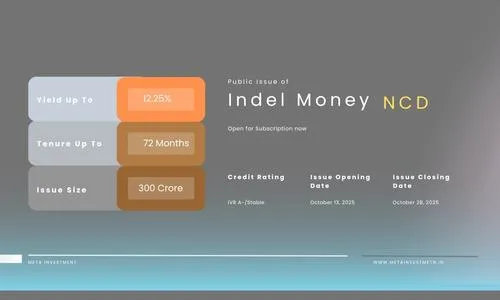 ArticleDiwali Investment 2025: Brighten Your Financial Future with Indel Money Secured NCD | High Yield Fixed Income for Pune Investors
 ArticleAdani Enterprises NCD 2026: 8.9% Yield, Secure Options for Retail Investors | Apply Now
This communication is intended solely for general educational and informational purposes. The information provided is general in nature and does not take into account the specific financial goals, risk profile, investment horizon, financial circumstances or other requirements of any particular investor. It should not be construed as personalised investment advice or as a recommendation to buy, sell or hold any specific financial product.
Fixed-income instruments such as Fixed Deposits, Bonds and NCDs carry credit/default, interest-rate, liquidity, reinvestment and issuer-specific risks; bank FDs and corporate instruments have different risk characteristics.
Distributor Disclosure: Where this content is provided by a distributor/intermediary, any applicable commission, remuneration, affiliation or other material conflict of interest shall be disclosed separately. The availability of a product through the distributor does not by itself imply that the product is suitable for every investor.
No Guarantee: No statement on this page should be interpreted as a promise, assurance or guarantee of returns or investment outcomes.
Meta Investment – Your Investment and Insurance Companion
Mutual fund updates, SIP tips, and what's moving the market. No daily noise — only when there's something worth reading.