NPS vs Mutual Funds: Which is Better for Retirement in India? (2026)
Both National Pension System (NPS) and Mutual Funds are popular long-term investment tools designed to build retirement wealth. However, they operate under different regulatory frameworks, carry distinct tax implications, and suit different investor profiles. This comparison will help you make an informed decision — or understand how to use both together.
What is NPS?
The National Pension System (NPS) is a government-sponsored, defined-contribution pension scheme regulated by the Pension Fund Regulatory and Development Authority (PFRDA). Contributions are invested across asset classes — equity (E), corporate bonds (C), and government securities (G) — chosen by the subscriber. At maturity (age 60), at least 40% of the corpus must be used to purchase an annuity; the remaining 60% can be withdrawn as a tax-free lump sum.
NPS is available to all Indian citizens aged 18–70 and mandatory for central government employees who joined service after January 2004.
What are Mutual Funds?
Mutual Funds are SEBI-regulated investment vehicles managed by professional fund managers. They offer hundreds of schemes across equity, debt, hybrid, and index categories — with no mandatory annuity requirement and no government-mandated lock-in (except ELSS which has 3 years). Learn more: How Mutual Funds Work.
NPS vs Mutual Funds — Head-to-Head Comparison
| Factor | NPS (Tier-1) | Mutual Funds |
|---|---|---|
| Regulator | PFRDA | SEBI |
| Minimum Investment | ₹1,000/year | ₹100/month via SIP |
| Lock-in | Until age 60 (partial exits allowed) | None (except ELSS: 3 years) |
| Tax Deduction | 80C (₹1.5L) + 80CCD(1B) (₹50,000 extra) | 80C via ELSS only (₹1.5L) |
| Tax on Maturity | 60% lump sum tax-free; annuity taxed at slab | LTCG 12.5% above ₹1.25L (equity); slab rate for debt |
| Annuity Requirement | 40% corpus must buy annuity | None |
| Returns | Market-linked (10–13% equity historically) | Market-linked (12–15% equity historically) |
| Liquidity | Very low (Tier-1); High (Tier-2, no tax benefit) | High (redeem any business day) |
| Flexibility | Low — limited asset class choices | Very high — thousands of schemes |
| Expense Ratio | Very low (0.01–0.09%) | Moderate (0.1–1.5%) |
| Death Benefit | Nominee gets full corpus | Nominee gets full units |
| Who Manages Funds | PFRDA-empanelled Pension Fund Managers | AMC-appointed fund managers |
When to Prefer NPS
NPS is a strong choice when:
- You are in the 30% tax bracket and want to utilise the additional ₹50,000 deduction under 80CCD(1B) — this alone saves ₹15,000 in tax annually
- You are a central or state government employee for whom NPS is mandatory
- You want a pension structure — a guaranteed monthly income through annuity in retirement
- You prefer very low fund management costs (NPS charges among the lowest in the world at 0.01–0.09%)
- You need the discipline of a locked-in corpus that you cannot withdraw impulsively
When to Prefer Mutual Funds
Mutual funds are the better choice when:
- You need flexibility — access to money before retirement for education, emergencies, or opportunities
- You want higher equity allocation with no ceiling (NPS caps auto-choice equity at 75%, reducing to 50% at age 50)
- You prefer no annuity mandate — your full corpus remains yours at redemption
- You are building wealth for multiple goals (not just retirement) through a single portfolio
- You want to choose from a wider universe of specific fund categories (sectoral, international, small-cap, etc.)
Can You Use Both? Yes — And Here's How
A practical retirement strategy for most salaried investors combines both:
- NPS Tier-1: Contribute at least ₹50,000/year to claim the 80CCD(1B) deduction (saves ₹15,000/year at 30% tax bracket)
- ELSS SIP: Invest for 80C deduction (₹1.5L/year) with 3-year lock-in and equity growth potential
- Equity Mutual Fund SIP: Additional long-term SIP in large-cap or index funds for flexible wealth building — accessible whenever needed
This combination gives you structured pension savings (NPS), tax-efficient equity growth (ELSS), and liquid wealth accumulation (open-ended MF) — covering all three dimensions of retirement planning.
Which is Better? — The CFP Perspective
As a SEBI-regulated, AMFI-registered MFD and CFP, we view NPS and mutual funds as complementary, not competing, tools. The NPS 80CCD(1B) deduction is one of the best tax-saving opportunities available — especially at higher tax brackets — and should not be left on the table. Beyond the tax benefit, the discipline of NPS lock-in helps investors stay invested long-term.
However, for the bulk of retirement corpus building and pre-retirement goal funding, equity mutual funds — especially through monthly SIPs — offer unmatched flexibility, liquidity, and return potential.
The right split depends on your income, tax bracket, risk tolerance, and retirement timeline. Connect with us for a personalised retirement plan.
Also see: National Pension System (NPS) — Full Guide | SIP Calculator | ELSS Tax-Saving Funds
Frequently Asked Questions
Is NPS or SIP better for retirement?
There is no universal answer — it depends on your employment type, tax bracket, and need for flexibility. NPS offers an additional ₹50,000 tax deduction under 80CCD(1B) and is ideal for those who want a pension structure. SIP (Systematic Investment Plan) in mutual funds gives full flexibility — no lock-in beyond ELSS and no annuity mandate. Many investors use both: NPS for the extra tax deduction and mutual fund SIPs for liquid, flexible wealth building.
Can I withdraw from NPS before 60?
Partial withdrawals from NPS Tier-1 are allowed after 3 years of subscription for specific purposes: higher education, marriage of children, purchase/construction of residential house, treatment of specified illnesses, disability exceeding 75%, or starting a new venture. Up to 25% of your own contributions can be withdrawn. Full premature exit (before 60) requires 80% of the corpus to be used for annuity purchase; only 20% is tax-free lump sum.
What is the difference between NPS Tier 1 and Tier 2?
NPS Tier-1 is the mandatory pension account with lock-in until age 60 (partial withdrawals allowed under specific conditions). Contributions qualify for 80C and 80CCD tax deductions. NPS Tier-2 is a voluntary savings account with no lock-in — you can withdraw anytime, but contributions do not attract any tax deduction (except for central government employees). Tier-2 is effectively a low-cost investment account, not a pension account.
Does NPS give guaranteed returns?
No. NPS returns are market-linked and depend on the asset class allocation you choose: equity (E), corporate bonds (C), or government securities (G). Historically, NPS equity funds have delivered 10–13% CAGR over 10-year periods, but returns are not guaranteed. The Pension Fund Regulatory and Development Authority (PFRDA) regulates NPS, not SEBI.
Which has better returns: NPS or ELSS?
Over long periods (10+ years), ELSS (equity mutual funds) have generally delivered higher absolute returns than NPS equity funds — typically 12–15% CAGR for ELSS vs. 10–13% for NPS equity. However, NPS offers an additional ₹50,000 deduction under 80CCD(1B) over and above 80C — which, depending on your tax bracket, can make NPS more tax-efficient overall. The right comparison is post-tax, post-cost returns adjusted for the annuity mandate at maturity.
What is the annuity requirement in NPS at maturity?
At age 60, at least 40% of the NPS Tier-1 corpus must be used to purchase an annuity (a regular monthly pension) from a PFRDA-empanelled annuity provider. The remaining 60% can be withdrawn as a lump sum and is fully tax-free. If the total corpus is below ₹5 lakh, you can withdraw the entire amount. The annuity income is taxed as per your income slab in retirement.
Can NPS and mutual funds be used together?
Yes — and this is a common strategy for retirement planning. Use NPS Tier-1 to claim the extra ₹50,000 deduction under 80CCD(1B) while also investing in equity mutual fund SIPs for flexible, long-term wealth creation. The NPS portion handles the pension/annuity structure; the mutual fund portfolio remains fully liquid and accessible for goals before retirement (children's education, home purchase, etc.).
What happens to NPS if I change jobs or become self-employed?
NPS is fully portable — your PRAN (Permanent Retirement Account Number) stays with you regardless of employer changes. If you move from a corporate/government employer to self-employment, you continue contributing to the same account as an individual subscriber (All Citizens Model). Contributions from the previous employer's tier stop, but your own contributions and the accumulated corpus continue to grow.
Read more about
 GuideMutual Funds in India 2026: Types, SIP Returns & Guide
 GuideUnlocking Wealth: The Comprehensive Guide to ELSS Mutual Funds
- GuideMutual Fund Distributor & Financial Planner in Pune
- GuideBeginner’s Guide to Mutual Funds in India – How to Start Investing in 2026
 GuideIndex Mutual Funds: Smart, Cost-Effective Investing for Indian Investors
 GuideMutual Fund Categorization and Types of Schemes: A Comprehensive Guide
- GuideCorporate NPS in Pune: Setup for Companies | Meta Investment
- GuideUnderstanding the NAV of Mutual Funds in India
Mutual Funds Insights
 GuideGold FoF Pause: What It Means for Your Gold SIPMutual Funds
 GuideGot a Bonus? Jio IPO or SIP: A Simple Decision FrameworkMutual Funds
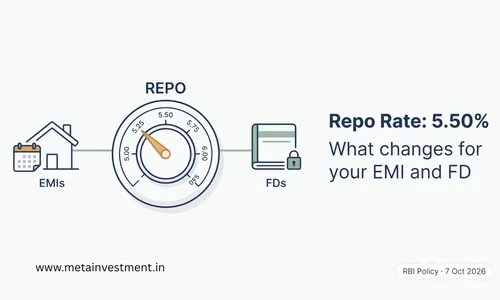 GuideRBI Hikes Repo Rate to 5.50%: What It Means for Your EMI and FDMutual Funds
Related Posts
 ArticleUnified Pension Scheme (UPS) vs NPS: Which is better for your retirement?
 ArticleNew NPS Exit Rules 2025: Higher Lump Sum, No Lock-in & Flexible Withdrawals
 ArticleA Look Back at 10 Years of Performance of Equity schemes of NPS
  ArticleNPS Retirement Income Schemes (RIS) & Drawdown Options Explained
This communication is intended solely for general educational and informational purposes. The information provided is general in nature and does not take into account the specific financial goals, risk profile, investment horizon, financial circumstances or other requirements of any particular investor. It should not be construed as personalised investment advice or as a recommendation to buy, sell or hold any specific financial product.
Mutual Fund investments are subject to market risks. Please read all scheme-related documents carefully before investing. Past performance is not indicative of future results and may not be sustained.
The suitability of any mutual fund product, scheme, category or strategy discussed on this page depends on an investor's individual circumstances, including financial goals, risk appetite, investment horizon and liquidity requirements. Investors should independently assess suitability and, where appropriate, seek professional advice before making investment decisions.
Meta Investment is an AMFI-registered Mutual Fund Distributor (ARN-129322) and is not a SEBI-registered Investment Adviser. If investments are made through a mutual fund distributor, the distributor may receive commission from Asset Management Companies in respect of eligible Regular Plan investments. Commission structures may vary across schemes and AMCs. Such commissions should not influence suitability-based recommendations, and applicable conflicts of interest will be disclosed. Please refer to our Commission Disclosure for further details.
Tax treatment of mutual fund investments depends on individual circumstances and prevailing tax laws, which are subject to change. Investors should consult a qualified tax professional for advice specific to their circumstances.
This disclaimer is intended to provide general disclosure and does not replace any scheme-specific disclosures, risk factors, regulatory disclosures or information contained in the applicable Scheme Information Document (SID), Statement of Additional Information (SAI) and Key Information Memorandum (KIM).
Distributor Disclosure: Where this content is provided by a distributor/intermediary, any applicable commission, remuneration, affiliation or other material conflict of interest shall be disclosed separately. The availability of a product through the distributor does not by itself imply that the product is suitable for every investor.
No Guarantee: No statement on this page should be interpreted as a promise, assurance or guarantee of returns or investment outcomes.
Meta Investment – Your Investment and Insurance Companion
Mutual fund updates, SIP tips, and what's moving the market. No daily noise — only when there's something worth reading.