EPFO SWP: Take Your PF as Monthly Income After Retirement
EPFO's Board has approved a way to take your PF as a regular income after retirement instead of one large cheque. It is a real change, but it is not in force yet, and the tax answer that decides its value is still missing.
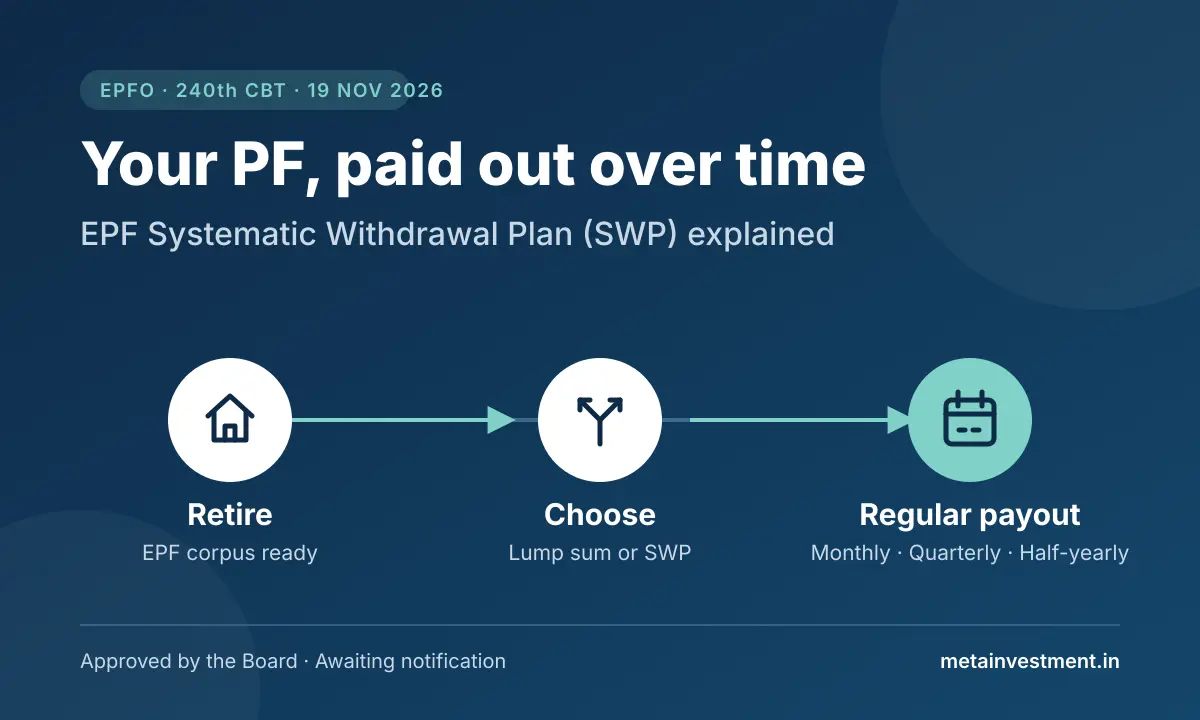
Picture the day you retire. Twenty-five or thirty years of EPF and VPF arrive in your bank account at once: ₹50 lakh, ₹80 lakh, sometimes over ₹1 crore. Then come the hard questions. Where does this money sit? How does it become a monthly income? How do you stop it from leaking into a new car, a relative's loan or a "sure-shot" scheme?
On 19 November 2026, the 240th meeting of EPFO's Central Board of Trustees (CBT) approved an answer that keeps part of this inside EPF itself: a Systematic Withdrawal Plan (SWP).
Here is what was actually approved, what is still pending, and how it fits into a retirement income plan. We will update this post when the rules are notified.
What Is the EPFO Systematic Withdrawal Plan?
The EPFO SWP lets a retiring member receive the accumulated provident fund in periodic instalments instead of withdrawing the whole amount in one go. According to the official Labour Ministry release:
- Payout frequency: monthly, quarterly or half-yearly, as the member chooses.
- Voluntary: no one is forced into it. The full lump sum remains available.
- Interest continues: the corpus not yet paid out keeps earning returns.
- On death: the nominee or dependant can take the remaining balance or keep receiving the instalments.
- First users: EPFO estimates about 6.32 lakh members aged above 55 with PF balances over ₹5 lakh will be the main beneficiaries in the initial phase.
How it compares with a mutual fund SWP
The name is borrowed from mutual funds, but the engine is different. A mutual fund SWP sells units at the day's NAV, so the remaining corpus rises and falls with markets. An EPF SWP has no units and no NAV. The balance earns the EPF rate declared for each year (8.25% for FY 2025-26, credited in July 2026). That rate is reviewed annually and can change.
What it is not
It is not the EPS pension. SWP pays out your EPF corpus, the money you and your employer contributed plus interest. The EPS pension is a separate scheme with its own service conditions, and this decision does not change it.
Why This Matters: Interest Does Not Last Forever Today
Most retirees miss this. Under current rules, if you retire at 55 or later, your EPF keeps earning interest for three years after retirement. After that the account becomes inoperative and stops earning. Leave service before 55 and interest runs only until you turn 58.
So today, a retiree effectively has to withdraw and redeploy the corpus within three years. SWP changes that. The unpaid balance stays with EPFO and keeps earning while instalments go out. For anyone who values stability, that is the real gain, more than the monthly cheque itself.
Approved but Not in Force: What Still Needs Notification
Board approval is not the same as a rule you can use. The Labour Ministry release says the EPF Scheme amendments "will be notified accordingly after approval from the Ministry", and that a corresponding Income Tax Act amendment "is being taken up with the Ministry of Finance". No effective date has been announced.
The official release does not yet answer these questions:
- How the instalment is set: a fixed amount, a percentage of the balance, or a chosen tenure.
- Minimum and maximum tenure, and any minimum instalment size.
- Whether you can stop, change the amount, or take the rest as a lump sum midway.
- Whether a part lump sum plus SWP on the balance will be allowed.
- How to apply: a claim form, the member portal or UMANG.
- How instalments and post-retirement interest will be taxed.
Until the notification arrives, treat every detail beyond the official release as reporting, not rules.
Worked Example: How Long Would ₹50 Lakh Last?
Illustrative only. It assumes the 8.25% FY 2025-26 rate continues unchanged, ignores tax, and uses monthly compounding. EPF calculates interest on the monthly running balance and credits it once a year, so real figures will differ. Future EPF rates are not known.
A ₹50 lakh corpus at 8.25% earns about ₹4.125 lakh a year, or roughly ₹34,000 a month.
| Monthly SWP from ₹50 lakh | What happens to the corpus (illustrative, at 8.25%) |
|---|---|
| ₹30,000 a month | Payout is below the interest earned, so the capital stays roughly intact |
| ₹40,000 a month | Payout exceeds interest; the corpus lasts about 24 years |
| ₹50,000 a month | Payout well above interest; the corpus lasts about 14 years |
The rule is simple. Withdraw less than the interest and the capital holds. Withdraw more and you are spending the capital, faster than most people expect. At 60, a 24-year runway reaches 84. A 14-year runway ends at 74.
Inflation is the other half of the story. ₹40,000 a month today will buy far less in 2045. A fixed payout from a fixed-income pool does not grow with your expenses.
The Other Big Changes from the Same Meeting
The 240th CBT also approved changes that affect working members, not just retirees. These too take effect only after notification.
- Minimum balance cut from 25% to 10%. In October 2025 the Board had required 25% of contributions to stay in the account at all times. That is now 10%, so members may be able to access up to 90% of the eligible balance, subject to withdrawal conditions.
- Final withdrawal waiting period cut from 12 months to 2 months. In October 2025 the Board had extended the premature final settlement period from 2 months to 12. This brings it back to 2 months.
- UAN-linked voluntary contributions. A route for direct voluntary contributions and third-party micro-contributions (such as customer tips for gig and platform workers), independent of employer payroll.
- AIF investment. In-principle approval to invest up to 3% of fresh accretion in eligible Alternative Investment Funds, within the overall ceiling and initially through government-backed entities.
- EDLI exemption relief. EDLI Scheme 2026 amendments, with a six-month window for eligible establishments to renew expired exemptions.
Easier access is a double-edged change. The 25% floor existed to protect retirement savings. With it lowered, the discipline of leaving EPF untouched moves back to you.
EPF SWP vs Lump Sum: The Trade-Offs
| Factor | EPF SWP | Lump sum at retirement |
|---|---|---|
| Interest on the unpaid balance | Continues while instalments are paid, as per the release | Stops once withdrawn; interest ends three years after retirement if left idle |
| Liquidity | Depends on the notified rules on stopping or switching | Full access immediately |
| Reinvestment risk | Lower, as money stays in EPF | You must find a new home for the whole corpus |
| Temptation to spend | Lower, as money arrives in instalments | Higher, as the full amount sits in your account |
| Tax | Pending the Income Tax Act amendment | Generally exempt after five years of continuous service |
| Inflation protection | Limited; payouts come from a fixed-income pool | Depends on where you reinvest |
| Flexibility | Choice of monthly, quarterly or half-yearly | Complete, along with full responsibility |
How EPF SWP Compares with Other Retirement Income Options
| Option | Return type | Investment limit | Liquidity | Tax on income |
|---|---|---|---|---|
| EPF SWP (pending) | EPF rate declared each year (8.25% for FY 2025-26) | Your EPF corpus | To be notified | Pending I-T amendment |
| SCSS | Fixed for 5 years; 8.2% for Oct–Dec 2026 deposits | ₹30 lakh per individual | Premature closure with penalty | Interest taxable |
| NPS systematic exit (SLW/SUR) | Market-linked | Your NPS corpus | Phased; depends on corpus slab | Check lump-sum exemption rules |
| Annuity | Fixed for life, per annuity rate at purchase | No upper limit | Very low | Annuity income taxable |
| Debt or hybrid mutual fund SWP | Market-linked NAV | No upper limit | High; exit loads may apply | Capital gains, per category rules |
| RBI Floating Rate Savings Bonds | NSC rate + 0.35%, reset every six months | No upper limit | 7-year lock-in, limited early exit for seniors | Interest taxable |
Each option solves a different problem. EPF SWP offers continuity, SCSS a fixed rate, NPS phased exits and market growth, annuities lifelong income, and mutual fund SWPs flexibility with market risk. The suitability of any investment category depends on an investor's financial goals, risk appetite, investment horizon and overall financial circumstances.
Tax: What We Know and What We Don't
What we know:
- An EPF withdrawal after five years of continuous service is generally tax-exempt.
- Tax tribunals have held that EPF interest credited after employment ends is taxable in the year it is credited, even though the balance on the date you left was exempt.
- Interest on employee contributions above ₹2.5 lakh a year (₹5 lakh where there is no employer contribution) is already taxable. This matters for IT professionals with large VPF contributions.
What we don't know:
- Whether SWP instalments will be treated like today's exempt lump sum.
- Whether interest earned on the retained balance after retirement will be exempt or taxable.
This is the single biggest open question. A tax-free 8.25% and a taxable 8.25% are very different numbers for someone in the 30% bracket. We will update this section once the Income Tax Act amendment is notified.
Who Might Find EPF SWP Useful, and Who Might Not
It may suit:
- Conservative retirees who want predictable income without managing a portfolio.
- People who know a lump sum in a savings account would not stay intact.
- Members with large EPF and VPF balances who have other assets for growth.
It may not suit:
- Those who need a large sum at retirement, for a home loan, a child's education or a wedding.
- Those with long life expectancy who need growth assets to keep up with inflation over 25 to 30 years.
- Those who may be better served by other products once the final tax rules are known.
Whether it fits depends on your full picture: expenses, other assets, health, dependants and the tax rules when they arrive.
How to Plan Around EPF SWP: A 5-Step Checklist
- Check your UAN passbook. Note your EPF and VPF balance separately, and confirm your service history is complete across employers.
- Separate EPF from EPS. SWP covers only EPF. Check whether you qualify for the EPS pension and what it may pay.
- Work out your monthly expenses. Then set aside an emergency fund of at least six to twelve months outside any payout plan.
- Split stable income from growth. Decide how much of your retirement income needs to come from stable sources (EPF SWP, SCSS, NPS exit options, annuities) and how much stays invested for growth.
- Recheck once the rules are notified. Look again at instalment rules, flexibility and tax before choosing SWP or the lump sum.
If you are a few years from retirement, steps 1 to 3 can start today. Steps 4 and 5 wait for the notification.
Key Takeaways
- EPFO's Board approved a voluntary SWP on 19 November 2026: monthly, quarterly or half-yearly PF payouts for retiring members.
- The unpaid balance keeps earning returns, which matters because idle EPF accounts stop earning three years after retirement today.
- It is not in force yet. The EPF Scheme amendment and an Income Tax Act amendment are pending.
- Tax on instalments and post-retirement interest is the deciding unknown.
- The minimum balance (25% to 10%) and final withdrawal wait (12 months to 2 months) changes also await notification.
- SWP is one income tool, not a complete retirement plan.
A Pension-Like Option Worth Waiting For
EPF SWP turns a corpus that used to arrive as one cheque into something closer to a pension, while the balance keeps earning. For retirees who value stability, that is a meaningful step.
But the value depends on details still pending, especially tax. The sensible move today is to know your numbers, separate EPF from EPS, and decide how stable income and growth should share your retirement. If you are working out how EPF, NPS and mutual funds can together fund your retirement income, that is a conversation worth having. You can also check your risk profile with RiskPro or explore our NPS guides.
Source: Ministry of Labour & Employment, PIB release on the 240th CBT meeting, 19 November 2026. Information is current as of 22 November 2026 and may change on notification.
Interested in Investing? Connect with Meta Investment
Meta Investment is a financial product distribution and services firm. If you'd like to explore whether a financial product is the right fit for your portfolio, our team will walk you through the details, help you assess suitability, and guide you through the onboarding process.
Meta Investment – Your Investment and Insurance Companion
Frequently Asked Questions
What is the EPFO Systematic Withdrawal Plan (SWP)?
It is a voluntary option approved by EPFO's Central Board of Trustees on 19 November 2026. It lets a retiring EPF member receive the provident fund corpus in periodic instalments (monthly, quarterly or half-yearly) instead of one lump sum, while the unpaid balance stays with EPFO and keeps earning returns.
Is EPFO SWP available now?
No. As of 22 November 2026 it has been approved by the Board but not yet notified. The Labour Ministry has said the EPF Scheme amendments will be notified after Ministry approval, and a matching Income Tax Act amendment is being taken up with the Ministry of Finance. No effective date has been announced.
Who is eligible for EPF SWP?
The facility is meant for members retiring from service, and it is entirely voluntary. EPFO estimates about 6.32 lakh members aged above 55 with PF balances over ₹5 lakh will be the main users in the first phase. Detailed eligibility conditions will come with the notified scheme amendment.
Will I keep earning interest on the PF balance I have not withdrawn under SWP?
According to the official release, the remaining corpus keeps earning returns while instalments are paid out. Because each instalment reduces the balance, the interest earned falls over time. The EPF rate is declared every year and is not fixed; it was 8.25% for FY 2025-26.
Can I take part of my PF as a lump sum and the rest through SWP?
The official release does not say. Some reports suggest a combination may be possible, but this will only be clear once the scheme amendment is notified. Until then, it is best treated as an open question.
Is EPF SWP the same as the EPS pension?
No. SWP pays out your EPF corpus, which is your own and your employer's accumulated contributions plus interest. The EPS pension is a separate defined-benefit pension, generally payable after 10 years of eligible service. The SWP decision does not change EPS rules.
Are EPF SWP instalments taxable?
This is not yet settled. Today, an EPF withdrawal after five years of continuous service is generally tax-exempt. Whether periodic instalments, and interest earned on the retained balance after retirement, get the same treatment depends on the Income Tax Act amendment now being taken up with the Ministry of Finance.
Is EPF interest earned after retirement taxable today?
Tax tribunals have held that EPF interest credited after a member stops being employed is taxable in the year it is credited, even though the balance at the date of leaving was exempt. This is why the tax treatment of the retained SWP balance matters so much.
What happens to the EPF SWP balance if the member dies?
As per the official release, the nominee or dependant can either withdraw the remaining balance or continue receiving the periodic payments. The release also says the option may extend to eligible family members or beneficiaries.
How long does an EPF account earn interest after retirement today?
Under current rules, a member retiring at 55 or later earns interest for three years after retirement, after which the account becomes inoperative and stops earning interest. A member leaving service before 55 earns interest until age 58. SWP is designed to keep the unpaid corpus earning while payouts continue.
What is the new EPF minimum balance rule?
The Board reduced the minimum balance that must stay in the account from 25% of contributions to 10%. This means members may be able to access up to 90% of eligible balance instead of 75%, subject to withdrawal conditions. The change takes effect only after notification.
What is the new waiting period for EPF final withdrawal?
The Board cut the waiting period for final withdrawal from 12 months to 2 months. In October 2025 the Board had increased the premature final settlement period from 2 months to 12 months; this decision brings it back to 2 months, subject to notification.
How is EPF SWP different from a mutual fund SWP?
A mutual fund SWP redeems units at a market-linked NAV, so the value of the remaining corpus moves with markets. An EPF SWP pays out from a balance that earns the EPF rate declared each year, with no units or NAV. The two carry different risks, liquidity and tax treatment.
How much monthly income can a ₹50 lakh EPF corpus give under SWP?
For illustration only, at 8.25% a ₹50 lakh balance earns about ₹34,000 a month in interest. Withdrawals below that level would roughly preserve the capital; ₹40,000 a month would last about 24 years and ₹50,000 a month about 14 years. Actual results depend on future EPF rates, the notified rules and tax.
What else did the 240th CBT meeting approve?
Besides SWP, the Board approved UAN-linked voluntary and third-party micro-contributions outside employer payroll, gave in-principle approval to invest up to 3% of fresh accretion in eligible AIFs, approved EDLI Scheme 2026 amendments with a six-month exemption renewal window, and reviewed the CITES 2.0 claims platform.


म्युच्युअल फंड अपडेट्स, SIP टिप्स आणि बाजारात काय घडतंय. रोजचा गोंधळ नाही — फक्त वाचण्यासारखं काही असेल तेव्हाच.
Read more about
- Taxation on Liquid Funds - Updated for Finance Bill 2023 (Budget 2023)
- How to Prepare Retirement Plan
- A Comprehensive Guide to Save Tax with Insurance in India
- Ensuring Retirement Bliss: Key Factors to Assess Retirement Income Sufficiency
- Using Capital Gains Bonds in India to Maximizing Wealth Growth
- The Tax Harvesting Garden - Cultivating Wealth with Care
- Invest in this Nifty 50 Index Fund to Save Tax
- A Look Back at 10 Years of Performance of Equity schemes of NPS
- Demystifying Annuities: Your Retirement Income Lifeline?
- Boost Your Retirement Savings with Enhanced NPS Benefits in Budget 2024
- Taxation- Capital Gains- Revised Rates vs Previous Rate
- Unified Pension Scheme (UPS) vs NPS: Which is better for your retirement?
- NPS Vatsalya launched today
- Building Blocks of Wealth: A Guide to Investing for Kids
- Building Your Layer Cake
- MOIC: A Comprehensive Guide
- Equity Linked Savings Schemes
- 7-Day Plan for Indian Women to Kickstart Their Financial Journey: From Scarcity to Abundance
- Unified Pension Scheme (UPS) for Government Employees: A Complete Guide
- NRI Mutual Fund Taxation: How DTAA Can Save You Tax (Anushka Shah Case)
- Common Myths About Corporate NPS Debunked
- HDFC Life Click 2 Achieve – Guaranteed Savings Plan with Life Cover
- The Power of a No-Contest Clause: How Ratan Tata's Will Prevented a Legal Battle
- India Surpasses Japan to Become 4th Largest Economy in 2025 | Growth & Challenges
- ManipalCigna Sarvah Uttam Health Insurance Plan: Comprehensive Coverage with Unique Benefits
- Mutual Funds Are the New Status Symbol (Not Your Bank Balance)
- Mutual Fund Scheme Name Changes in India (2025) – Complete List & Reasons
- From Freedom Fighters to Financial Freedom: Gen Z Investing & Independence Day Lessons
- All Weather Gold: A Principal-Protected Way to Bet on Gold (Until Aug 31)
- ESAF SFB NCD Issue: 11.30% Coupon | Basel II Compliant Bonds
- Begin Your Wealth Journey This Ganesh Chaturthi: Ganpati-Inspired Mutual Fund Lessons
- Tata AIA Health SIP Review 2025: A Smart Health + Investment Plan?
- NPCI Raises UPI Transaction Limits: A Complete Guide to High-Value Payments from Sept 2025
- NPS Exit Rules 2025: Your Guide to the Major Changes for Withdrawal, Annuity & More
- New NPS Exit Rules 2025: Higher Lump Sum, No Lock-in & Flexible Withdrawals
- EPS 2026: What the New Employees' Pension Scheme Means for You
- NPS Swasthya Explained: Wait for the Health-Linked Pension, or Buy Health Cover Now?
- AMFI Stock Reclassification: What It Means for Your Fund
- FTSE India Index Explained: What It Is & Why It Matters Now
- Tata Mumbai Marathon 2027 Fee Is ₹5,000: How to Budget for It
- Pune on India's Wealth Map: What the 2026 List Reveals
- Emergency Fund: The Money That Buys the Right to Say No
- The 8 Freedoms Checklist for Financial Independence
- How to Check an Insurer's Complaint Record Before You Buy
- Your Increment Came Through. Did Your SIP?
- PFRDA's New NPS Scheme Categories: What Actually Changed
- SEBI Mandatory Nomination Rules for Demat and MF Folios
- Financial Green Flags That Matter More Than Salary
- Record SIP Inflows in a Falling Month: Reading August's AMFI Data
- NPS Swasthya Guidelines 2026: What PFRDA Just Changed
- Alchemy India Long Term Fund: GIFT City Guide for NRIs
- Navratri to Diwali 2026: Your Festive-Season Money Calendar
- NPS Sanchay Explained: Who It Is For and How It Differs
- RBI Hikes Repo Rate to 5.50%: What It Means for EMIs and FDs
- Got a Bonus? Jio IPO or SIP: A Simple Decision Framework
- IPO Money Blocked vs Debited: What Actually Happens
- Can NRIs Apply for Indian IPOs? NRE vs NRO Explained
- GIFT City Funds vs International Fund of Funds: Differences
- IPO Refund or Unblock Not Received: What to Check
- Didn't Get an IPO Allotment? Here's Why
- Have a Problem With Your Mutual Fund? Here's How a Complaint Works, Step by Step
- Investing in Your Child's Name: Mutual Funds vs NPS Vatsalya
- What Is a Target Maturity SDL Index Fund? A Plain Guide
- HDFC Charity Fund for Cancer Cure NFO: How It Works
- EPFO SWP: Take Your PF as Monthly Income After Retirement
- महिलांसाठी आर्थिक यशस्वीतेची 7-दिवसीय नियोजन: टंचाईपासून विपुलतेकडे
- सरकारी कर्मचाऱ्यांसाठी एकीकृत पेन्शन योजना (यूपीएस): एक संपूर्ण मार्गदर्शक
- NRI म्युच्युअल फंड कर: DTAA मदतीने कसे कर बचत करू शकता (अनुष्का शहा केस)
- HDFC Life Click 2 Achieve – निश्चित बचत योजना आणि जीवन विमा संरक्षण
- एप्रिल २०२५ पासून भारतातील म्युच्युअल फंड स्कीमच्या नावातील बदल - संपूर्ण यादी आणि कारणे
- Demat आणि MF Folio साठी SEBI चे अनिवार्य Nomination नियम
- NPS Swasthya मार्गदर्शक तत्त्वे 2026: PFRDA ने नेमके काय बदलले
- नवरात्री ते दिवाळी 2026: सणासुदीच्या काळातील आर्थिक दिनदर्शिका
- NPS Sanchay सोप्या भाषेत: कोणासाठी आणि इतर NPS पेक्षा वेगळे कसे
- RBI ने रेपो दर 5.50% केला: तुमच्या EMI आणि FD वर काय परिणाम?
- बोनस मिळाला? Jio IPO की SIP: निर्णय घेण्याची सोपी पद्धत
- IPO चे पैसे ब्लॉक होतात की कापले जातात? प्रत्यक्षात काय होते
- NRI भारतीय IPO साठी अर्ज करू शकतात का? NRE आणि NRO मधील फरक
- IPO रिफंड किंवा अनब्लॉक झाले नाही: काय तपासायचे
- IPO वाटप मिळाले नाही? त्याची कारणे
- टार्गेट मॅच्युरिटी SDL इंडेक्स फंड म्हणजे काय? सोप्या भाषेत
- HDFC Charity Fund for Cancer Cure NFO: तो कसा काम करतो
Related Posts
 ArticleEPF Scheme 2026 Explained: New PF Rules, Withdrawals & NPS Comparison
- GuideHow to Get Monthly Income After Retirement in India: SWP vs SCSS vs Annuity vs FD (2026)
 ArticleEPS 2026: What the New Employees' Pension Scheme Means for You
- GuideHow Much Money Do You Need to Retire Comfortably in India? (2026 Guide)
This communication is intended solely for general educational and informational purposes. The information provided is general in nature and does not take into account the specific financial goals, risk profile, investment horizon, financial circumstances or other requirements of any particular investor. It should not be construed as personalised investment advice or as a recommendation to buy, sell or hold any specific financial product.
Mutual Fund investments are subject to market risks. Please read all scheme-related documents carefully before investing. Past performance is not indicative of future results and may not be sustained.
The suitability of any mutual fund product, scheme, category or strategy discussed on this page depends on an investor's individual circumstances, including financial goals, risk appetite, investment horizon and liquidity requirements. Investors should independently assess suitability and, where appropriate, seek professional advice before making investment decisions.
Meta Investment is an AMFI-registered Mutual Fund Distributor (ARN-129322) and is not a SEBI-registered Investment Adviser. If investments are made through a mutual fund distributor, the distributor may receive commission from Asset Management Companies in respect of eligible Regular Plan investments. Commission structures may vary across schemes and AMCs. Such commissions should not influence suitability-based recommendations, and applicable conflicts of interest will be disclosed. Please refer to our Commission Disclosure for further details.
Tax treatment of mutual fund investments depends on individual circumstances and prevailing tax laws, which are subject to change. Investors should consult a qualified tax professional for advice specific to their circumstances.
This disclaimer is intended to provide general disclosure and does not replace any scheme-specific disclosures, risk factors, regulatory disclosures or information contained in the applicable Scheme Information Document (SID), Statement of Additional Information (SAI) and Key Information Memorandum (KIM).
Distributor Disclosure: Where this content is provided by a distributor/intermediary, any applicable commission, remuneration, affiliation or other material conflict of interest shall be disclosed separately. The availability of a product through the distributor does not by itself imply that the product is suitable for every investor.
No Guarantee: No statement on this page should be interpreted as a promise, assurance or guarantee of returns or investment outcomes.
Meta Investment – Your Investment and Insurance Companion