NPS Swasthya: Rules, Withdrawal Limit, Insurance & Charges (PFRDA 2026)
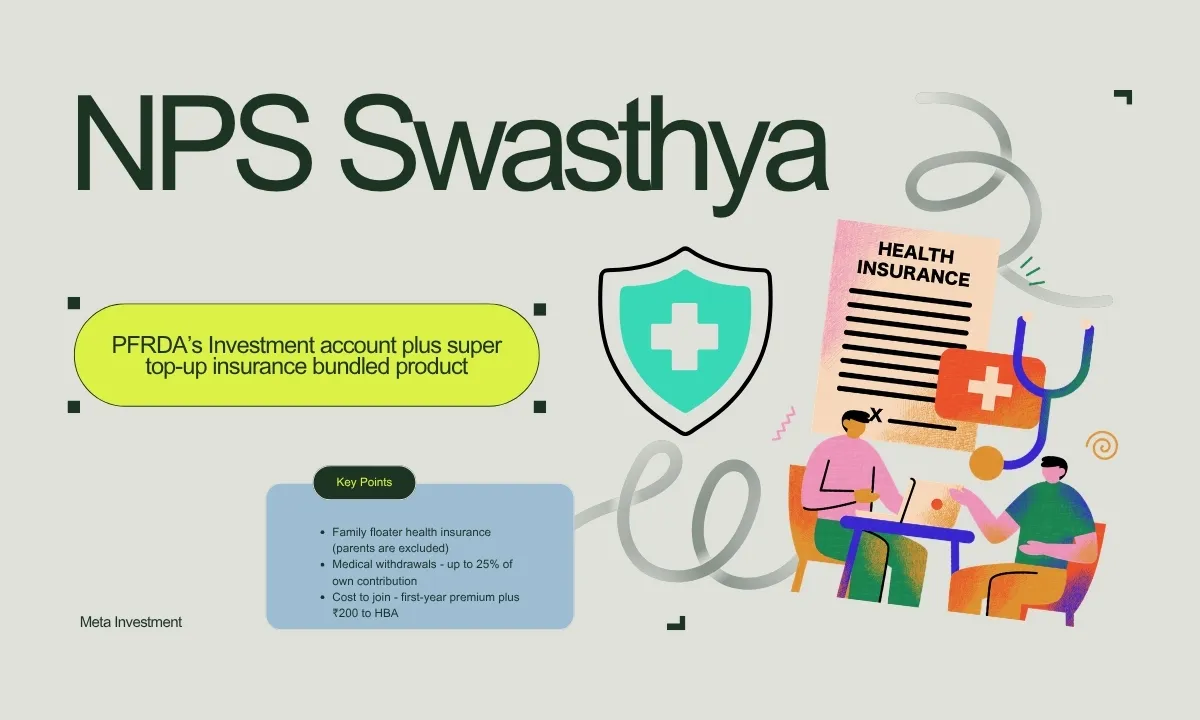
NPS Swasthya is a specific-purpose National Pension System scheme that combines a dedicated NPS investment account with a mandatory, standardised super top-up health insurance policy. It allows a subscriber to use part of their own pension contributions towards eligible medical bills.
PFRDA notified the operational guidelines on 18 September 2026 (Circular No. PFRDA/2026/49/NPS-SWASTHYA/01), effective immediately. The scheme had earlier run as a pilot under PFRDA's regulatory sandbox. It will be offered by individual pension funds.
NPS Swasthya at a Glance
| Feature | Detail |
|---|---|
| Structure | NPS Swasthya investment account + mandatory super top-up policy (legally and operationally distinct) |
| Who can join | Anyone eligible for NPS; insurance entry age 18-70, renewal up to 85 |
| Coverage | Family floater: self, spouse, up to 2 dependent children. Parents excluded |
| Minimum initial contribution | First-year premium (with taxes) + ₹200 HBA charge (plus taxes) + ₹1,000 to the account |
| Minimum later contribution | ₹10 |
| Investment | Central Government Scheme pattern; separate scheme account per pension fund |
| Partial withdrawal | Up to 25% of the subscriber's contributions; unlimited number; no waiting period |
| Who gets the money | Hospital / healthcare provider, never the subscriber |
| Extra charges | Up to 0.08% p.a. of AUM (pension fund) + ₹200 a year (HBA), plus standard All Citizen Model charges |
How NPS Swasthya Works
- Two components, both mandatory. The account sits under your existing PRAN in a separate NPS Swasthya scheme at the pension fund. The insurance policy is issued under a master policy arrangement by an IRDAI-registered insurer. You cannot enrol in one without the other.
- Corpus and deductible work together. The super top-up policy starts paying once the family's total insurance-admissible expenses in the policy year cross the deductible. The NPS Swasthya corpus is the pool that can be used towards healthcare expenses, including amounts the insurer does not pay.
- A Health Benefit Administrator (HBA) empanelled by the Association of NPS Intermediaries verifies eligibility, the withdrawal limit and available corpus, and coordinates settlement with the hospital. It is not an insurer or insurance intermediary and cannot solicit or advise on insurance.
Partial Withdrawals for Healthcare
- Withdrawals towards eligible out-patient and in-patient expenses cannot exceed 25% of the contributions made to the NPS Swasthya account. The cap is on contributions, not on the current market value of the corpus.
- No restriction on the number of withdrawals and no waiting period, including for the first one.
- The money is settled with the hospital or provider, not paid to the subscriber.
- An Eligible Healthcare Expense is defined irrespective of whether the insurance policy admits it. An expense not paid by insurance may be considered from the corpus.
- Fabricated or fraudulent healthcare requests are not paid from the corpus.
Illustration: if ₹2 lakh has been contributed to the account, partial withdrawals for healthcare are capped at ₹50,000 in total. A larger inpatient bill has to be met by the insurance policy or through the premature-exit route below.
The Standard Insurance Policy
Every pension fund must offer the same standard policy; an insurer-specific variant is not allowed. This makes schemes comparable on premium and service.
| Annual aggregate deductible | Family floater sum insured |
|---|---|
| ₹10,000 | ₹1 lakh |
| ₹50,000 | ₹5 lakh |
| ₹1 lakh | ₹10 lakh |
| ₹3 lakh | ₹30 lakh |
The deductible applies to cumulative expenses of all covered family members in the policy year, not to each claim.
Cover under the standard policy
- Single private room for normal hospitalisation; ICU at actuals within the sum insured
- Pre-hospitalisation 30 days, post-hospitalisation 60 days
- Road ambulance up to ₹2,500 per emergency hospitalisation
- Day-care procedures, inpatient and domiciliary hospitalisation, AYUSH treatment, prescribed modern treatments and organ-donor expenses, subject to the final policy wording
- No co-payment and no disease-specific sub-limits
Waiting periods and underwriting
- Initial waiting period: 30 days (except accidents)
- Pre-existing diseases: 12 months. Specified diseases or procedures: 12 months
- Controlled Type 2 diabetes, hypertension, hyperlipidaemia and asthma that do not trigger enhanced underwriting are covered after 12 months
- Enrolment is ordinarily based on a Good Health Declaration covering 15 listed conditions (for example heart attack, stroke, cancer, Type 1 diabetes, HIV/AIDS), without formal medical reports. A trigger leads to a premium loading; a decline for one family member does not by itself disqualify the others
- No fresh underwriting at renewal unless the sum insured is increased, and renewal premium cannot be raised merely because of an individual's claim
Premiums are quoted for three entry-age cohorts: 18-40, above 40 to 60, and above 60 to 70 years. The final policy wording is the reference for coverage and exclusions.
Costs and Charges
- To start: first-year premium (with taxes) + ₹200 annual HBA maintenance charge (plus taxes) + ₹1,000 into the account.
- Ongoing: standard NPS All Citizen Model charges + up to 0.08% per annum of AUM (plus taxes) + ₹200 a year (plus taxes) to the HBA.
- Premium and its taxes must be shown separately from account charges, and no other charge can be recovered unless PFRDA permits it.
- From the second year, the renewal premium may be paid from the corpus under the subscriber's mandate.
Because the premium recurs every year, the real cost of taking part is meaningfully higher than the ₹1,000 headline investment.
Transfer from an Existing NPS Account
A subscriber may transfer funds from an existing NPS scheme under the All Citizen Model into the NPS Swasthya account, but only to the extent needed to meet the applicable deductible.
Exit, Renewal and Switching
| Situation | What the guidelines say |
|---|---|
| Premature exit | Allowed where eligible inpatient expenditure in a single instance exceeds the partial-withdrawal limit. Corpus is first used for that expense; any balance merges into an All Citizen Model NPS scheme (created if none exists). A policy already in force continues for its remaining period |
| Normal exit / death | Rules for non-Government NPS subscribers apply; nomination rules also follow non-Government subscribers |
| Renewal funding | Pension fund to alert at 90, 60 and 30 days before renewal where the balance may be short |
| Lapse | If premium stays unpaid after the grace period and cover lapses, NPS Swasthya is closed and merged into an All Citizen Model scheme |
| Switching | Allowed at insurance renewal; may change pension fund and insurer. Waiting-period and portability credits carry over per IRDAI rules; outgoing insurer remains responsible for claims from its period |
| Other NPS accounts | Closure of NPS Swasthya does not affect them |
Service Standards Written into the Rules
- Insurance policy starts within T+1 working day of successful enrolment and receipt of the minimum initial contribution
- Cashless pre-authorisation within one hour of a complete request; final discharge authorisation within three hours
- Planned inpatient corpus authorisation within one working hour of complete documents
- Corpus settlement intimation within 7 working days of final billing documents
- Reimbursement target within 15 calendar days of the last necessary document
Grievances against any participant (pension fund, CRA, PoP, HBA or insurer) can be lodged on PFRDA's Pension Sahayak platform. Claim-related grievances stay with the insurer under IRDAI rules.
If You Were in the Pilot
The sandbox schemes are discontinued when the guidelines are implemented. Pilot subscribers are to be offered a choice: migrate to an NPS Swasthya scheme under the new guidelines, or merge into an NPS scheme under the All Citizen Model, with continuity of records, benefits and applicable insurance cover. Read the migration notice from your pension fund before choosing.
Points to Check Before Enrolling
- Existing health cover. A super top-up sits above a deductible; check how it interacts with employer group cover and personal policies.
- Deductible slab. Whether the corpus can realistically fund a deductible that applies to the family's total yearly expenses.
- Parents. They are excluded, so their medical costs need a separate plan.
- Total annual cost. Premium + ₹200 HBA charge + up to 0.08% AUM charge + standard NPS charges.
- Contribution discipline. Irregular contributions can leave renewals unfunded, and a lapse closes the whole NPS Swasthya structure.
- Investment pattern. It is fixed by regulation, not chosen by you; check it fits the role this money is meant to play.
- Tax treatment. The circular is silent on tax; confirm with a qualified tax professional.
Related Reading
- NPS Swasthya Guidelines 2026: What PFRDA Just Changed - our detailed walkthrough
- NPS Exit Rules 2025: Withdrawal, Annuity and Partial Exit
- NPS Vatsalya - NPS for minors
- NPS Returns by Scheme and Pension Fund
Source: PFRDA Circular No. PFRDA/2026/49/NPS-SWASTHYA/01 dated 18 September 2026, Operational Guidelines for NPS Swasthya under the National Pension System (NPS), 2026. Individual pension funds will roll out their own schemes, premiums and processes; details may change as PFRDA issues clarifications.
The suitability of any investment category depends on an investor's financial goals, risk appetite, investment horizon and overall financial circumstances. This page is for educational purposes only and is not a recommendation to enrol in, or avoid, NPS Swasthya. NPS investments are market-linked and subject to market risks. Insurance is the subject matter of solicitation; the linked policy is governed by IRDAI regulations and the insurer's terms and conditions.
If investments are made through a mutual fund distributor, the distributor may receive commissions from Asset Management Companies. Such commissions should not influence suitability-based recommendations. Mutual Fund investments are subject to market risks. Please read all scheme-related documents carefully before investing.
Frequently Asked Questions
What is NPS Swasthya?
NPS Swasthya is a specific-purpose NPS scheme under Regulation 4A of PFRDA's Exits and Withdrawals Regulations, 2015. It has two parts: a dedicated NPS Swasthya investment account and a mandatory super top-up health insurance policy. It lets a subscriber use part of their own contributions for eligible healthcare expenses.
How much can I withdraw from NPS Swasthya for medical expenses?
Partial withdrawals cannot exceed 25% of the contributions the subscriber has made to the NPS Swasthya account. There is no limit on the number of withdrawals and no minimum waiting period. The amount is settled directly with the hospital or healthcare provider, never paid to the subscriber.
Is NPS Swasthya the same as health insurance?
No. The NPS Swasthya account and the insurance policy are legally and operationally distinct. The account is governed by PFRDA; the super top-up policy is governed by IRDAI regulations and the insurer's policy terms. Withdrawals come from your own corpus, while insurance claims are paid by the insurer once the annual aggregate deductible is crossed.
Who can join NPS Swasthya?
Any individual eligible to join NPS can enrol. The insurance policy accepts subscribers aged 18 to 70 at entry, and renewal can continue up to and including age 85, subject to premium, policy terms and applicable law.
Who is covered under the insurance policy?
A single family floater covering the subscriber, spouse and up to two dependent children. Parents are excluded.
What is the annual aggregate deductible?
It applies to the combined insurance-admissible expenses of all covered family members in a policy year, not to each claim separately. The four options are ₹10,000 (sum insured ₹1 lakh), ₹50,000 (₹5 lakh), ₹1 lakh (₹10 lakh) and ₹3 lakh (₹30 lakh).
What is the minimum contribution to open NPS Swasthya?
The first year's insurance premium including taxes, plus an annual maintenance charge of ₹200 (plus taxes) payable to the Health Benefit Administrator, plus ₹1,000 towards the investment account. Later contributions can be as low as ₹10.
How is the NPS Swasthya corpus invested?
As per the investment pattern prescribed for the Central Government Scheme under PFRDA's investment guidelines, in a separate scheme account maintained by each pension fund. The subscriber does not choose the allocation, and PFRDA may modify the pattern. The corpus is market-linked and can fluctuate.
What charges apply?
The standard NPS All Citizen Model charges, plus up to 0.08% per annum of NPS Swasthya AUM (plus taxes) levied by the pension fund, plus the ₹200 annual maintenance charge (plus taxes) for the Health Benefit Administrator. The insurance premium and its taxes are shown separately.
Can NPS Swasthya pay for an expense my insurer does not cover?
Yes, within limits. An Eligible Healthcare Expense is defined irrespective of whether the insurance policy admits it, so an expense not paid by insurance may be considered from the corpus. An insurer's decision based on material non-disclosure does not by itself bar payment of a genuine expense, but fabricated or fraudulent requests are not paid.
What happens if I cannot fund the insurance renewal?
Renewal premium may be paid from the corpus under the subscriber's mandate. Where the balance may be insufficient, the pension fund should, where practicable, alert the subscriber 90, 60 and 30 days before renewal. If the premium stays unpaid after the grace period and cover lapses, NPS Swasthya is closed and merged into an NPS scheme under the All Citizen Model.
Can I exit NPS Swasthya early?
Yes, where eligible inpatient healthcare expenditure in a single instance exceeds what partial withdrawal permits. The corpus first goes towards that expense; any balance is merged into an NPS All Citizen Model scheme, and an insurance policy already in force continues for its remaining period. Normal exit and exit on death follow the rules for non-Government NPS subscribers.
What happens to subscribers of the NPS Swasthya pilot?
The regulatory sandbox schemes are discontinued once the guidelines are implemented. Existing pilot subscribers are to be offered an option to migrate to an NPS Swasthya scheme under the new guidelines or to merge into an NPS scheme under the All Citizen Model, with continuity of records, benefits and applicable insurance cover.
Are NPS Swasthya contributions eligible for a tax deduction?
The PFRDA circular does not address tax treatment. Confirm the treatment of contributions, premiums and withdrawals against prevailing tax law, or with a qualified tax professional, before assuming any deduction.
Read more about
 GuideNPS Vatsalya
 GuideNPS Scheme - National Pension System Benefits, Tax Savings & How to Invest
- GuideHow to Open an NPS Account Online – A Complete Guide
- GuideNPS FAQ's
 GuideCorporate NPS – Tax Benefits & How It Works for Employers
 - GuideNPS Returns: Last 10 Years by Scheme & Pension Fund Manager (2026)
Related Posts
This communication is intended solely for general educational and informational purposes. The information provided is general in nature and does not take into account the specific financial goals, risk profile, investment horizon, financial circumstances or other requirements of any particular investor. It should not be construed as personalised investment advice or as a recommendation to buy, sell or hold any specific financial product.
NPS is a defined-contribution retirement product regulated by PFRDA; investment outcomes depend on the selected investment option and market performance, and applicable exit/withdrawal conditions should be reviewed.
Distributor Disclosure: Where this content is provided by a distributor/intermediary, any applicable commission, remuneration, affiliation or other material conflict of interest shall be disclosed separately. The availability of a product through the distributor does not by itself imply that the product is suitable for every investor.
No Guarantee: No statement on this page should be interpreted as a promise, assurance or guarantee of returns or investment outcomes.
Meta Investment – Your Investment and Insurance Companion
Mutual fund updates, SIP tips, and what's moving the market. No daily noise — only when there's something worth reading.