Long-Short SIF: Why Cash % Isn't Market Exposure
Open a long-short SIF's portfolio statement and you may find a large slice of it sitting in cash and T-bills. The obvious reading, that more cash means less risk, can be wrong.
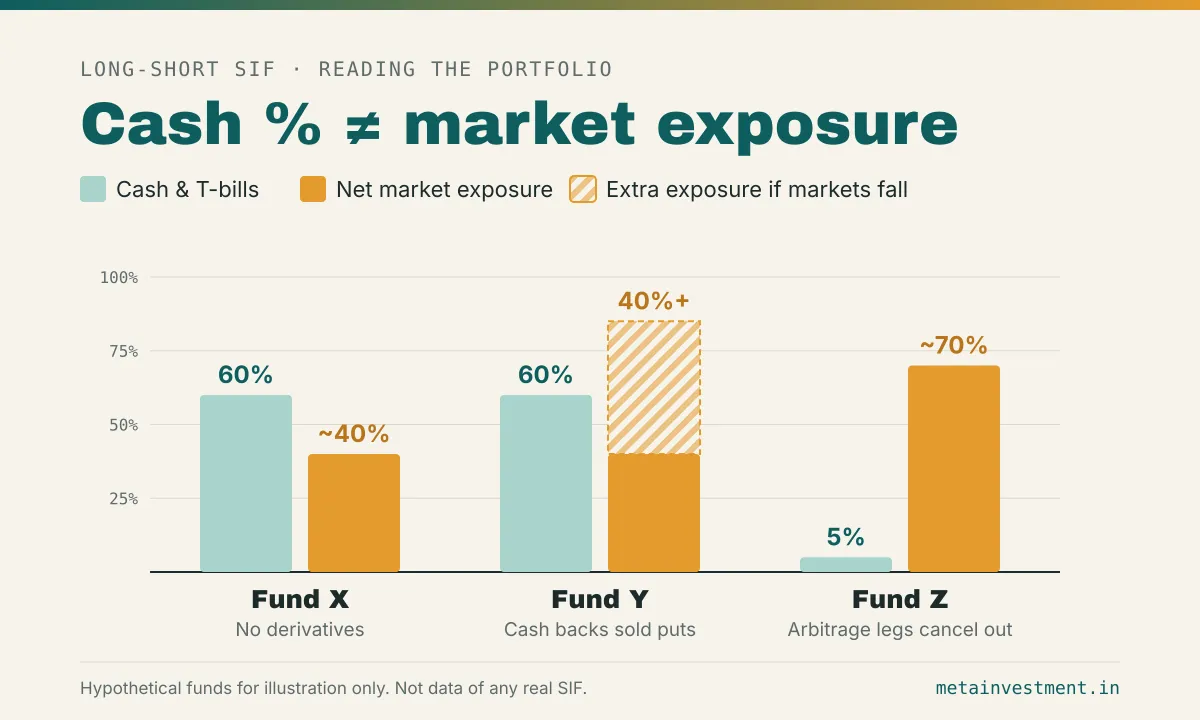
Under SEBI's Specialized Investment Fund (SIF) framework, long-short strategies can use futures and options in ways a regular mutual fund cannot. That changes what the cash line on a portfolio statement means.
Here's the uncomfortable part. A strategy with half its money in cash is not necessarily "only half invested". Some of that cash may be working hard as collateral for positions you can't see on the cash line.
This post explains what a long-short SIF does, why it holds cash, and which numbers in a disclosure actually describe market exposure. It does not compare or recommend any strategy.
What Is a Specialized Investment Fund (SIF)?
A SIF is a mutual fund product regulated by SEBI, designed to sit between regular mutual funds and Portfolio Management Services (PMS). SEBI laid out the framework in a circular dated 27 February 2025, effective 1 April 2025.
Key features from the framework:
- Minimum investment: ₹10 lakh, counted at PAN level across all strategies of a SIF. Regular mutual fund holdings with the same AMC don't count towards it. Accredited investors are exempt.
- Separate brand: a SIF carries its own brand name and logo, distinct from the sponsoring mutual fund.
- Short exposure: strategies can take unhedged short exposure of up to 25% of net assets, using exchange-traded derivatives. This is in addition to derivatives used for hedging and rebalancing.
- Strategy types: three equity-oriented (Equity Long-Short, Equity Ex-Top 100 Long-Short, Sector Rotation Long-Short), two debt-oriented (Debt Long-Short, Sectoral Debt Long-Short) and two hybrid (Active Asset Allocator Long-Short, Hybrid Long-Short).
- Distribution: distributors need the NISM Series-XIII Common Derivatives certification to distribute SIF products.
What "Long-Short" Means in Plain Language
Long means owning something because you expect it to rise. Short means holding a position that gains if a price falls.
In a SIF, short positions are taken through exchange-traded derivatives such as futures and options. The building blocks you will commonly see in a long-short portfolio are:
- Stocks plus hedges: shares held, with part of the exposure offset by sold futures.
- Arbitrage: buying a stock in the cash market and selling its future, which captures a price gap with very little market exposure.
- Option strategies: selling call options on stocks already held (covered calls), or selling put options backed by cash.
- Long futures: gaining market exposure through futures instead of buying shares, while the money sits in cash or T-bills as margin.
The key idea: the same rupee of NAV can support exposure of very different sizes, depending on which derivatives are used.
Why a Long-Short SIF Might Hold a Lot of Cash
Cash and T-bills on a long-short SIF's portfolio statement can be doing several different jobs.
Margin and collateral
Exchanges require margin for derivative positions. Managers often keep this in cash, T-bills or TREPS.
Cash-secured put-selling
Selling a put means agreeing to buy a stock or index at a set price if it falls below that level. The seller earns a premium but carries the loss if prices drop. Cash is kept aside to honour that obligation.
That strategy is exposed to market falls even though the asset shows as "cash".
Long futures instead of shares
A manager can get market exposure by buying index or stock futures instead of shares. Only a margin is paid to the exchange; the rest of the money can sit in cash or T-bills. On the statement, that looks like a big cash holding. In practice, the strategy is participating in the market as if it held the shares. The cash is supporting market exposure, not standing aside from it.
Money waiting to be deployed
Some cash may simply be dry powder: money from new inflows not yet invested, or held back while the manager waits for opportunities. A single statement can't tell you whether a high cash figure is the intended allocation or a temporary position.
Takeaway: cash % is a balance-sheet label. It does not show what the cash is doing.
Gross Exposure vs Net Exposure: The Numbers That Matter More
Two measures tell you far more about market risk than cash percentage:
- Gross exposure = longs + shorts, added without netting. It shows how much is in play.
- Net exposure = longs minus shorts. It roughly shows how much the portfolio moves with the market.
SEBI's SIF circular also sets a ceiling: cumulative gross exposure across all instruments cannot exceed 100% of net assets. And it measures a sold option at the market price of the underlying, not the small premium received. A sold put on ₹50 of index value counts as ₹50 of exposure, even if only ₹1 of premium came in.
An illustrative comparison
The three funds below are simplified, hypothetical examples. They are not any real strategy's numbers, and they ignore how regulators compute limits in detail.
| Hypothetical fund | Cash & T-bills | What the portfolio holds | Approximate net exposure |
|---|---|---|---|
| Fund X | 60% | 40% stocks, no derivatives | About 40% long |
| Fund Y | 60% | 40% stocks, plus sold index puts covering 50% of NAV, backed by the cash | Well above 40% if markets fall |
| Fund Z | 5% | 95% stocks, of which 25% of NAV is paired with short futures on the same stocks (arbitrage) | About 70% long |
Fund X and Fund Y show the same cash figure. Their downside risk is very different. Fund Z shows almost no cash and 95% in stocks, yet its net exposure is closer to 70%, because the arbitrage legs largely cancel out.
Options add one more twist. Sold puts tend to lose more in sharp falls. Covered calls cap the upside. In options language, a position's "delta" describes how much it moves for a small change in the underlying price, and that sensitivity itself changes as markets move.
Put together, long futures and option positions can push a strategy's net exposure well above its stock holdings, even when the cash figure looks comfortable.
What to Look for in a SIF Portfolio Disclosure
Use this checklist when reading any long-short SIF's portfolio statement. Each item stands on its own.
- Check the disclosure date. SEBI requires full portfolio disclosure at the end of alternate months (May, July, September, November, January and March), published within 10 days. Exposure in a long-short strategy can shift a lot between statements.
- Look for net and gross exposure. If the AMC states them, start there. If not, work them out roughly from holdings and derivative positions.
- List every derivative position. Note futures (long or short), options (bought or sold), strikes, expiries and the notional value as a percentage of NAV.
- Ask what the cash is earmarked for. Margin for futures, backing for sold puts, or genuinely free cash.
- Read the ISID. The Investment Strategy Information Document describes the strategy, the instruments it may use and a scenario analysis of potential losses from market movements.
- Check the risk band. Each SIF strategy carries a five-level risk band, from level 1 (lowest) to level 5 (highest), evaluated monthly.
- Compare month to month. A single statement is a snapshot, not a strategy.
These questions are for understanding a strategy, not for picking a "winner".
Common Misreadings of a Long-Short SIF Portfolio
- "High cash means conservative." Not necessarily. Cash backing sold puts or long futures still carries market risk.
- "Zero cash means aggressive." Not necessarily. Short futures can hedge a fully invested stock portfolio.
- Comparing a long-short SIF with a regular equity fund on cash % alone. A long-only fund's cash is usually just uninvested money. A long-short strategy's cash often isn't.
- Judging a long-short strategy on a few months of returns. These strategies are built to behave differently from long-only funds across market phases.
- Treating a third-party summary as the full picture. Comparison tables and screeners are useful starting points. The AMC's own disclosure and ISID, with dates, are the primary source.
Where SIFs Fit
SIFs are designed for investors who can meet the ₹10 lakh minimum and are comfortable with derivative-based strategies. The complexity is part of the product, not a side detail.
The suitability of any investment category depends on an investor's financial goals, risk appetite, investment horizon and overall financial circumstances. Whether a long-short strategy has any place in a portfolio is an individual question. A blog post can't answer it.
Key Takeaways
- In a long-short SIF, cash and T-bills often work as collateral for derivative positions.
- Cash can back sold puts or long futures, so a high cash figure does not mean low market risk.
- Net exposure, gross exposure and the derivative book describe market risk better than cash %.
- SEBI counts sold options at the full value of the underlying when measuring exposure.
- Read the AMC's own portfolio disclosure, its date and the ISID before drawing conclusions.
Reading Past the Cash Line
A cash number tells you where money sits, not what it is doing. In a long-short SIF, the real story is in the derivative positions and net exposure. If you are trying to understand how these strategies work before deciding whether they belong in your plan, that's a conversation worth having.
Regulatory details: SEBI circular dated 27 February 2025 and SEBI's SIF FAQs issued 22 September 2026.
Interested in Investing? Connect with Meta Investment
Meta Investment is a financial product distribution and services firm. If you'd like to explore whether a financial product is the right fit for your portfolio, our team will walk you through the details, help you assess suitability, and guide you through the onboarding process.
Meta Investment – Your Investment and Insurance Companion
Frequently Asked Questions
What is a long-short SIF?
A long-short SIF is an investment strategy under SEBI's Specialized Investment Fund framework that holds securities expected to rise and can also take positions that gain if prices fall. Short positions are taken through exchange-traded derivatives, and unhedged short exposure is capped at 25% of net assets.
What is a Specialized Investment Fund (SIF) in India?
A SIF is a SEBI-regulated mutual fund product meant to sit between regular mutual funds and PMS. It allows more advanced strategies, including limited unhedged short exposure through derivatives, and requires a minimum investment of ₹10 lakh at PAN level across a SIF's strategies, except for accredited investors.
Why do some long-short SIFs hold so much cash?
Cash and T-bills in a long-short SIF often serve as margin or collateral for derivative positions such as futures or sold options. Some of it may also be money awaiting deployment. The cash line alone does not reveal which of these it is.
Does high cash in a SIF mean lower risk?
Not necessarily. Cash that backs sold put options or long futures still leaves the strategy exposed to market movements. Net exposure and the derivative positions give a better picture of market risk than the cash percentage.
Does zero cash in a SIF mean it is aggressive?
Not necessarily. A strategy can be almost fully invested in stocks yet hedge part of that exposure with short futures, which lowers its net exposure. The derivative book has to be read alongside the holdings.
What is net exposure in a fund?
Net exposure is the value of long positions minus short positions, expressed as a percentage of net assets. It roughly indicates how much the portfolio is likely to move with the market. A net exposure of 70% means the portfolio behaves broadly like 70% of its value invested in the market, though options can make this uneven.
What is gross exposure in a fund?
Gross exposure adds long and short positions together without netting them off. It shows how much is in play in total. Under SEBI's SIF framework, cumulative gross exposure across all instruments cannot exceed 100% of net assets.
What is put-selling and why does it need cash?
Selling a put option means agreeing to buy a stock or index at a set price if the buyer of the option chooses to sell it to you. The seller earns a premium but carries losses if the price falls. Cash is kept aside so the obligation can be met, which is why it can appear as a large cash holding.
How does SEBI measure exposure for options sold by a SIF?
Under the SEBI SIF circular dated 27 February 2025, exposure for options sold is calculated using the market price of the underlying multiplied by lot size and number of contracts. That means a sold option counts at the full value of the underlying, not at the small premium received.
How often do SIFs disclose their portfolios?
SEBI requires each SIF strategy to disclose its full portfolio, including derivative positions, at the end of alternate months: May, July, September, November, January and March. It has to be published on the AMC and AMFI websites within 10 days of month-end.
What is the risk band for a SIF?
Each SIF strategy carries a five-level pictorial risk band, from level 1 (lowest) to level 5 (highest). It is evaluated monthly, and changes are communicated to unitholders.
Where can I find a SIF strategy's investment approach?
The Investment Strategy Information Document (ISID) describes the strategy, its permitted instruments and risks. SEBI requires the ISID to include a scenario analysis of potential losses from market movements. The ISID, KIM and SAI are available on the SIF's website and the AMFI website.
How is a SIF different from a mutual fund and PMS?
Like a mutual fund, a SIF pools investor money into units of a strategy, but it can take limited unhedged short positions through derivatives and has a ₹10 lakh minimum. Unlike PMS, investors do not get an individually managed portfolio in their own name.
Can I invest in a SIF through SIP?
Yes. AMCs can offer SIP, STP and SWP facilities for SIF strategies, subject to the features and limits in each strategy's ISID and the ₹10 lakh minimum investment threshold.
What happens if my SIF investment falls below ₹10 lakh due to market movement?
SEBI treats a fall caused only by NAV decline as a passive breach, with no compulsory redemption. While below the threshold, the investor can redeem only the entire holding, not a part of it.


Mutual fund updates, SIP tips, and what's moving the market. No daily noise — only when there's something worth reading.
Read more about
- A Fresh Perspective on Portfolio Management Services (PMS) for NRI/HNI Investors
- Abans Global Arbitrage Fund: A Deep Dive
- Phillip Income Builder Portfolio Review: Fixed Income PMS for HNIs & Stable Returns
- CAT III AIF in India: Top Performing Funds, Oldest Funds, and Key Insights for Investors (2025)
- How to Become an Accredited Investor in India: A Guide for HNIs | SEBI Framework
- Mirae Asset Global Allocation Fund - Invest in Global Markets via GIFT City | Tax Benefits for NRIs & HNIs
- Sky One Corporate Park: A Prime Investment Opportunity for HNIs and NRIs
- India’s First Specialized Investment Fund (SIF): Bridge Between MF & PMS | quant Guide
- Beyond the Market Rollercoaster: A Guide to the Altiva Hybrid Long-Short SIF | Edelweiss MF
- Light Up Your Finances This Diwali: A Guide to Wealth, Wisdom, and Long-Term Prosperity
- Diviniti Equity Long Short Fund NFO 2025 | Investment for Indian HNIs & NRIs
- The Investor and The Distributor: A Lesson on SIP Discipline
- Financial Wellness for Men: Boost Health with Smart Investing, SIP & Retirement Planning
- Kotak Market Outlook 2026: India Equity, Debt, Gold & Silver
- DynaSIF Equity Long-Short Fund NFO: Strategy, Benefits & Details
- Ametra PMS Review: FactorCapro & FactorIncome Explained
- Pune on India's Wealth Map: What the 2026 List Reveals
- SEBI's Proposed MF-Only PMS: What Investors Should Know
- Alchemy India Long Term Fund: GIFT City Guide for NRIs
- GIFT City Funds vs International Fund of Funds: Differences
- फिलिप इनकम बिल्डर पोर्टफोलिओ पुनरावलोकन: HNIs आणि स्थिर परताव्यासाठी फिक्स्ड इनकम PMS
- मिराए अॅसेट ग्लोबल अलोकेशन फंड - गिफ्ट सिटी मार्गे जागतिक बाजारात गुंतवणूक | एनआरआय आणि एचएनआय साठी कर फायदे
- स्काय वन कॉर्पोरेट पार्क: HNIs आणि NRIs साठी एक उत्तम गुंतवणूक संधी
Related Posts


This communication is intended solely for general educational and informational purposes. The information provided is general in nature and does not take into account the specific financial goals, risk profile, investment horizon, financial circumstances or other requirements of any particular investor. It should not be construed as personalised investment advice or as a recommendation to buy, sell or hold any specific financial product.
Specialized Investment Funds (SIF) are a distinct SEBI-regulated category, separate from traditional mutual funds, with their own eligibility, minimum-investment and risk-disclosure requirements. Investors should review the Investment Strategy Information Document (ISID) and applicable risk factors before investing.
Distributor Disclosure: Where this content is provided by a distributor/intermediary, any applicable commission, remuneration, affiliation or other material conflict of interest shall be disclosed separately. The availability of a product through the distributor does not by itself imply that the product is suitable for every investor.
No Guarantee: No statement on this page should be interpreted as a promise, assurance or guarantee of returns or investment outcomes.
Meta Investment – Your Investment and Insurance Companion