
RBI MPC April 2026: Repo Rate Held, What It Means for Your Investments
RBI's MPC kept the repo rate unchanged at 5.25% in April 2026 amid West Asia conflict risks. Learn what this means for your mutual funds, debt investments, and financial planning.

The Reserve Bank of India’s Monetary Policy Committee (MPC) met from April 6 to 8, 2026, and delivered a carefully calibrated decision — hold rates steady and watch. With global geopolitical tensions reshaping the economic outlook, here’s a plain-language breakdown of what was decided and what it means for you as an investor.
What the RBI Decided: Repo Rate Unchanged at 5.25%
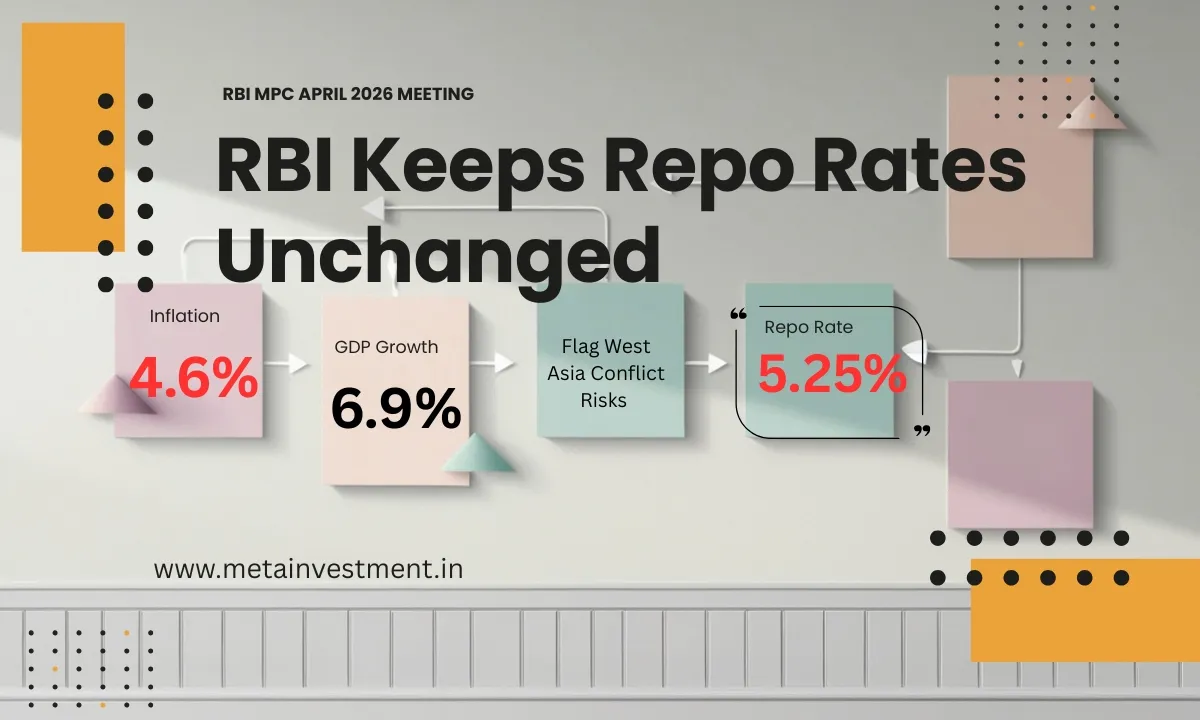
In its 60th meeting, chaired by RBI Governor Shri Sanjay Malhotra, the MPC voted unanimously to keep the policy repo rate unchanged at 5.25%. The related rates also remain steady:
- Standing Deposit Facility (SDF) rate: 5.00%
- Marginal Standing Facility (MSF) rate & Bank Rate: 5.50%
- Monetary policy stance: Neutral (unchanged)
The “neutral stance” is significant — it means the RBI is keeping its options open, ready to respond in either direction depending on how the economy evolves.
Why Did the RBI Hold Rates? The West Asia Factor
The single biggest reason for the RBI’s “wait and watch” approach is the ongoing conflict in West Asia, which has:
- Severely disrupted global supply chains, particularly through the Strait of Hormuz
- Spiked crude oil and energy prices, increasing India’s imported inflation risk
- Raised freight and insurance costs, making merchandise exports costlier
- Strengthened the US dollar as global investors sought safe-haven assets, putting pressure on the Indian rupee
- Corrected equity valuations globally and hardened sovereign bond yields
The MPC acknowledged that while India’s economic fundamentals are strong, the conflict introduces significant uncertainty. As the Governor stated, the economy is confronting a supply shock, and it is prudent to assess the evolving situation before acting on rates.
India’s GDP Growth Outlook for 2026-27
Despite the global headwinds, the Indian economy showed strong resilience in 2025-26, with real GDP growing at 7.6% — driven by robust private consumption, fixed investment, and a buoyant services sector.
For 2026-27, the RBI projects real GDP growth at 6.9%, with the quarterly breakdown:
| Quarter | Projected GDP Growth |
|---|---|
| Q1 2026-27 | 6.8% |
| Q2 2026-27 | 6.7% |
| Q3 2026-27 | 7.0% |
| Q4 2026-27 | 7.2% |
Growth is expected to be supported by:
- Robust private consumption and rural demand backed by healthy agricultural conditions
- GST rationalisation benefits filtering through the economy
- Government’s infrastructure spending push, with capex budgeted to expand by 11.5%
- Services sector momentum and rising capacity utilisation in manufacturing
- Healthy bank and corporate balance sheets
Key downside risks include further escalation of the West Asia conflict, global financial market volatility, and adverse weather events.
Inflation Outlook: Contained, But Risks Are Rising
Headline CPI inflation in January-February 2026 remained below the RBI’s 4% target — at 2.7% and 3.2% respectively. Core inflation (excluding food and fuel) remained muted, especially when precious metals are excluded (2.1%).
However, the RBI projects CPI inflation for 2026-27 at 4.6%, with the quarterly trajectory:
| Quarter | Projected CPI Inflation |
|---|---|
| Q1 2026-27 | 4.0% |
| Q2 2026-27 | 4.4% |
| Q3 2026-27 | 5.2% |
| Q4 2026-27 | 4.7% |
Key inflation risks:
- Elevated energy prices from the West Asia conflict — domestic LPG and diesel prices have already seen increases
- Possible El Niño conditions that could impact the southwest monsoon and food prices
- Second-round effects of higher input costs flowing through to broader prices
On the positive side, robust rabi crop production and comfortable food buffer stocks provide near-term comfort on food inflation.
India’s External Sector: Resilient but Watchful
A few important external sector data points from the RBI:
- Foreign exchange reserves: US$ 697.1 billion as of April 3, 2026 — providing approximately 11 months of import cover
- Gross FDI grew 18.1% to US$ 88.3 billion in April-February 2025-26
- Merchandise exports contracted marginally, impacted by weaker demand in key markets including the US (-17.5%), Netherlands, and UK
- Services exports remained strong, growing ~9.7% in February 2026
- FPI (Foreign Portfolio Investment): Net outflows of US$ 16.5 billion in 2025-26, primarily from the equity segment, reflecting global risk-off sentiment
The RBI also reiterated its market-determined exchange rate policy — it intervenes only to curb excessive volatility, not to target any specific level for the rupee.
Banking Sector: Healthy and Well-Capitalised
India’s banking system remains on solid footing:
- Capital adequacy (CRAR): 16.91% — well above regulatory minimums
- Gross NPA ratio improved to 1.89% in December 2025 from 2.42% a year ago
- Bank credit growth: 13.8% year-on-year as of mid-March 2026
- Liquidity Coverage Ratio: 125.85% — robust liquidity buffers
The RBI also announced measures to ease MSME onboarding on TReDS platforms and rationalise regulatory compliance requirements for banks.
What Does This Mean for Your Investments?
Here’s a practical perspective for Indian investors:
Debt Fund Investors:
- A stable repo rate with a neutral stance is generally supportive for short-to-medium duration debt funds
- Gilt funds may see some volatility if the West Asia conflict worsens and global yields harden further
- Corporate bond and Banking & PSU debt funds offer reasonable risk-adjusted returns in this environment
Equity Investors:
- Domestic consumption-driven sectors (FMCG, consumer discretionary, financials) remain relatively insulated from global turmoil
- Export-oriented sectors (IT, pharma, gems & jewellery) may face some near-term pressure
- Long-term equity SIPs continue to be the recommended approach — avoid reacting to short-term global noise
Hybrid Fund Investors:
- Dynamic Asset Allocation and Balanced Advantage Funds are well-suited to navigate uncertain environments, as they adjust equity-debt mix based on market conditions
Key Takeaways
- RBI held the repo rate at 5.25% — unanimous decision, neutral stance maintained
- GDP growth projected at 6.9% for 2026-27, with India’s fundamentals remaining strong
- Inflation projected at 4.6% for 2026-27 — within the tolerance band, but upside risks from energy prices
- West Asia conflict is the dominant global risk, creating uncertainty for both growth and inflation
- Banking system remains healthy, with strong capital buffers and improving asset quality
- Next MPC meeting: June 3–5, 2026; minutes of this meeting to be released April 22, 2026
Conclusion
The RBI’s April 2026 policy is a measured, prudent response to a world in flux. India enters 2026-27 from a position of economic strength, but the West Asia conflict demands careful navigation. For investors, this is not a time for panic — it is a time for disciplined asset allocation, SIP continuity, and portfolio review aligned to your goals and risk tolerance.
If you’re uncertain about how these macro developments affect your specific portfolio, our team at Meta Investment is here to help. We provide transparent, data-driven guidance tailored to your financial journey.
Interested in Investing? Connect with Meta Investment
Meta Investment is a financial product distribution and services firm. If you'd like to explore whether a financial product is the right fit for your portfolio, our team will walk you through the details, help you assess suitability, and guide you through the onboarding process.
🔗 Download the Meta Investment App & Plan Your Portfolio
Mutual Fund investments are subject to market risks. Read all scheme related documents carefully. Past performance may or may not be sustained in the future. This article is for informational and educational purposes only and does not constitute investment advice. Please consult your AMFI-registered Mutual Fund Distributor or financial advisor before making investment decisions.
Data sourced from RBI Monetary Policy Statement and Governor’s Statement dated April 8, 2026. Verify all data independently before investing.
Meta Investment – Your Investment and Insurance Companion.
Frequently Asked Questions
What did RBI MPC decide in April 2026?
The Reserve Bank of India's Monetary Policy Committee (MPC) voted unanimously on April 8, 2026 to keep the policy repo rate unchanged at 5.25%. The MPC also continued with its neutral stance, retaining flexibility to respond to the evolving growth-inflation situation, primarily shaped by the West Asia conflict.
Why did the RBI keep the repo rate unchanged in April 2026?
The MPC adopted a 'wait and watch' approach due to the unprecedented uncertainty caused by the West Asia conflict. While headline inflation remains below target and domestic growth fundamentals are strong, the conflict poses significant upside risks to inflation (through energy prices) and downside risks to growth. The RBI preferred to remain vigilant before making any rate changes.
What is the current repo rate in India as of April 2026?
The current RBI policy repo rate is 5.25% as of April 8, 2026. The Standing Deposit Facility (SDF) rate stands at 5.00% and the Marginal Standing Facility (MSF) rate and Bank Rate are at 5.50%.
What is RBI's inflation forecast for 2026-27?
The RBI has projected CPI inflation for 2026-27 at 4.6%, with Q1 at 4.0%, Q2 at 4.4%, Q3 at 5.2%, and Q4 at 4.7%. The primary upside risk is elevated global energy prices stemming from the West Asia conflict, along with possible El Niño conditions affecting food prices.
What is RBI's GDP growth forecast for 2026-27?
The RBI has projected real GDP growth for 2026-27 at 6.9%, with Q1 at 6.8%, Q2 at 6.7%, Q3 at 7.0%, and Q4 at 7.2%. India's GDP grew at 7.6% in 2025-26, and the projection factors in the drag from the West Asia conflict on exports, energy costs, and global demand.
How does the RBI repo rate decision affect mutual fund investments?
When the repo rate is held steady with a neutral stance, it signals a stable interest rate environment. For debt mutual funds, especially medium-to-long duration and gilt funds, this is a broadly supportive environment. Equity funds may face some pressure from global uncertainty, but domestic consumption-driven sectors remain resilient. Investors should review their asset allocation with an advisor.
What is the 'neutral stance' that RBI MPC has maintained?
A 'neutral stance' means the RBI is neither committed to raising nor cutting rates in the near term. It retains the flexibility to move in either direction based on incoming data on growth and inflation. This is different from an 'accommodative stance' (bias towards cuts) or a 'withdrawal of accommodation' stance (bias towards hikes).
What is the West Asia conflict's impact on the Indian economy?
The West Asia conflict, particularly disruptions in the Strait of Hormuz, is creating multiple pressures on India: elevated crude oil prices raising imported inflation, disruption to shipping routes raising freight costs, weaker global demand impacting exports, and safe-haven flows strengthening the US dollar against the rupee. However, India's strong fundamentals provide resilience.
Is it a good time to invest in debt funds given the current RBI policy?
With the repo rate on hold at 5.25% and a neutral stance, the interest rate environment is relatively stable. Short-to-medium duration debt funds can be considered for stable income. However, gilt funds carry interest rate risk if the conflict worsens and global yields harden further. Consult your financial advisor or AMFI-registered distributor for personalized guidance.
When is the next RBI MPC meeting scheduled?
The next RBI MPC meeting is scheduled for June 3 to 5, 2026. The minutes of the April 2026 meeting will be published on April 22, 2026.

0