Understanding the Global Economic Policy Uncertainty (GEPU) Index: Implications for Indian Investors
In the world of investing, understanding macroeconomic indicators is crucial for making informed decisions. One such critical metric is the Global Economic Policy Uncertainty (GEPU) Index.
For Indian investors, this index is not just a theoretical concept but a practical tool to gauge risks and opportunities in the market. Let’s break down what GEPU is, why it matters, and how it impacts investments in India.
What is the GEPU Index?
The GEPU Index is a globally recognized measure that quantifies uncertainty in economic policies across major economies. It tracks factors like:
- Changes in tax policies
- Regulatory shifts
- Trade tensions (e.g., US-China trade wars)
- Geopolitical risks (e.g., conflicts, sanctions)
- Central bank actions (e.g., interest rate changes)
The index is constructed using data from news articles, government reports, and economic forecasts. A higher GEPU score indicates greater uncertainty, while a lower score suggests stability.
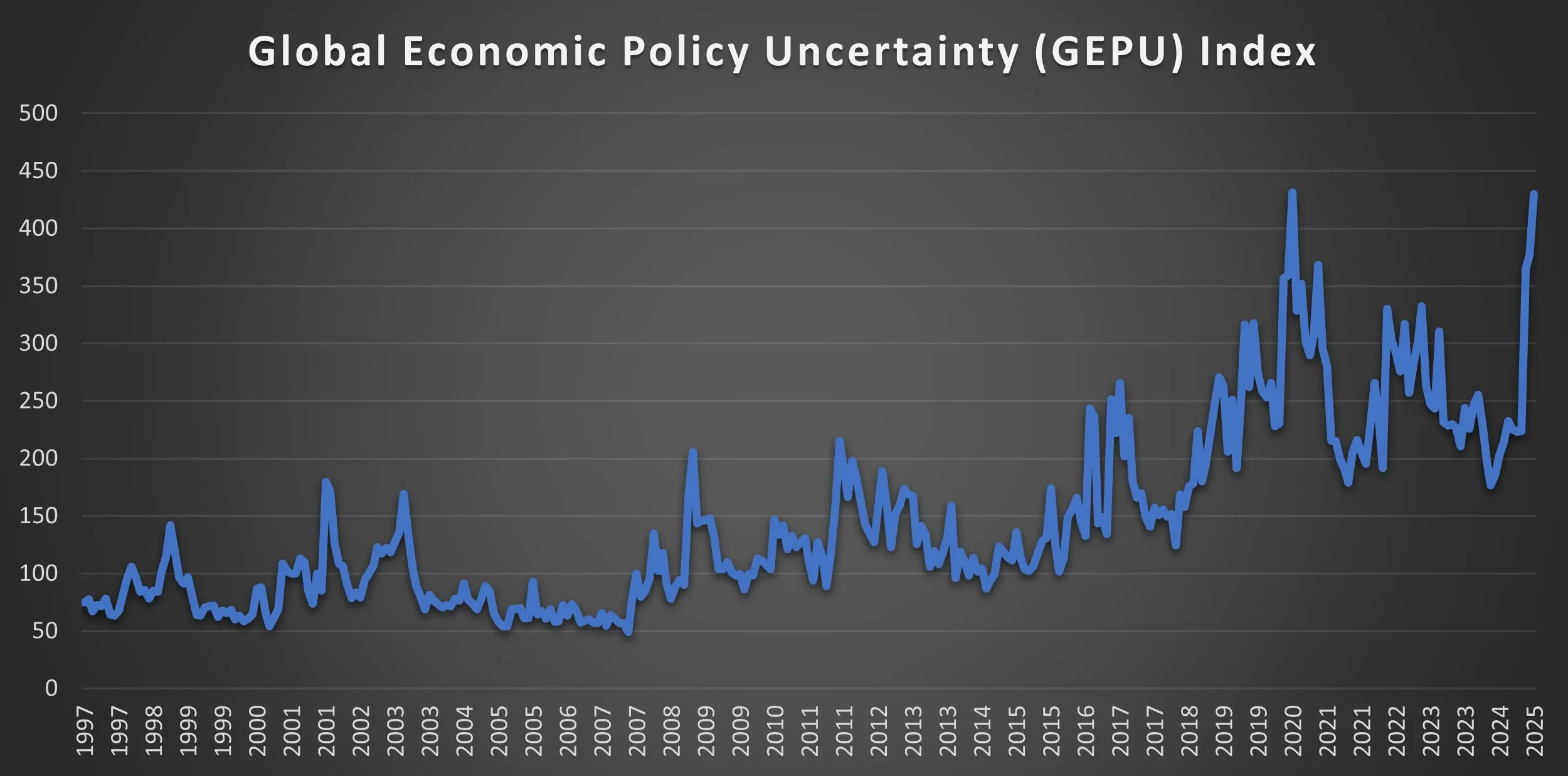
Historical Trends:
- 1997-2000: The GEPU index remained relatively stable, with occasional spikes. For example, in December 1997, the index peaked at 105.96 (GEPU_current) due to the Asian Financial Crisis.
- 2001-2003: The index saw significant spikes, particularly in September 2001 (179.70) and March 2003 (169.19), coinciding with the 9/11 attacks and the Iraq War, respectively.
- 2008-2009: The Global Financial Crisis caused a massive surge in uncertainty, with the index reaching 205.90 in October 2008 and remaining elevated throughout 2009.
- 2011-2012: The Eurozone debt crisis and US debt ceiling debates led to another spike, peaking at 214.76 in August 2011.
- 2016: The Brexit referendum and US presidential election caused a sharp rise, with the index hitting 243.33 in June 2016.
- 2020: The COVID-19 pandemic caused the highest spike in the index's history, reaching 431.57 in May 2020, reflecting unprecedented global uncertainty.
- 2022-2023: The Russia-Ukraine war, inflation concerns, and central bank tightening policies kept the index elevated, with peaks in March 2022 (329.92) and March 2023 (310.58).
- 2024-2025: The tariff war initiated by the newly elected US President, Donald Trump, led to a significant spike in the GEPU Index.
Why Should Indian Investors Care About GEPU?
India is deeply integrated into the global economy. Whether it’s foreign institutional investments (FIIs), export-import dynamics, or corporate earnings, global economic policy uncertainty has a ripple effect on Indian markets. Here’s how GEPU impacts investments:
1. Foreign Institutional Investments (FIIs):
- FIIs are a major driver of Indian equity markets. When global uncertainty rises (high GEPU), foreign investors often adopt a "risk-off" approach, pulling money out of emerging markets like India and moving to safer assets like US Treasuries or gold.
- This can lead to volatility in Indian stock markets, affecting equity mutual funds and direct stock investments.
2. Currency Fluctuations:
- A high GEPU often weakens emerging market currencies, including the Indian rupee. A weaker rupee can increase the cost of imports (e.g., crude oil, electronics), leading to higher inflation and impacting sectors like automobiles, FMCG, and pharmaceuticals.
- For debt investors, currency volatility can affect the returns of international bond funds or funds with foreign exposure.
3. Corporate Earnings:
- Global uncertainty can disrupt supply chains, increase input costs, and reduce demand for Indian exports. Companies in sectors like IT, pharmaceuticals, and metals are particularly vulnerable.
- This can lead to lower corporate earnings, impacting stock prices and equity mutual fund NAVs.
4. Commodity Prices:
- India is a major importer of crude oil and gold. High GEPU often leads to fluctuations in commodity prices, which can impact inflation and interest rates in India.
- Rising oil prices, for instance, can hurt sectors like aviation, logistics, and paints, while benefiting oil marketing companies.
5. Domestic Policy Responses:
- In times of high global uncertainty, the Indian government and the Reserve Bank of India (RBI) may adjust fiscal and monetary policies. For example, the RBI might cut interest rates to stimulate growth or increase liquidity in the system.
- Such measures can influence bond yields, fixed deposit rates, and the performance of debt mutual funds.
How to Use GEPU in Investment Strategy
The GEPU Index can serve as a risk management tool rather than a timing indicator. Here’s how it can be incorporated into an investment approach:
1. Diversify Your Portfolio:
- During periods of high GEPU, diversifying across asset classes (equity, debt, gold, and real estate) can help reduce risk.
- Allocating more to defensive sectors like FMCG, healthcare, and utilities, which tend to perform better in uncertain times, may also be beneficial.
2. Focus on Quality:
- Investing in high-quality stocks and mutual funds with strong fundamentals, low debt, and consistent earnings can provide resilience during global uncertainty.
3. Increase Exposure to Domestic-Focused Sectors:
- Sectors like banking, infrastructure, and consumer goods, which rely more on domestic demand, are less affected by global uncertainty compared to export-oriented sectors.
4. Use Systematic Investment Plans (SIPs):
- Volatility caused by high GEPU can create buying opportunities. SIPs allow for regular investments, averaging out market fluctuations and benefiting from lower valuations.
5. Monitor Debt Investments:
- In uncertain times, interest rates may fluctuate. Short-duration debt funds or dynamic bond funds that can adapt to changing rate scenarios may be worth considering.
6. Stay Informed, Not Reactive:
- While GEPU is a useful indicator, avoiding impulsive decisions based on short-term spikes in uncertainty is key. Focusing on long-term financial goals and sticking to a well-defined asset allocation plan is essential.
Current Scenario: GEPU and India
As of 2025, global economic policy uncertainty remains elevated due to factors like:
- Ongoing geopolitical tensions (e.g., Russia-Ukraine conflict)
- Central banks tightening monetary policies to combat inflation
- Slowing global growth and recession fears
For Indian investors, this means staying cautious but not overly defensive. India’s relatively strong domestic economy, robust forex reserves, and proactive policy measures provide a cushion against global headwinds.
Conclusion: GEPU as a Compass, Not a Crystal Ball
The GEPU Index is a valuable tool for understanding the global economic landscape and its impact on Indian markets. However, it’s not a standalone indicator. Combining it with other metrics like GDP growth, inflation, and corporate earnings can help make informed investment decisions.
The key takeaway is to stay disciplined, focus on financial goals, and use tools like GEPU to navigate uncertainty rather than fear it. Volatility is not a risk but an opportunity for those who are prepared.
Please consult a financial advisor before making any investment decisions.


म्युच्युअल फंड अपडेट्स, SIP टिप्स आणि बाजारात काय घडतंय. रोजचा गोंधळ नाही — फक्त वाचण्यासारखं काही असेल तेव्हाच.
Read more about
- Welcome to Meta Investment blogFunds
- Achieving Milestones: Running and SIP - A Journey of Consistency and Wealth Accumulation
- Achieving Financial Success through Goal-Based Investing
- From Appathon to SIPathon
- Building Your Crorepati Dream
- Unveiling the Secrets of Wealth
- The Cafe vs. The Nest Egg
- Daughters Who Know Dough
- New KYC Norms
- Celebrating Maharashtra Day
- महाराष्ट्र दिवसाच्या हार्दिक शुभेच्छा
- US Federal Reserve continues to hold rates
- Earn More Than Traditional Fixed Income with Market-Linked Debentures
- A Fresh Perspective on Portfolio Management Services (PMS) for NRI/HNI Investors
- This Mother's Day, Give the Gift of Security: Invest for Her Future and Protect Her Health
- Don't Be a Target: Investor Awareness and ARN Verification to avoid Mutual Fund fraud
- Beyond Market Caps: Unveiling Factor Investing with Mutual Funds in India
- Anchoring Your Portfolio: Why Fixed Income Products Deserve a Place in Your Investment Journey
- Rev Up Your Portfolio: SBI Mutual Fund Launches SBI Automotive Opportunities Fund NFO!
- Anywhere But Home: Investing Lessons from an Ultra-Triathlete
- Riding the Waves: Unveiling Business Cycle Funds in India
- Unveiling the Nifty 50 TRI: A Deeper Look at India's Total Return Champion
- Secure Your Golden Years: A Guide to Corporate NPS for Employees
- Peer-to-Peer Lending: A New Era for Indian Investors?
- The Great Debate: Trading vs. Investing
- Strava and SIPs: How One Cyclist Conquered Both Roads and Finances
- Don't Panic Sell!
- Growing Their Future: Why Mutual Funds Are a Smart Investment for Minors
- Foreign Institutional Investors: A Critical Force in India's Financial Landscape
- Abans Global Arbitrage Fund: A Deep Dive
- Investing in India's Defence Sector
- Sharma Ji Ke Papa
- How To Lose 1 Crore Rupees
- Considering a positive outlook for TCS or Titan? These new MLDs might be for you!
- Yoga of Investing with Bachat Babu
- Mutual Fund Mystery: Online Platform, Missing Money?
- The Mutual Fund That Invests in Other Mutual Funds
- The Lazy Investor's Guide to Beating the Market
- Exciting News for Meta Investment Clients!
- RBI Floating Rate Savings Bonds: A Flexible Investment Option for Uncertain Times
- One Idiot: A Movie Where the Only Idiot is the One Who Doesn't Watch It (Probably)
- Journey to Financial Independence
- Large and Mid Cap Mutual Funds: The Best of Both Worlds
- Retirement Planning for Young Indians
- ₹800 crore Adani NCD Opens for Subscription: Is it the Right Investment for You?
- SIP Saheli: HDFC MF's Masterclass Empowers Women to Take Charge of Their Financial Future
- Bollywood Stars Shine on the 2024 Hurun India Rich List
- Long-Short Style Strategy: A Balanced Approach to Investing
- Happy Ganesh Chaturthi!
- 5 Ganesha Mantras for Successful Investing
- 11% Edelweiss Financial Services NCD Opens for Subscription
- Understanding 1st Capital Market Index Fund of India
- Conquer Your 10 Financial Demons This Dussehara
- Motilal Oswal Digital India Fund NFO
- Why Now is a Good Time to Consider Target Maturity Index Funds
- Don't invest this Diwali
- 📢📢 Buy gold in a new avatar, this Dhanteras!
- Multi Sector Rotation Fund: A New Player in the Market
- Coming Soon, Mutual Fund Lite
- A New Year, A New Chapter for Your Wealth
- The Ever-Shifting Sands: Why Asset Allocation is Key to Investment Success
- Quality Investing Through Mutual Funds in India
- Understanding Risk-On and Risk-Off Environments in the Stock Market
- Forgot Your Mutual Fund Investments? MITRA Can Help You Find Them!
- Gold Investments: A Casual WhatsApp Group Discussion of Friends (Ft. Bachat Babu’s Wisdom)
- Samudra Manthan of the Stock Market: Churning Wealth with Shiva’s Grace
- 7-Day Plan for Indian Women to Kickstart Their Financial Journey: From Scarcity to Abundance
- From Cricket to Code to Fitness: Investment Lessons from India’s ICC Champions Trophy 2025 Win
- Unlock Financial Wisdom at PIFAA Smart Money Seminar 2025 in PCMC!
- Understanding the Global Economic Policy Uncertainty (GEPU) Index: Implications for Indian Investors
- Nido Home Finance Limited NCD: A Secure Investment Opportunity
- Tata AIA Shubh Flexi Income Plan: A Comprehensive Guide
- How to Invest Like You Train: Discipline, Consistency, and Growth
- Usain Bolt vs. Eliud Kipchoge: What Runners Can Learn About Trading and Investing
- Direct vs Regular Mutual Funds: Why Professional Advice Matters (2025 Guide)
- Wishing You a Prosperous Gudi Padwa, Ugadi, Cheiraoba, Navreh, and Cheti Chand!
- Master Market Volatility: Krishan Sharma’s Investing Wisdom
- World Health Day 2025: Why Health Insurance & Financial Planning Matter for Women
- Financial Equality: How Dr. Ambedkar’s Vision Aligns with Wealth Creation
- Estate Planning in India: Wills, Trusts & Tax Tips for NRIs & Residents
- Mutual Will: Why Married Couples Must Have One | Estate Planning Guide
- Understanding Beneficial Nominee in Insurance & Its Role in Estate Planning
- NRI Mutual Fund Taxation: How DTAA Can Save You Tax (Anushka Shah Case)
- Gold vs. Mutual Funds vs. Multi-Asset Funds: Best Investment for Akshaya Tritiya 2025
- The Ultimate Guide to Investing in Silver: Digital, ETFs, and Physical Options
- From Piggy Bank to Portfolio: A Father’s Day Guide to Building Wealth
- HDFC Innovation Fund NFO 2025 – Invest in India’s Growth Story | Returns, Fund Manager & Performance
- Nido Home Finance NCD 2025: Secure 10.75% Returns | CRISIL A+ Rated Investment
- Bajaj Finserv Small Cap Fund NFO 2025 – High-Growth Investment Opportunity
- 📈💰 World Emoji Day Special: Smart Investing, SIP & Wealth Growth Made Fun! 🚀💡
- The Importance of Personalized, Transparent Financial Advice in Today’s Digital Age
- RBI’s August 2025 MPC Meeting: Key Highlights & What It Means for You
- Mutual Funds Are the New Status Symbol (Not Your Bank Balance)
- Mutual Fund Scheme Name Changes in India (2025) – Complete List & Reasons
- From Freedom Fighters to Financial Freedom: Gen Z Investing & Independence Day Lessons
- All Weather Gold: A Principal-Protected Way to Bet on Gold (Until Aug 31)
- ESAF SFB NCD Issue: 11.30% Coupon | Basel II Compliant Bonds
- Begin Your Wealth Journey This Ganesh Chaturthi: Ganpati-Inspired Mutual Fund Lessons
- Tata AIA Health SIP Review 2025: A Smart Health + Investment Plan?
- NPCI Raises UPI Transaction Limits: A Complete Guide to High-Value Payments from Sept 2025
- Tired of Market Volatility? Two New Smart Investment Ideas for 2025
- India’s First Specialized Investment Fund (SIF): Bridge Between MF & PMS | quant Guide
- New GST Changes 2025: Impact on Investors, Sectors, and Mutual Fund Opportunities
- Beyond the Market Rollercoaster: A Guide to the Altiva Hybrid Long-Short SIF | Edelweiss MF
- The Dream and the Nightmare: Honoring Final Wishes Amid Life’s Uncertainties
- RBI Holds Rates Steady: What the October 2025 Policy Means for Your Wallet and Investments
- World Financial Planning Day 2025: Why Urban India Needs Smart Financial Planning
- Diwali Investment 2025: Brighten Your Financial Future with Indel Money Secured NCD | High Yield Fixed Income for Pune Investors
- Light Up Your Finances This Diwali: A Guide to Wealth, Wisdom, and Long-Term Prosperity
- The Investor and The Distributor: A Lesson on SIP Discipline
- Financial Wellness for Men: Boost Health with Smart Investing, SIP & Retirement Planning
- Kotak Market Outlook 2026: India Equity, Debt, Gold & Silver
- HSBC Tax Saver Fund Merger: Your Complete Guide & Options
- Year-End Review: Mutual Fund Categories & Performance Explained
- Minor Folio in Mutual Funds: Secure Your Child's Financial Future
- Step-Up SIP Strategy: Scale Your Mutual Fund Investments in 2026
- SEBI's New Voluntary Lock-in for Mutual Fund Folios: What Every Investor Must Know
- SEBI's New Voluntary Lock-in for Mutual Fund Folios: What Every Investor Must Know
- NRI Mutual Fund KYC in 2026: The Ultimate Compliance Handbook
- Step-Up SIP Strategy: Scale Your Mutual Fund Investments in 2026
- EPF Scheme 2026 Explained: New PF Rules, Withdrawals & NPS Comparison
- निफ्टी 50 TRI चे अनावरण: भारताच्या एकूण रिटर्न चॅम्पियनवर सखोल नजर
- म्युच्युअल फंड: अल्पवयीन मुलांसाठी स्मार्ट गुंतवणूक का आहे?
- विदेशी संस्थात्मक गुंतवणूकदार: भारताच्या आर्थिक परिदृश्यातील एक गंभीर शक्ती
- महिलांसाठी आर्थिक यशस्वीतेची 7-दिवसीय नियोजन: टंचाईपासून विपुलतेकडे
- निदो होम फायनान्स लिमिटेड एनसीडी: एक सुरक्षित गुंतवणूकीची संधी
- टाटा एआयए शुभ फ्लेक्सी इनकम प्लॅन: एक सविस्तर मार्गदर्शिका
- तुमच्या प्रशिक्षणाप्रमाणे गुंतवणूक कशी करावी: शिस्त, सातत्य आणि वाढ
- उसेन बोल्ट विरुद्ध एलिउड किपचोगे: धावपटू ट्रेडिंग आणि गुंतवणुकीबद्दल काय शिकू शकतात
- डायरेक्ट vs रेग्युलर म्युच्युअल फंड: व्यावसायिक सल्ल्याचे महत्त्व (२०२५ मार्गदर्शक)
- तुम्हाला गुढी पाडवा, उगादी, चेइराओबा, नवरेह आणि चेटीचंदच्या हार्दिक शुभेच्छा!
- बाजारातील चढ-उतारांवर मात करा: कृष्ण शर्मा यांच्याकडून महत्त्वाचे धडे
- विश्व आरोग्य दिन २०२५: महिलांसाठी आरोग्य विमा आणि आर्थिक नियोजन का महत्त्वाचे आहे
- आर्थिक समानता: डॉ. आंबेडकरांच्या दृष्टिकोनातून संपत्ती निर्मिती
- भारतात एस्टेट प्लॅनिंग: NRI आणि रहिवाशांसाठी इच्छापत्र, ट्रस्ट आणि कर टिप्स
- म्युच्युअल विलः विवाहित जोडप्यांसाठी का आवश्यक? | एस्टेट प्लॅनिंग मार्गदर्शक
- विमा योजनांमध्ये लाभार्थी नामनिर्देशित व्यक्ती (बेनिफिशियरी नॉमिनी) आणि एस्टेट प्लॅनिंगमधील त्याची भूमिका
- NRI म्युच्युअल फंड कर: DTAA मदतीने कसे कर बचत करू शकता (अनुष्का शहा केस)
- सोने vs म्युच्युअल फंड vs मल्टी-अॅसेट फंड: अक्षय तृतीया २०२५ साठी सर्वोत्तम गुंतवणूक
- पिगी बँक ते पोर्टफोलिओ: वडिल दिनासाठी संपत्ती निर्मितीची मार्गदर्शिका
- HDFC इनोव्हेशन फंड NFO 2025 – भारताच्या नाविन्यपूर्ण वाढीत गुंतवणूक करा | परतावा, फंड व्यवस्थापक आणि कामगिरी
- 📈💰 वर्ल्ड इमोजी डे स्पेशल: SIP आणि गुंतवणूक मजेशीर पद्धतीने! 🚀💡
- एप्रिल २०२५ पासून भारतातील म्युच्युअल फंड स्कीमच्या नावातील बदल - संपूर्ण यादी आणि कारणे
Related Posts


This communication is intended solely for general educational and informational purposes. The information provided is general in nature and does not take into account the specific financial goals, risk profile, investment horizon, financial circumstances or other requirements of any particular investor. It should not be construed as personalised investment advice or as a recommendation to buy, sell or hold any specific financial product.
Mutual Fund investments are subject to market risks. Please read all scheme-related documents carefully before investing. Past performance is not indicative of future results and may not be sustained.
The suitability of any mutual fund product, scheme, category or strategy discussed on this page depends on an investor's individual circumstances, including financial goals, risk appetite, investment horizon and liquidity requirements. Investors should independently assess suitability and, where appropriate, seek professional advice before making investment decisions.
Meta Investment is an AMFI-registered Mutual Fund Distributor (ARN-129322) and is not a SEBI-registered Investment Adviser. If investments are made through a mutual fund distributor, the distributor may receive commission from Asset Management Companies in respect of eligible Regular Plan investments. Commission structures may vary across schemes and AMCs. Such commissions should not influence suitability-based recommendations, and applicable conflicts of interest will be disclosed. Please refer to our Commission Disclosure for further details.
Tax treatment of mutual fund investments depends on individual circumstances and prevailing tax laws, which are subject to change. Investors should consult a qualified tax professional for advice specific to their circumstances.
This disclaimer is intended to provide general disclosure and does not replace any scheme-specific disclosures, risk factors, regulatory disclosures or information contained in the applicable Scheme Information Document (SID), Statement of Additional Information (SAI) and Key Information Memorandum (KIM).
Distributor Disclosure: Where this content is provided by a distributor/intermediary, any applicable commission, remuneration, affiliation or other material conflict of interest shall be disclosed separately. The availability of a product through the distributor does not by itself imply that the product is suitable for every investor.
No Guarantee: No statement on this page should be interpreted as a promise, assurance or guarantee of returns or investment outcomes.
Meta Investment – Your Investment and Insurance Companion