
The Dollar Index
Imagine the US Dollar ($) as a star athlete, and the Dollar Index (DXY) is its scoreboard, tracking how well it performs against a team of other major currencies. This index is a crucial indicator for the global economy, and understanding it can help Indian investors make smarter decisions.
What is the Dollar Index?
The Dollar Index measures the strength of the US dollar against a basket of six major currencies: the euro, Japanese yen, British pound, Canadian dollar, Swedish krona, and Swiss franc. It's like a weighted average, giving more importance to currencies that are heavily traded with the US.
Why is the Dollar Index Important for the World Economy?
- Global Trade: The US dollar is the world's reserve currency, meaning it's widely used for international transactions. A stronger dollar can make US exports more expensive, impacting global trade flows.
- Commodity Prices: Many commodities like oil and gold are priced in dollars. When the dollar strengthens, these commodities become more expensive for buyers using other currencies, potentially affecting global inflation. While there have been discussions and proposals to explore alternative currencies for oil transactions, the US dollar remains the dominant currency for pricing and settling oil trades globally.
- Emerging Markets: Countries with large dollar-denominated debts may face challenges if the dollar rises, as it makes their debt more expensive to repay.
- Interest Rates: The US Federal Reserve's decisions on interest rates can influence the dollar index. Higher rates generally attract foreign investors, leading to a stronger dollar.
History
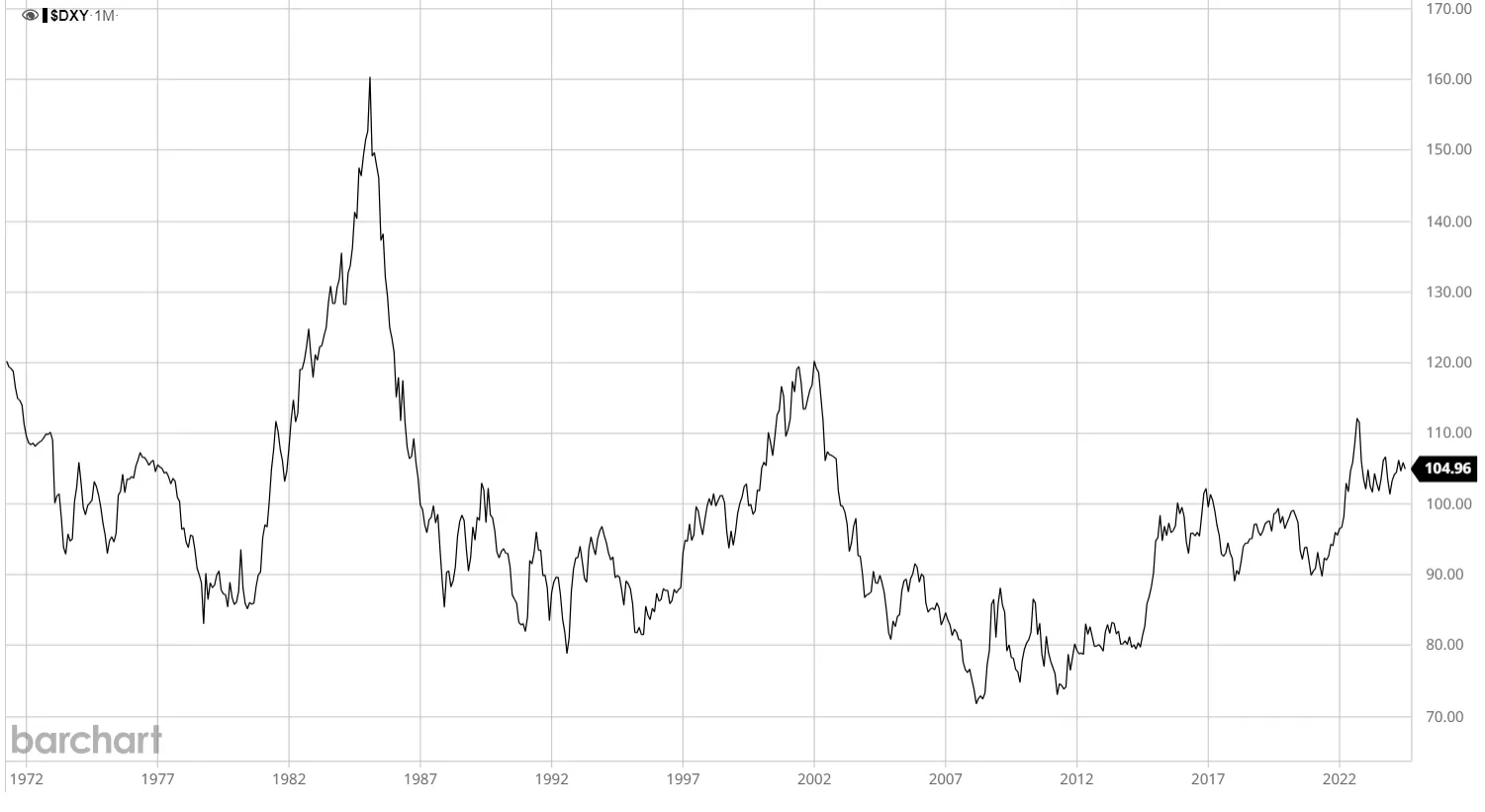
The Dollar Index (DXY) has a long and rich history, reflecting the fluctuations in the US dollar's strength relative to other major currencies.
Key historical points of the Dollar Index:
- 1985: Reached an all-time high of 164.72 in February.
- 1992: Hit a low point of 78.19 in June.
- 2001: Peaked at 121.02 in July.
- 2008: Experienced significant volatility during the global financial crisis.
- 2020: Reached a recent high of 102.99 in March during the initial COVID-19 panic.
Current State
The Dollar Index (DXY) is currently in a bit of a rollercoaster ride. It recently had a strong run, reaching highs not seen in years, mainly due to the US Federal Reserve raising interest rates to combat inflation. This attracted a lot of investors to the US dollar, making it more valuable compared to other currencies.
However, lately, the dollar has been giving back some of those gains. This is partly because other central banks, like the European Central Bank, are also raising interest rates, making their currencies more attractive. Additionally, there are concerns about a potential economic slowdown in the US, which could further weaken the dollar.
Overall, the dollar is still considered relatively strong, but its future path is uncertain. It will likely depend on how the US economy performs compared to other major economies and how central banks around the world continue to manage interest rates and inflation
Why is the Dollar Index Important for Indian Investors?
- Import Costs: A stronger dollar makes imports like oil and electronics more expensive for India, which can drive up inflation and impact the Indian rupee.
- Foreign Investments: A stronger dollar can make Indian assets less attractive to foreign investors, potentially leading to outflows from the Indian stock market.
- Company Profits: Indian companies that earn a significant portion of their revenue in dollars may see their profits affected by changes in the dollar index.
- Gold Prices: The dollar and gold often move in opposite directions. A stronger dollar could lead to lower gold prices, affecting Indian investors who hold gold as an investment.
How to Use the Dollar Index
- Track Global Trends: The Dollar Index is a good barometer of the overall health of the US economy and its relationship with other major economies.
- Assess Currency Risk: If you invest in foreign assets or companies with international exposure, the Dollar Index can help you gauge the potential impact of currency fluctuations on your investments.
- Make Informed Decisions: Keeping an eye on the Dollar Index can help you make more informed investment decisions, whether it's choosing between domestic and international funds, investing in gold, or even deciding when to travel abroad.
In a Nutshell
The Dollar Index is a valuable tool for understanding the global economic landscape and its potential impact on your investments. By tracking its movements and understanding its implications, Indian investors can make more informed decisions and navigate the complexities of the global financial market.


म्युच्युअल फंड अपडेट्स, SIP टिप्स आणि बाजारात काय घडतंय. रोजचा गोंधळ नाही — फक्त वाचण्यासारखं काही असेल तेव्हाच.
Read more about
- Abans Global Arbitrage Fund: A Deep Dive
- The Dollar Index
- Smoot-Hawley vs Trump Tariffs: Impact on Tech, Pharma, Auto & Agri
- Mirae Asset Global Allocation Fund - Invest in Global Markets via GIFT City | Tax Benefits for NRIs & HNIs
- मिराए अॅसेट ग्लोबल अलोकेशन फंड - गिफ्ट सिटी मार्गे जागतिक बाजारात गुंतवणूक | एनआरआय आणि एचएनआय साठी कर फायदे
Related Posts
 ArticleUnderstanding the Global Economic Policy Uncertainty (GEPU) Index: Implications for Indian Investors
 ArticleUnlocking Opportunities: Investing in US Stocks for Indians
 ArticleFTSE India Index Explained: What It Is & Why It Matters Now
 ArticleThe Ever-Shifting Sands: Why Asset Allocation is Key to Investment Success
This communication is intended solely for general educational and informational purposes. The information provided is general in nature and does not take into account the specific financial goals, risk profile, investment horizon, financial circumstances or other requirements of any particular investor. It should not be construed as personalised investment advice or as a recommendation to buy, sell or hold any specific financial product.
Mutual Fund investments are subject to market risks. Please read all scheme-related documents carefully before investing. Past performance is not indicative of future results and may not be sustained.
The suitability of any mutual fund product, scheme, category or strategy discussed on this page depends on an investor's individual circumstances, including financial goals, risk appetite, investment horizon and liquidity requirements. Investors should independently assess suitability and, where appropriate, seek professional advice before making investment decisions.
Meta Investment is an AMFI-registered Mutual Fund Distributor (ARN-129322) and is not a SEBI-registered Investment Adviser. If investments are made through a mutual fund distributor, the distributor may receive commission from Asset Management Companies in respect of eligible Regular Plan investments. Commission structures may vary across schemes and AMCs. Such commissions should not influence suitability-based recommendations, and applicable conflicts of interest will be disclosed. Please refer to our Commission Disclosure for further details.
Tax treatment of mutual fund investments depends on individual circumstances and prevailing tax laws, which are subject to change. Investors should consult a qualified tax professional for advice specific to their circumstances.
This disclaimer is intended to provide general disclosure and does not replace any scheme-specific disclosures, risk factors, regulatory disclosures or information contained in the applicable Scheme Information Document (SID), Statement of Additional Information (SAI) and Key Information Memorandum (KIM).
Distributor Disclosure: Where this content is provided by a distributor/intermediary, any applicable commission, remuneration, affiliation or other material conflict of interest shall be disclosed separately. The availability of a product through the distributor does not by itself imply that the product is suitable for every investor.
No Guarantee: No statement on this page should be interpreted as a promise, assurance or guarantee of returns or investment outcomes.
Meta Investment – Your Investment and Insurance Companion